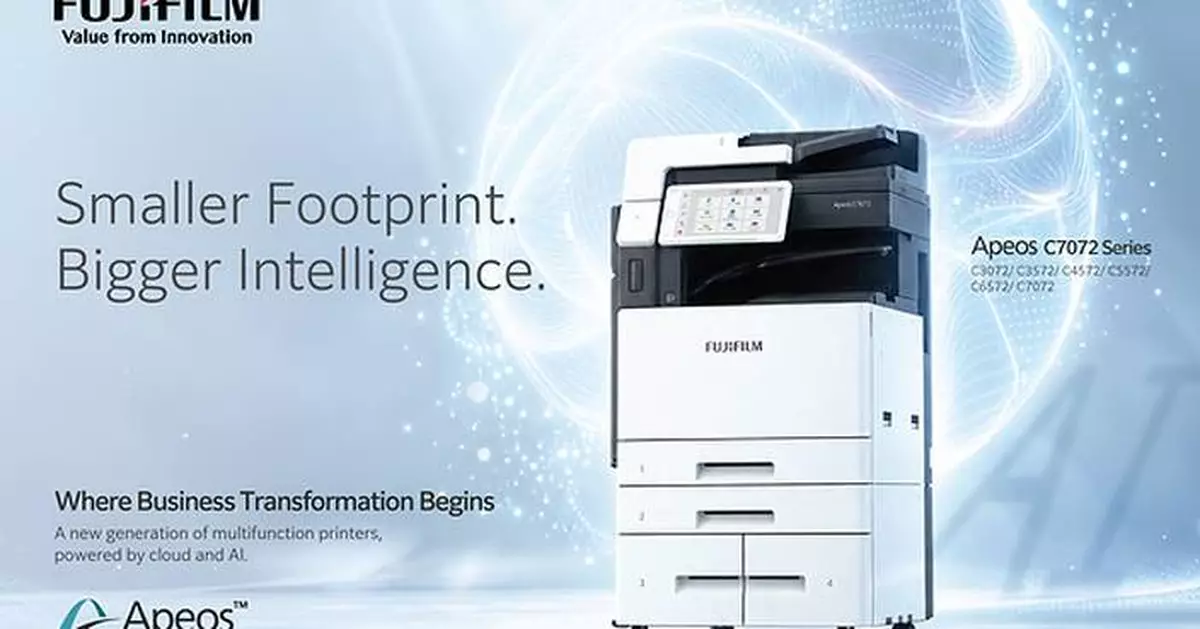
The Apeos C7072 Series Supports the Use of Organizational Know-how and Contributes to Reducing Environmental Impact
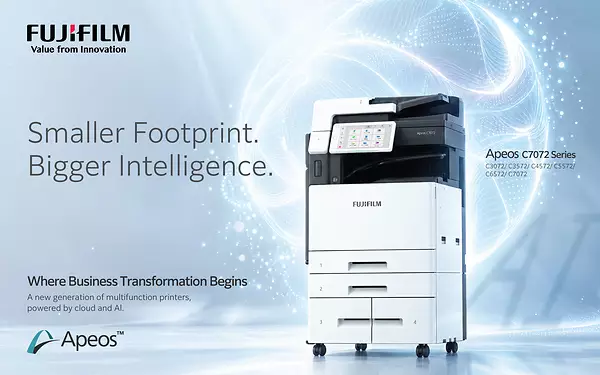
HONG KONG, Nov. 12, 2026 /PRNewswire/ -- FUJIFILM Business Innovation Hong Kong announces the launch of the Apeos C7072 Series, a new generation of A3 color multifunction printers (MFPs). Through cloud capabilities and AI technologies, the series helps organizations make better use of their know-how while reducing environmental impact through energy savings, resource circulation and more efficient maintenance services.
The Apeos C7072 Series is the first MFP from FUJIFILM Business Innovation to incorporate the company's AI technologies. Using technologies developed under its AI technology brand, REiLI Business, the series captures a wide range of information within organizations, including paper documents, electronic files and faxes, and organizes and structures it in the cloud. This process transforms accumulated information into assets that can be used by AI applications and other solutions. The series will continue to expand its functions and services through the cloud, delivering new value after installation as it evolves into an information-utilization platform.
In addition, AI-enabled power savings and more efficient maintenance, together with an environmentally conscious design*1 that incorporates recycled materials, help reduce environmental impact throughout the product lifecycle and across maintenance services.
Organizational Know-how Strengthens Competitiveness in the AI Era
As the use of AI expands, organizations are accumulating information through daily operations, in documents such as contracts, quotations, invoices and purchase orders. This information includes customer interaction records, operational expertise, and decision-making records that can support business growth. We refer to this accumulated information as "organizational know-how."
However, much of this information remains stored in a variety of formats, including paper documents, electronic files or emails, and is not readily available for use in AI applications or business systems. To use AI effectively, organizations need to organize and structure their accumulated information so that it can be applied to both AI and business operations.
FUJIFILM Business Innovation believes that preparing information accumulated within organizations for use by AI and in business operations will become a new role for MFPs in the AI era. The Apeos C7072 Series encourages customers to adopt AI by organizing and structuring dispersed information and transforming it into data that can be more easily used in AI applications and business processes.
A New Generation of MFPs with Solutions That Support the Use of Organizational Know-how
Built-in Cloud Capabilities Enable Organizations to Use Documents Immediately
The Apeos C7072 Series digitizes paper documents and provides an environment in which they can be shared and used across the organization. All models feature a newly developed duplex automatic document feeder and support high-speed scanning of up to 300 pages per minute for two-sided originals*2, among the highest speeds in the industry*3. The devices can scan small originals such as business cards and receipts, together with mixed-size originals, helping users digitize a wide variety of paper documents more efficiently. The Apeos Cloud Extension cloud service*4 enables seamless hybrid work by automatically storing scanned documents and fax data in the cloud, eliminating the need for complex system integration. OCR functions recognize text in documents and can automatically assign file names. The document organization function enables users to start digitizing, sharing and utilizing documents immediately after installation.
Multi-Crop scans multiple receipts or business cards together, then separates and saves them as individual files. Dropout Color digitizes documents while excluding a specified color such as red annotations on drawings. These functions convert paper documents into easier-to-manage electronic data and can streamline everyday tasks such as expense processing and document management.
Structuring Document Information for Use in Business Operations
The optional functions of Apeos Cloud Extension*5 enable customers to centrally manage digitized documents in the cloud. The Shared Mailbox allows documents to be shared and used across multiple locations and MFPs. Generative AI-powered OCR*6 extracts line-item information from documents such as invoices and quotations and converts it into structured data that can be used in business operations.
This helps organizations transform paper documents and other unstructured information into structured data that authorized users can search, share, analyze and use in their business processes, rather than simply storing it as an electronic file.
Security Settings That Support Cloud Use
Appropriate security measures are important when organizations use cloud services and AI. The Apeos C7072 Series provides device-level enterprise security functions, including authentication, access control and log management. The new easy security setting feature simplifies the application of recommended settings for each operating environment. Secure Office Mode strengthens security while maintaining functionality, while Protect Mode is designed for environments used by an unspecified number of people, such as public facilities and schools. These modes can reduce the burden of configuring security settings.
These features help organizations apply appropriate device-security settings for each operating environment and support consistent security operations across the organization.
Improved Environmental Performance Through AI and Environmentally Conscious Design
Combining Convenience and Energy Efficiency Through AI and New Technologies
ELFEAT toner, which delivers low-temperature fusing performance, and a fuser designed for low-temperature fusing reduce power consumption during fusing and achieve industry-leading low power consumption*6. In addition, the industry-first*7 AI-controlled energy-saving feature analyzes device usage patterns and factors affecting user convenience and automatically optimizes the time before the device enters low-power or sleep mode. This can reduce standby power consumption while maintaining a smooth user experience.
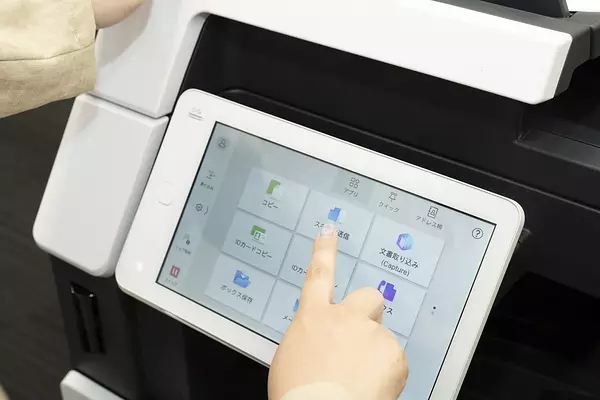
Smart WelcomEyes uses new sensing technology*8 to activate the control panel automatically when a user approaches. It reduces the activation time from approximately three seconds on the previous Apeos C7071 Series to approximately one second, enabling energy-efficient operation without compromising convenience.
Reducing Environmental Impact Through More Efficient Maintenance Services and Resource Circulation
AI automatically detects abnormal operating sounds and sends diagnostics data to a remote monitoring system. In addition, remote monitoring of status information, such as paper jams and image-quality issues, can help service personnel identify the likely cause of an issue and the required parts before visiting the customer. This contributes to faster maintenance response times, reduced device downtime, and fewer repeat service visits, thereby helping to reduce the environmental impact of maintenance-related travel.
Recycled plastic is used in components such as exterior covers and trays, accounting for 50% of the device's*9 total plastic content by weight. Recycled steel is also used, with recycled materials accounting for 5% by weight of all steel sheets used in the device*9. The product also adopts a design that takes reuse and recycling into account, supporting the promotion of resource circulation.
The Apeos C7072 Series Continues to Evolve as a Platform for Leveraging Organizational Know-how
The Apeos C7072 Series expands the role of the MFP into information utilization. It continues to evolve as an information-utilization platform that helps organizations make better use of their organizational know-how.
Going forward, APIs*10 and MCP*11 are expected to expand opportunities for integration with AI agents and a variety of SaaS applications. In addition to preparing information accumulated within organizations for use by AI, the company aims to expand integration with external business services. This will support the entire process from information utilization to task execution, enabling more advanced decision-making and the creation of new values.
Other Key Product Features
1. New Control Panel for Improved Visibility and Usability
- An IPS*12 panel provides accurate color reproduction and a wide viewing angle.
- The new user interface features a white-based light theme and can be switched to the conventional dark theme according to the operating environment or user preference.
- Frequently used settings can be pinned to the home screen, making everyday operations clearer and smoother.
2. Versatile Media Support Expands In-House Production of Promotional Materials
- In addition to printing envelopes*13 and postcards from the standard tray, the devices support paper weights from 52 to 300 g/m2 and long paper up to 320 x 1,200 mm. Customers can produce a variety of printed materials in-house as needed, including direct-mail postcards, envelopes, point-of-purchase materials and posters.
3. Compact Finisher Supporting Staple-Free Binding
- The new space-saving Finisher A4 can be installed within the main unit. It supports one-position and two-position staple-free binding and can bind up to 10 sheets without metal staples.
- In addition to the two standard output destinations, an optional side tray provides a third destination, allowing copies, print jobs and received faxes to be separated.
4. Supporting a Quieter and Comfortable Office Environment
- Enhanced low-noise design for both the main unit and finisher creates a quieter, more conducive working environment.
- The product meets stringent indoor air quality standards*14 for chemical emissions released from the device.
Product Lineup and Key Specifications
| Model Name | Speed | Features/Configuration |
| Apeos C3072 | Color 30ppm | Copy, Print, Scan function |
| Apeos C3572 | Color 35ppm | |
| Apeos C4572 | Color 45ppm | Copy, Print, Scan function |
| Apeos C5572 | Color 55ppm | |
| Apeos C6572 | Color 65ppm | Copy, Print, Scan function |
| Apeos C7072 | Color 70ppm |
Model Name
Speed
Features/Configuration
Apeos C3072
(Model-CPS)
Color 30ppm
Monochrome 30ppm
Copy, Print, Scan function
1 pass Automatic Duplex Scanning 300ppm
520 sheets x 4-tray + Bypass Tray 100 sheets
Apeos C3572
(Model-CPS)
Color 35ppm
Monochrome 35ppm
Apeos C4572
(Model-CPS)
Color 45ppm
Monochrome 45ppm
Copy, Print, Scan function
1 pass Automatic Duplex Scanning 300ppm
520 sheets x 2-tray + 840 sheets tray + 1,230 sheets tray
+ Bypass Tray 100 sheets
Apeos C5572
(Model-CPS)
Color 55ppm
Monochrome 55ppm
Apeos C6572
(Model-CPS)
Color 65ppm
Monochrome 65ppm
Copy, Print, Scan function
1 pass Automatic Duplex Scanning 300ppm
520 sheets x 2-tray + 840 sheets tray + 1,230 sheets tray +
Bypass Tray 100 sheets
Apeos C7072
(Model-CPS)
Color 70ppm
Monochrome 70ppm
About REiLI Business, FUJIFILM Business Innovation's AI Technology Brand
REiLI Business represents FUJIFILM Business Innovation's approach to accelerating value creation and innovation through AI-enabled products and solutions.
It brings together AI capabilities with the knowledge, expertise and know-how accumulated within organizations to help customers address real-world business challenges, enhance the way they work and create new value.
Built on the Fujifilm Group's long-standing core technologies, including image processing and natural language processing, it offers a suite of AI agents that structure and leverage information, knowledge, and know-how within organizations. These AI agents support business growth, improve the efficiency of commercial printing workflows, and drive innovation in image and texture expression.
REiLI Business aims to create a society where organizations of all sizes and across industries can use AI to create value in ways that reflect their unique strengths and business needs.
| * The services and product names mentioned in this press release are registered trademarks or trademarks of FUJIFILM Corporation and FUJIFILM Business Innovation Corp. |
* The services and product names mentioned in this press release are registered trademarks or trademarks of FUJIFILM Corporation and FUJIFILM Business Innovation Corp.
| *1 FUJIFILM Business Innovation's product-development framework, under which environmental quality targets for energy conservation, resource conservation and resource circulation are set and evaluated from the design stage, taking the entire product lifecycle into account. |
| *2 When scanning both sides in a single pass, using a standard A4 landscape original at 200/300/400 dpi and saving to a mailbox. |
| *3 Based on FUJIFILM Business Innovation internal research of A3 color MFPs |
| *4 Apeos Cloud Extension requires registration. |
| *5 A separate agreement is required. |
| *6 Based on FUJIFILM Business Innovation internal research, using the measurement method specified by the International ENERGY STAR Program. |
| *7 Based on FUJIFILM Business Innovation internal research. |
| *8 Compared with the Apeos C7071 Series. |
| *9 With four-tray configuration. Design values by weight. |
| *10 API stands for Application Programming Interface, an interface based on a set of rules for calling programs from outside a web system and enabling integration with other services. |
| *11 MCP stands for Model Context Protocol, a common protocol for connecting AI with external tools and databases. |
| *12 In-Plane Switching |
| *13 When using the envelope attachment. |
| *14 Certified under UL GREENGUARD Gold, an internationally recognized third-party certification program for chemical emissions operated by UL Solutions. (Link: World's First Multifunction Printer to Receive "UL GREENGUARD Gold Certification" | FUJIFILM Business Innovation) |
*1 FUJIFILM Business Innovation's product-development framework, under which environmental quality targets for energy conservation, resource conservation and resource circulation are set and evaluated from the design stage, taking the entire product lifecycle into account.
*2 When scanning both sides in a single pass, using a standard A4 landscape original at 200/300/400 dpi and saving to a mailbox.
*3 Based on FUJIFILM Business Innovation internal research of A3 color MFPs
*4 Apeos Cloud Extension requires registration.
*5 A separate agreement is required.
*6 Based on FUJIFILM Business Innovation internal research, using the measurement method specified by the International ENERGY STAR Program.
*7 Based on FUJIFILM Business Innovation internal research.
*8 Compared with the Apeos C7071 Series.
*9 With four-tray configuration. Design values by weight.
*10 API stands for Application Programming Interface, an interface based on a set of rules for calling programs from outside a web system and enabling integration with other services.
*11 MCP stands for Model Context Protocol, a common protocol for connecting AI with external tools and databases.
*12 In-Plane Switching
*13 When using the envelope attachment.
*14 Certified under UL GREENGUARD Gold, an internationally recognized third-party certification program for chemical emissions operated by UL Solutions. (Link: World's First Multifunction Printer to Receive "UL GREENGUARD Gold Certification" | FUJIFILM Business Innovation)
** This press release is distributed by PR Newswire through automated distribution system, for which the client assumes full responsibility. **
FUJIFILM Business Innovation Hong Kong Launches Next-Generation A3 Color MFPs That Continue to Evolve Through Cloud and AI

FUJIFILM Business Innovation Hong Kong Launches Next-Generation A3 Color MFPs That Continue to Evolve Through Cloud and AI
FUJIFILM Business Innovation Hong Kong Launches Next-Generation A3 Color MFPs That Continue to Evolve Through Cloud and AI