KYIV, Ukraine (AP) — Ukrainian President Volodymyr Zelenskyy said the United States had raised the possibility of a new security framework for Europe as part of efforts to end Russia’s war in Ukraine, warning that Moscow could use such discussions to weaken NATO and reshape the continent’s borders.
“In my view, this can be dangerous,” Zelenskyy told reporters Friday. “This should not be the main agenda.” His comments were embargoed until Saturday.
Zelenskyy also said that the United States had asked for the first time whether Ukraine would withdraw from parts of the Donbas region in eastern Ukraine that Russia does not control if Kyiv were admitted to NATO.
He said he believed Moscow was interested in reopening broader questions about European security rather than focusing exclusively on ending the 4 1/2-year war.
“(Russian President Vladimir) Putin’s desire to change borders in Europe is a fact. I am sure this is part of his concept of revising security guarantees in Europe,” he said. “This is dangerous because, in my view, it is precisely things like this that lead to wars or escalations.”
European leaders have stressed that decisions about the continent’s security must be made by Europeans themselves, warning against allowing Russia to dictate the terms of a new security order or negotiate NATO's future.
Zelenskyy reiterated that Kyiv would not surrender its territory.
Ukraine is discussing a comprehensive security package with its partners that could include specific guarantees from NATO and the European Union, a strong Ukrainian military and financial support for a specified period, he said. It would also include a recovery plan, he said.
“If the American side confirms precisely this to us, together with other NATO partners, then I will ask our Ukrainian society what it thinks: do we accept it or not?” Zelenskyy said.
He stressed that any arrangement would not involve recognizing occupied territories as Russian.
Zelenskyy also rejected the possibility of Ukraine committing to neutrality, saying that would require changing the country’s constitution.
“If Putin expects Ukraine’s neutrality to be enshrined, that’s not going to happen,” he said. “We’re not in NATO right now anyway.”
Zelenskyy warned that broader discussions about Europe’s security could allow Putin to seek changes to NATO’s military presence, including the withdrawal of American troops.
He said Putin had raised similar ideas with then-President Joe Biden in 2021, seeking a redistribution of power in Europe and the world.
“I think Putin will bring up Finland and Sweden. I’m sure he will raise the issue of Hungary and the presence of American troops in the Baltic countries,” Zelenskyy said.
He said any changes to Europe’s security arrangements must be decided by European NATO members only after the war ends.
“The sequence should be as follows: a ceasefire, an end to the war in Ukraine, and security guarantees for Ukraine,” he said. “There can be no security guarantees in Europe, or for Europe, without Ukraine.”
Zelenskyy said Ukraine’s priorities in the Abu Dhabi negotiations included an energy ceasefire, reopening the Black Sea, prisoner releases and preparations for a meeting between leaders to end the war.
He said Russian negotiators lacked authority to decide on several issues and that Moscow was unwilling to accept an energy ceasefire.
“At the meeting in Abu Dhabi, the Russian delegation said they didn’t have a mandate to decide this issue, but we can also see that they are unwilling,” he said, adding that negotiators had been told to resolve ceasefire questions directly with Putin.
Zelenskyy said discussions in Moscow with U.S. negotiators resulted in an agreement on a prisoner exchange involving more than 1,000 people on each side. The exact number was still being determined, he said, estimating it at 1,200 to 1,300.
He also said Washington supported Ukraine’s demand that European countries participate directly in future negotiations, rather than remain outside the main negotiating room.
Britain, France, Germany and Italy were among the countries represented at the Abu Dhabi meetings, Zelenskyy said. He expected between three and five European representatives to participate in future discussions.
Zelenskyy accused SpaceX of imposing restrictions on its Starshield satellite system in Russian-occupied Ukrainian territory, saying the limitations were hampering efforts to intercept Russian drones.
He said the system’s speed had been restricted to a maximum of 161 kph (100 mph) in occupied areas and that the limitations had been in place for five days.
Zelenskyy questioned the explanation that the problem was technical, saying the restrictions appeared to have been imposed by SpaceX despite previous assurances from U.S. Secretary of State Marco Rubio that Starshield was more under the control of the U.S. government.
“The current Starshield restrictions suggest that SpaceX imposed them,” Zelenskyy said. “That’s what our team is telling me. So this doesn’t quite line up with what we heard earlier. That’s why we need to get to the bottom of all this.”
He said the restrictions prevented Ukrainian forces from intercepting Russian jet-powered Shahed drones over occupied territory as they approached from the east, forcing them to wait until the drones reached areas where the limitations did not apply.
Follow AP’s coverage of the war in Ukraine at https://apnews.com/hub/russia-ukraine
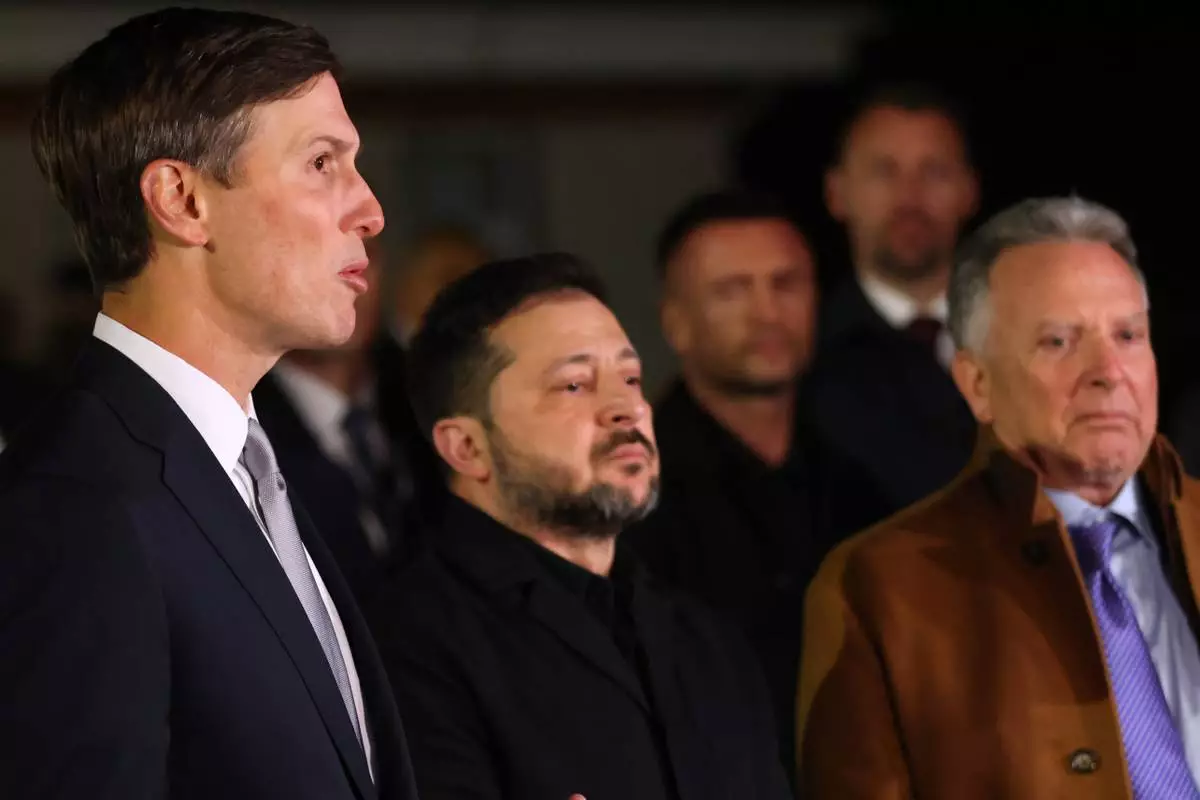
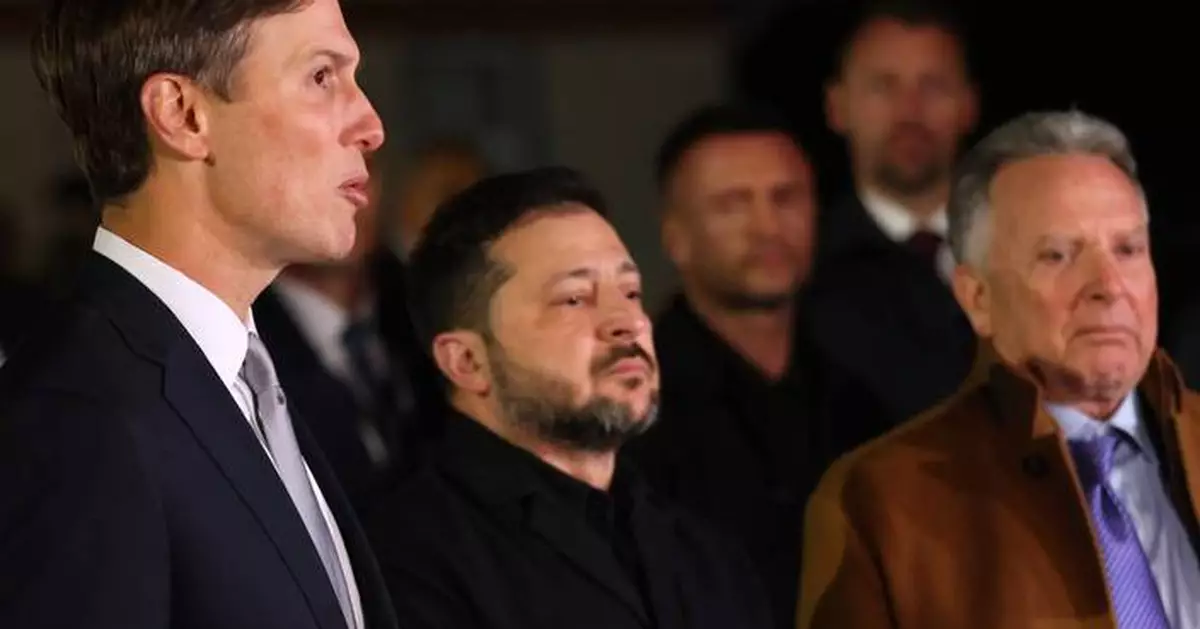
U.S. special envoys Steve Witkoff, right, Jared Kushner, U.S. President Donald Trump's son-in-law, left, and Ukraine's President Volodymyr Zelenskyy speak to the media at the airport in Dublin, Thursday, Nov. 12, 2026.(AP Photo/Peter Morrison)