Researchers and local fishermen are joining forces along the coast of east China's Shandong Province to revive vanishing seagrass meadows.
Beneath the surface of the ocean, seagrass meadows provide vital habitats for marine life while helping capture and store carbon. But around the world, these underwater ecosystems have been disappearing.
Along China's eastern coast, a restoration project is working to reverse that decline. In the waters off Shandong Province, conservationists, scientists and local fishermen have spent years bringing lost seagrass meadows back to life.
Seagrasses are the only flowering plants that spend their entire lives fully submerged in the sea. They provide habitat for marine life and help hold seabed sediments in place. And just like plants on land, they too photosynthesize.
They cover just 0.1 percent of the seafloor but store up to 18 percent of the ocean's buried carbon.
But these underwater meadows are in trouble. Globally, about a football field of seagrass disappears every half an hour.
Dongchu Island, on the tip of China's eastern coastline. There used to be so much seagrass that it supplied the local building material. However, it has completely disappeared in recent years.
To change the situation, one of China's flagship seagrass restoration projects started to process in the area.
The efforts are led by the environmental nonprofit SEE Foundation.
"There are two main causes. The first is coastal development, such as building docks, reclaiming land from the sea, and constructing other facilities along the shore. The second is water pollution. These two factors do the most damage to seagrass meadows," said Sui Haidong, Senior Marine Conservation Program Manager of SEE Foundation.
Working with marine scientists, the team has learned to raise native eelgrass from seed in inland nurseries.
"As far as we know, before we began, raising these seedlings in China was probably still confined to laboratories or small-scale trials. Full commercial-scale seedling production didn't exist in China before our project," Sui said.
The young plants are then bundled into biodegradable pots with nutrients to support their early growth.
Then, they will be planted by "plungers", freelance divers who make a living harvesting the ocean floor.
With no vegetation left to hold the sand in place, a breeze above the surface can send the sediment swirling through the water. Therefore, plungers need to be fast and precise and anchor each pot before the sediments cloud the view.
Working with the NGO, the local teams of plungers and fishermen have planted 66 million shoots of seagrass back into these waters.
Where seagrass returns, so do livelihoods.
"We carried out a survey of marine life. Compared with before the restoration, more than 22 species have returned. Golden cuttlefish had disappeared from the northern Yellow Sea. After we restored the seagrass over the past few years, we released some golden cuttlefish eggs into our seagrass meadow," said Zhang Yitao, Project Manager, Rongcheng Chudao Aquatic Products Co.
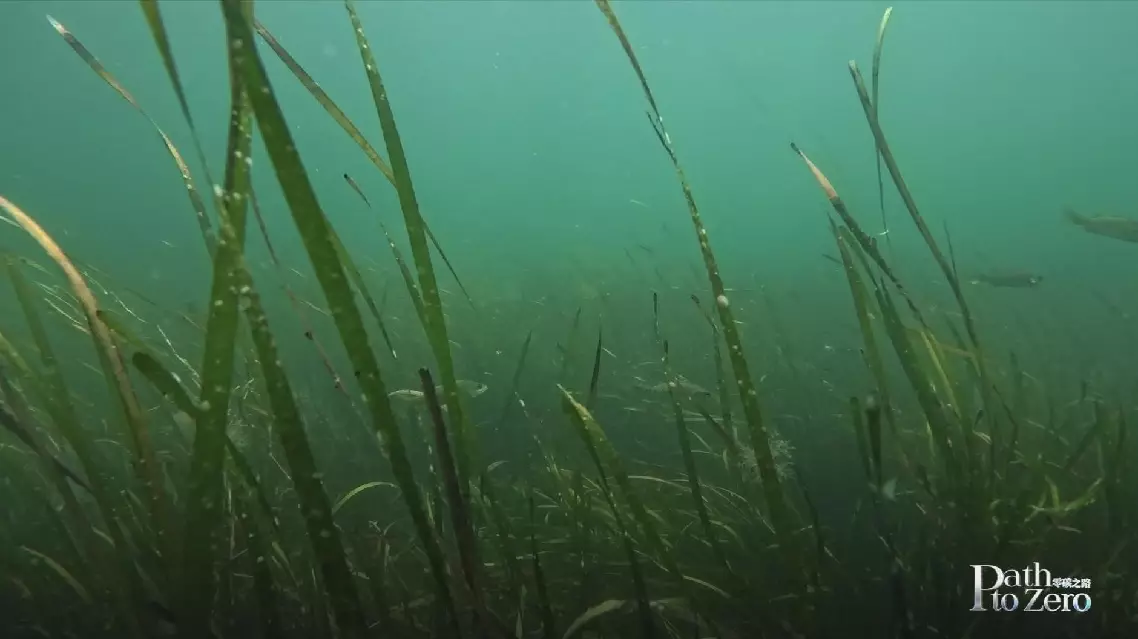
China's eastern coast restores seagrass meadow to rebuild marine ecosystem