A collaborative international research team led by the Faculty of Dentistry of the University of Hong Kong (HKU) has developed DentalGEN, a large-scale controllable generative artificial intelligence-plus (AI+) framework for automated dental crown restoration. This study, published in npj Digital Medicine and supported by the General Research Fund (GRF) of the Research Grants Council (RGC) of the Hong Kong SAR, represents an important advancement in digital prosthodontics, smart dental manufacturing, and Industry 4.0 applications in dentistry.
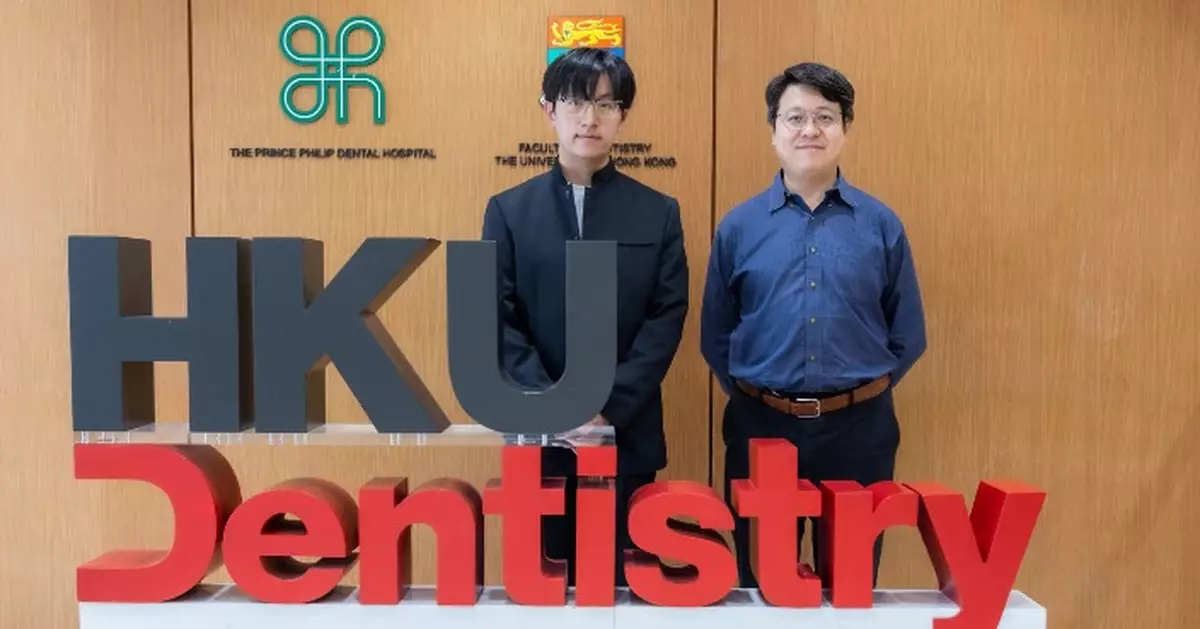
The research was led by Professor James Kit Hon Tsoi (right), Assistant Dean (Innovation) and Associate Professor in Dental Materials Science. Photo source: HKU
The research was led by Professor James Kit Hon Tsoi, Assistant Dean (Innovation) and Associate Professor in Dental Materials Science at the HKU Faculty of Dentistry, in collaboration with researchers from ShanghaiTech University, Shanghai Jiao Tong University, Wuhan University, The Hong Kong University of Science and Technology, and Texas A&M University.
Dental crowns are among the most commonly used dental restorations, designed to restore the shape, function, and appearance of damaged or prepared teeth. Although computer-aided design and manufacturing (CAD/CAM) technologies have transformed dental laboratories and clinical restorative workflows, crown fabrication still relies heavily on manual input. Dental technicians often need to adjust crown designs using CAD software and perform visual shade matching, manual staining and glazing, and sintering to reproduce the appearance of natural teeth. These procedures are time-consuming, labour-intensive, and operator-dependent, creating production bottlenecks and increasing the cost and turnaround time of dental treatment.
To address these challenges, the HKU Dentistry-led team developed DentalGEN as an AI-driven engine for automated dental crown design and characterisation. The framework can generate patient-specific, high-resolution, manufacture-ready 3D dental crowns across all tooth positions. By integrating AI directly into the digital dental production pipeline, DentalGEN supports an automated “scan–design–manufacture” workflow and reduces active design time by more than 90%.
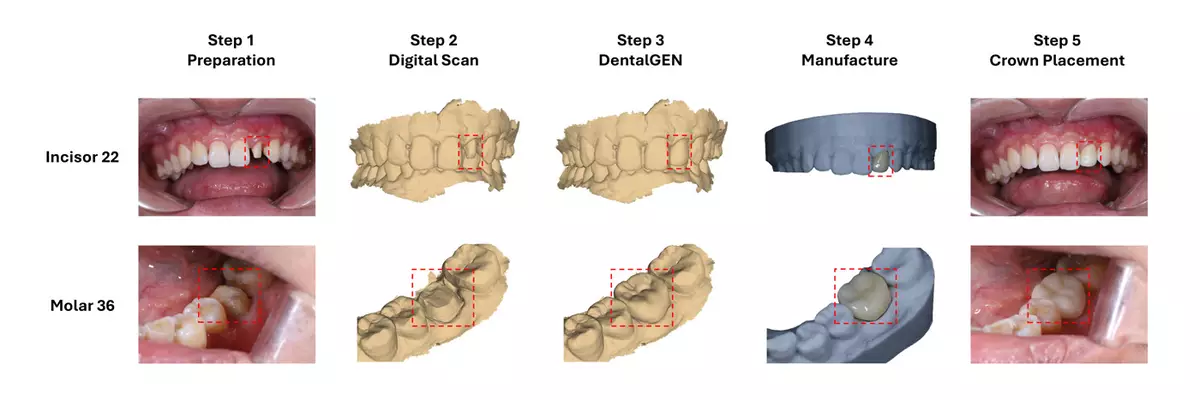
Clinical verification results of DentalGEN-integrated restoration workflow. Photo source: HKU
DentalGEN uses a controllable multi-view diffusion model that incorporates clinically relevant information during the crown generation process, including neighbouring teeth, opposing bite relationships, the finish line of the prepared tooth, and the colour of surrounding teeth. This enables the framework not only to generate high-detailed 3D complete crown geometry, but also harmonious and biomimetic colour information, allowing the digital restoration to better match the patient’s oral environment.
The study evaluated DentalGEN using the largest multicenter cross-domain dataset comprising 26,614 dental samples across 7880 patients. Compared with previous generative AI models for dental crown design, DentalGEN achieved a 70% reduction in design error. In a blinded clinical assessment based on World Dental Federation (FDI) criteria, crowns generated by DentalGEN showed overall clinical performance comparable to those designed by experienced human dental technicians, with no statistically significant difference in the average clinical score. In selected tooth positions, DentalGEN-generated designs outperformed human-designed crowns, which was further proven by a clinical proof-of-concept study.
DentalGEN also demonstrated substantial efficiency gains. Using a standard graphics processing unit, the framework generated complete, manufacture-ready 3D crowns in under 60 seconds per case. Moreover, DentalGEN enables the parallel generation for many cases at one time. This capability points to the potential for rapid, high-throughput dental laboratory operations and offers a new pathway for scalable and automated production of personalised dental restorations.
“DentalGEN is a clinical-proven solution and stepping stone towards Industry 4.0 in dentistry,” said Professor Tsoi, who led the research. “By integrating AI+ directly into smart manufacturing workflows, dental laboratories can move from labour-intensive manual operations towards high-efficiency supervisory production. Such automation is important for addressing global shortages of specialised dental personnel, meeting the needs of ageing populations, and strengthening personalised medical and dental device manufacturing capacity that the Greater Bay Area is currently supplying 30-35% globally.”
At present, the texture maps generated by DentalGEN can serve as digital visual blueprints for technicians during glazing and staining. As multi-material 3D printing technologies continue to develop for clinical use, DentalGEN may help enable fully automated, single-visit “scan–design–print” restorative workflows in the future.
The research team is also expanding the AI framework to support more complex dental prostheses, including multi-unit bridges, complete dentures, and titanium bone meshes. In addition, a start-up company has been established with support from the SPIN programme at Hong Kong-Shenzhen Innovation and Technology Park (HSITP) to further translate the technology into innovative and smart dental manufacturing applications.
Link to research: https://www.nature.com/articles/s41746-026-03236-7