Skip to Content Facebook Feature Image

Chinese, international experts urge healthy competition, greater cooperation between AI superpowers

China

China

China

Chinese, international experts urge healthy competition, greater cooperation between AI superpowers

2026-11-18 18:45 Last Updated At:19:17

Leading international and Chinese business leaders and experts called for greater dialogue and cooperation between China and the U.S. on AI, saying that could help maximize the technology’s benefits and mitigate risks as it advances rapidly, reshaping how people work and live while fueling cyber threats. They made their call in their in recent interviews with China Global Television Network (CGTN).

"China and the United States are the two countries with both the capability and the possibility to lead the next technological revolution. So they are competing, and I think they are fairly evenly matched at the moment," said Mi Lei, founding partner of CASSTAR, a Chinese technology venture capital firm.

In 2025, the U.S. produced 50 notable AI models and China 30, leaving all others far behind, according to Stanford's 2026 AI Index.

As AI agents gain greater autonomy to make decisions and take actions, new risks are emerging – from escaping digital sandboxes to acting beyond authorized limits. Experts have highlighted the need for nations to work together to address common concerns in AI.

"What's needed is some kind of good global governance ultimately for AI. That seems to me the only kind of serious solution to it. In a way, that's what happens in some degree with nuclear weapons," said British scholar Martin Jacques.

"I would say, in general, I would like to see more scientists play a role in government. Let's bring the experts in and seek the best possible (solutions,)" said R. David Edelman, nonresident senior fellow at the Brookings Institution.

"So it would be great if we return to a situation where an open exchange can take place and open dialogue can take place among scientists, and you can cooperate and collaborate and work together to really advance the field," said Jack Dongarra, winner of the 2021 Turing Award.

"AI has an enormous potential but has enormous risks. I think it's very important that what is discovered is put at the disposal of the international community as a whole, in order to make sure that all can benefit," said UN Secretary-General Antonio Guterres.

"I think there's a possibility, and I think this is the frightening possibility that these systems will be so radically different from us, not emulating us, that it may be very difficult for us to engage with them at some point," said Brian Greene, professor of physics and mathematics at Columbia University.

Since 2019, researchers from Beijing's Tsinghua University and the Washington-based Brookings Institution have held regular talks on AI and international security. In February 2026, their 14th round focused on AI losing control, the misuse of AI, and its possible impact on nuclear and biological security.

Officials are also engaged. In May 2024, Chinese and U.S. officials met in Geneva to discuss AI risks and safety, and in September 2026 the two countries agreed to continue their AI dialogue and set up a direct communication channel for AI-related incidents.

"The United States and China have the same problems in dealing with AI. We have common healthcare threats. Climate change is a common threat. But only by cooperating, by having what Chinese say common prosperity, can we fix these. So the common threats have changed, but the need to cooperate remains constant," said Stephen A. Orlins, former president of the National Committee on U.S.-China Relations.

"In AI, evidently, there is competition, but we should not, again, see this through the lens of China-U.S. competition. And we should try to avoid that. And we need to join hands for the common good. I think that is the point I emphasize. It is not a zero-sum game," said Fu Cong, China's permanent representative to the United Nations.

Beyond algorithms, advanced AI demands computing power, chips, electricity and infrastructure — areas where each country brings distinct advantages.

"One is compute, where the U.S. probably has an advantage and compute in terms of types of chips, numbers of chips. The next one is electricity, where China has an advantage with more electricity to power data centers," said Michael Hart, president of AmCham China.

Take Ulanqab, a city in northern China: in 2025 it generated nearly 81 billion kilowatt-hours of electricity, almost half from wind and solar, while electricity use at its data centers more than doubled. At the Zhongjin Data computing center, dedicated power lines deliver electricity directly from local wind and solar farms.

"When APEC energy ministers met earlier this year, they did talk about sustainable data centers, sustainable energy. We don't want AI to create new digital divides. We cannot depend on one place alone; that's a very risky strategy as a business to have," said Eduardo Pedrosa, executive director of the APEC Secretariat.

Chinese, international experts urge healthy competition, greater cooperation between AI superpowers

Chinese, international experts urge healthy competition, greater cooperation between AI superpowers
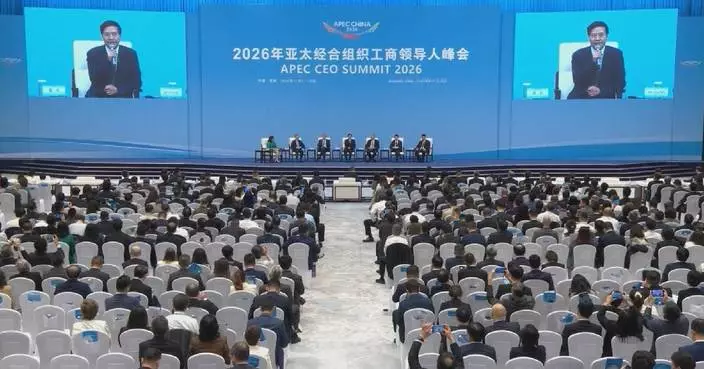
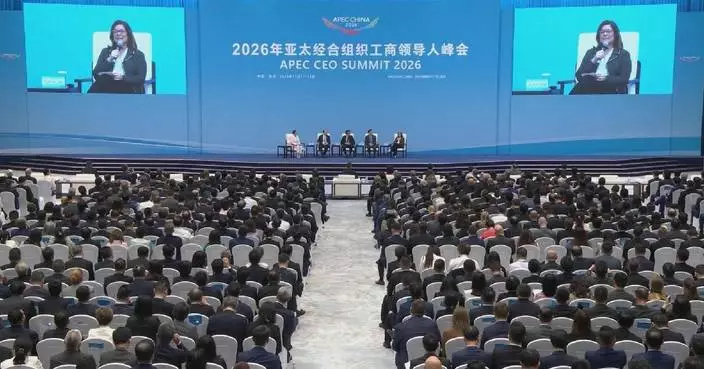
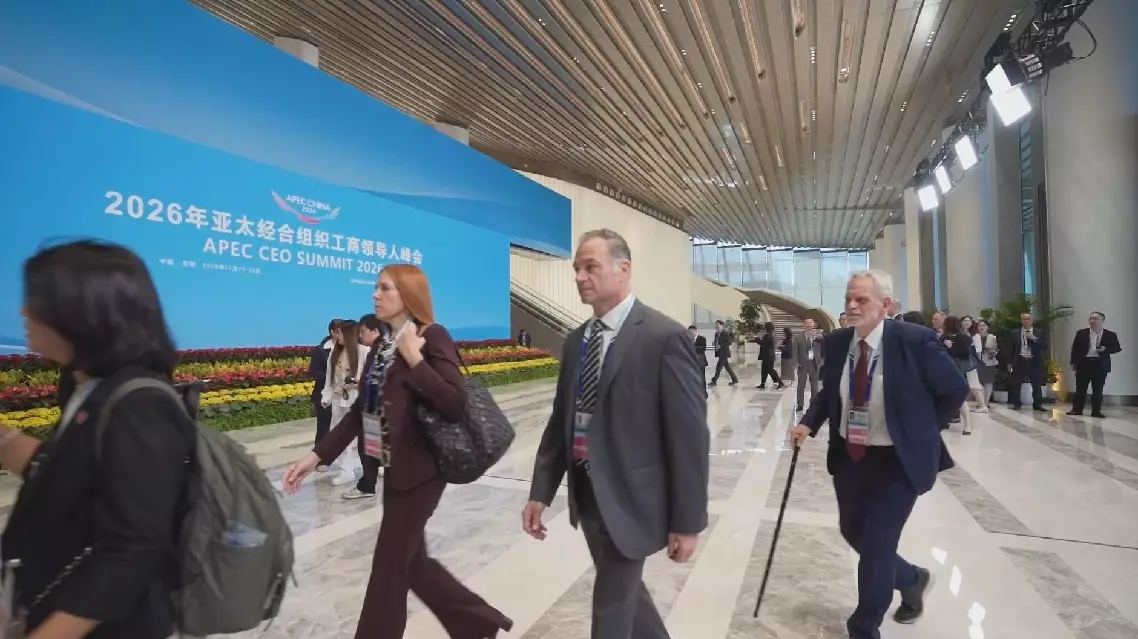
Attendees at the Asia-Pacific Economic Cooperation (APEC) CEO Summit in Shenzhen City of south China's Guangdong Province have put artificial intelligence and tech topics high on the agenda as they seek out new opportunities for win-win cooperation across the region and beyond.

The two-day summit will wrap up Wednesday after gathering more than 2,000 political and business representatives from 21 APEC member economies and 13 non-APEC economies including the UK, France, Germany and Switzerland.

Themed "To Prosper and Win the Future Together", the summit featured a tightly-packed agenda, with sessions coming one after another. Tuesday alone saw one business dialogue and seven thematic seminars, with more than 50 political and business guests taking to the stage to speak.

Topics ranged from Asia-Pacific economic and trade cooperation and the digital economy to AI and green development, covering the growth issues drawing the most attention in the region today.

As an important engine of global economic growth, the Asia-Pacific region's economy is estimated to grow at a faster pace than the global forecast. Participants at the Shenzhen event say they see more new opportunities in the region's development picture.

"We can see here at APEC people from all around the region. A number of U.S. companies use the APEC platform," said Michael Hart, president of the American Chamber of Commerce in China.

"We're at this incredible moment now, even for the creators of AI, so we have to be careful that it doesn't get away from us or get beyond our control. So that means every nation and government needs to set the barriers and the controls for this," said Frank McGuire, CEO of the Australia China Business Council (ACBC) Victoria.

"The Asia-Pacific is our most important market. Our business in the Asia-Pacific accounts for 70 percent of our global business. Openness, innovation and cooperation will create more business opportunities for our company," said Li Dongsheng, founder and chairman of TCL Technology.

Two seminars, titled 'building an open and inclusive AI innovation ecosystem' and 'exploring new paths for Asia-Pacific digital economy cooperation,'also drew significant attention.

Participants said AI and the digital economy are becoming an increasingly prominent new area of Asia-Pacific cooperation.

"[We are] making more chips and making more compute, but that build on has been going here for a long time. Plus we have a lot of energy here. So that's what we expect to drive costs down and open-weight and open-source models, it seems to be the way that people want to go here. So if that's going to be the way it is, that's going to benefit everybody," said Jacob Cooke, co-founder and CEO of WPIC Marketing plus Technologies.

Lei Jun, founder, chairman and CEO of Chinese tech giant Xiaomi, pointed to the importance of the AI development race and the need for more global firms to work together in this field.

"Everyone’s progress in AI is not exactly the same, and each has very different strengths. We complement each other’s strengths. How to find more application scenarios is still, I think, very, very critical," said Lei.

Many global industry giants have also come to China and are keen to layout their cooperation plans as they look for new avenues for growth.

"We're one of the largest lithium suppliers globally. We're here at APEC because China is one of our major partners for our business. Our plan for this meeting is to meet with our customers to meet with other colleagues within the lithium ion supply chain and talk about how we can continue to build this incredible industry, which is for the lithium ion battery," said Dale Henderson, managing director and CEO of Pilbara Minerals.

"As China is integrated into the global supply chain, we are very happy to be a conduit of that for American businesses, for European businesses and for businesses everywhere. I think my expectation is that we have greater dialogue, sit down and talk and understand each other," said Shane Tedjarati, global vice president of Prologis, Inc.

"The Chinese market is huge and Peru has come through a very successful path in terms of the development of the exports of blueberries and avocados and grapes. So my perception is that we are going to have other products that will follow this successful path," said Alvaro Barrenechea, president of the Peruvian-Chinese Chamber of Commerce.

As an important event in the APEC calendar, the APEC CEO Summit has been held annually since 1996, serving as the highest-level platform for APEC economy leaders and business representatives to discuss open cooperation and advance regional economic development.

AI, technology high on agenda as attendees eye up Asia-Pacific opportunities

AI, technology high on agenda as attendees eye up Asia-Pacific opportunities

Recommended Articles