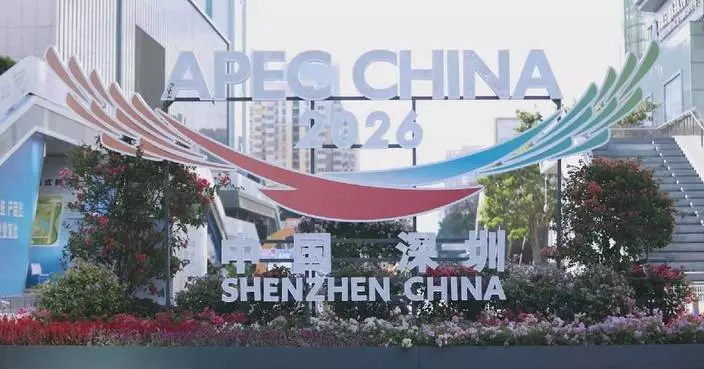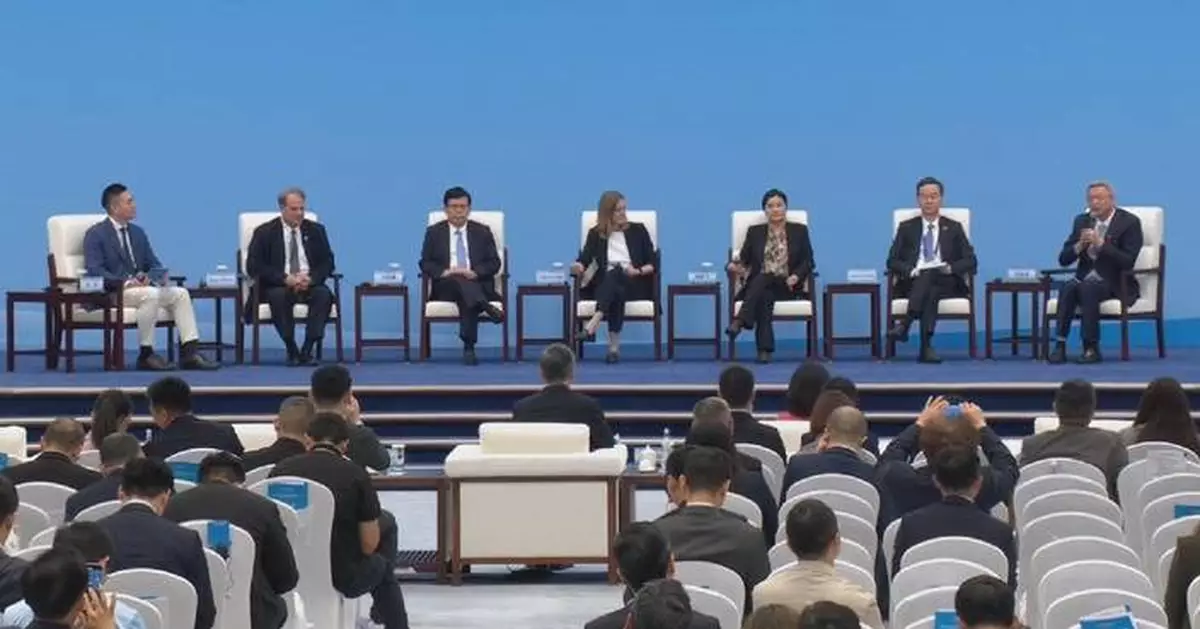
Business leaders at this week's Asia-Pacific Economic Cooperation (APEC) CEO Summit in Shenzhen pointed to digital technology, falling solar and battery storage costs, and cross-border partnerships as ways to make the green transition more commercially viable.
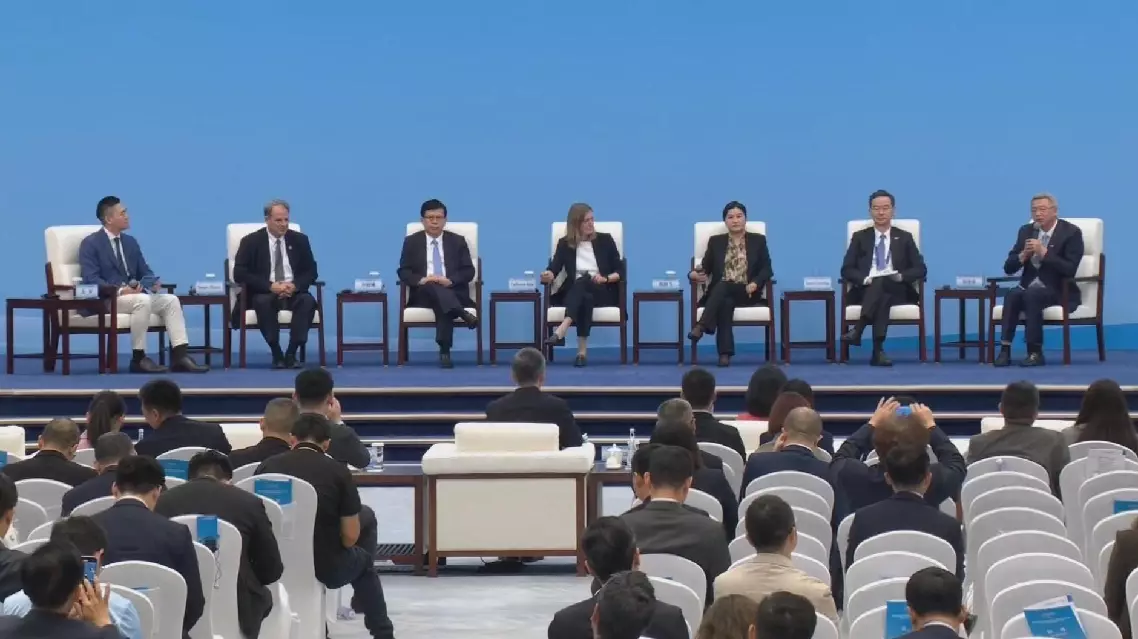
The remarks from top executives came during a panel on digital and green transformation hosted by China Global Television Network (CGTN) anchor Wang Guan on Tuesday.
Xu Xiaoxi, chairman of C and D Group, a Chinese conglomerate with a large-scale supply-chain business, said the two shifts were becoming closely linked as global supply chains changed.
"Global supply chains are being rapidly reshaped. Security and resilience, along with digital and low-carbon development, are emerging as new priorities. Digital and green transformation reinforce each other: digital technology provides the tools to put green initiatives into practice, while demand for greener operations gives digital technology real-world applications," Xu said.
Chau Kwan Fei, chairperson of Lens Technology, a Chinese company that makes components for consumer electronics and cars, described smart and green manufacturing as complementary.
"I started my business in Shenzhen in 1993. My 33 years as an entrepreneur have taught me that quality determines whether a business survives, while innovation creates value. I think smart manufacturing and green manufacturing are two sides of the same coin and complement each other," Chau said.
For Saravoot Yoovidhya, CEO of Thai beverage group TCP, which is behind the Red Bull brand, the first challenge is to treat the transition as an investment rather than a compliance expense.
"The first step we need to take is the change of our mindset. I think digitalization and green transformation shouldn't be seen as extra costs, or shouldn't be considered as something you have to do to comply with new regulations, but should be seen as a strategic investment in future competitiveness," Yoovidhya said.
Liu Jincheng, founder and chairman of EVE Energy, a Chinese maker of electric-vehicle and energy-storage batteries, offered an example of how technological advances could change the economics of renewable power. He described costs achievable in some cases, rather than an industry-wide figure.
"Through years of sustained efforts, China has significantly reduced the combined cost of solar power generation and lithium battery storage. In some cases, solar power generation costs around 0.1 yuan per kWh, while the cost of battery storage can be brought down to just over 0.1 yuan per kWh. So with further technological advances, renewable energy can become economically competitive with conventional energy sources, helping society achieve sustainable development. That's the power of technology," Liu said.
Bringing technologies to other markets requires more than lower costs. Sean Stein, president of the U.S.-China Business Council, a group representing American companies doing business in China, pointed to the need for local knowledge and partners.
"I think one thing that we bring to this is that local knowledge of both the economies of APEC, because certainly technology is not one-size-fits-all. You take it from one [country] and you move it to another country and to another country. There's always some specialization that needs to happen. But increasingly what we're seeing is not American companies going to APEC economies alone. They're partnering with companies like the companies that we have up here on the stage," Stein said.
Catherine Raw, chief development officer at Australian mining group BHP, which produces copper and iron ore, said cooperation would have to extend across the supply chain.
"So you have resource producers, you have customers, you have manufacturers, you have technological innovation, you have growing end user demand. It's all around partnership," Raw said.
APEC business leaders see lower costs, digital tools as drivers of green transition