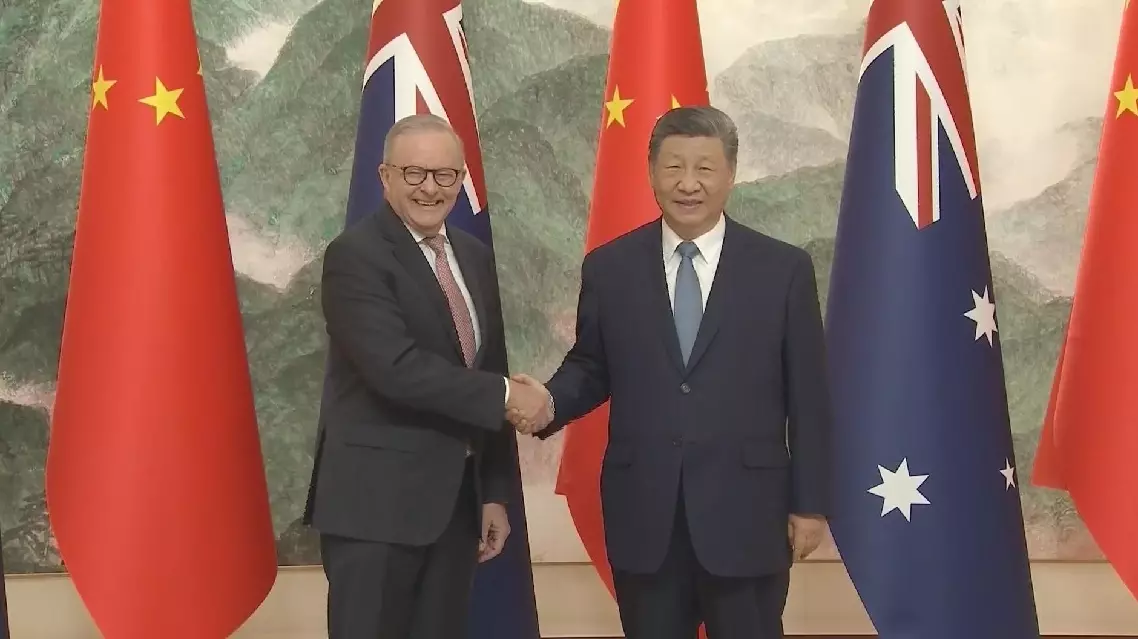
Chinese President Xi Jinping said Friday that China and Australia should be cooperative partners who trust each other and help each other succeed, as the two countries have no historical grievances or fundamental conflicts of interests.
China-Australia relations are stable at present, said Xi when meeting with Australian Prime Minister Anthony Albanese in Shenzhen, south China's Guangdong Province.
Xi said that in a volatile and turbulent world, the two countries should enhance mutual trust, accommodate each other's core interests and major concerns, and keep to the right direction of friendship and cooperation.
He called for deepening mutually beneficial cooperation in pursuit of the two countries' respective development goals, advancing traditional cooperation in agriculture, energy and minerals, and expanding cooperation in emerging areas such as the green economy, new energy, the digital industry, artificial intelligence and climate change response.
Efforts should be made to promote friendship between the two countries through expanded people-to-people exchanges, Xi said, noting that the two sides have agreed to designate 2027 as the China-Australia Year of Tourism.
He also emphasized the need to strengthen multilateral coordination in addressing global challenges, advance the building of an Asia-Pacific community, and jointly uphold the international system with the United Nations at its core and the international order based on international law.
Albanese said the improvement and development of Australia-China relations serve the interests of both countries and bring tangible benefits to the two peoples.
He thanked Xi for replying to a letter from Australian students, saying it was of great significance to enhancing friendship between the two peoples.
Australia is committed to the one-China principle and is willing to maintain close high-level exchanges with China, strengthen practical cooperation in trade, investment, artificial intelligence and other fields, deepen people-to-people exchanges, respect each other, properly address differences, and make Australia-China relations a model of constructive relations between countries with different systems, Albanese said.
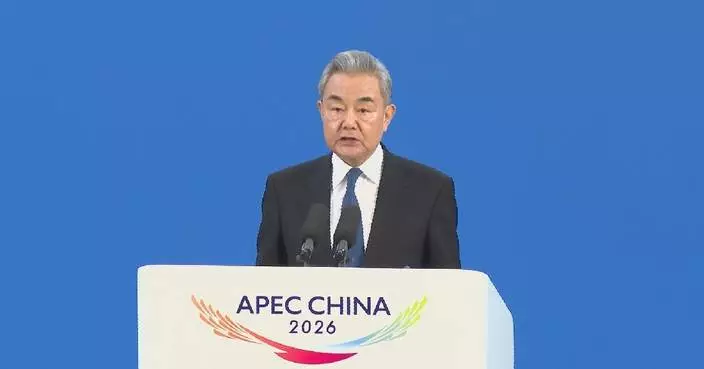
He congratulated China on hosting a successful APEC Economic Leaders' Meeting in Shenzhen, adding that in today's turbulent world, China is an important force for stability.
Albanese also congratulated China on successfully hosting the China-Russia-U.S. summit, which he said is highly important and conducive to safeguarding world and regional peace and stability.
Xi says China, Australia should be mutually trusted partners
Xi says China, Australia should be mutually trusted partners
The summit between Chinese President Xi Jinping, Russian President Vladimir Putin and U.S. President Donald Trump on Thursday has sent a positive signal to the international community and can help bring more certainty and stability to the world, according to scholars from various countries.
The historic sit-down, chaired by Xi in Shenzhen of south China's Guangdong Province, marked the first-ever face-to-face meeting between the Chinese, Russian and U.S. heads of state.
It came after all three had attended the 33rd Asia-Pacific Economic Cooperation (APEC) Economic Leaders' Meeting, which concluded in Shenzhen the same day.
The trilateral summit saw the three leaders share an in-depth exchange of views on the current international situation and commit to maintaining strategic stability and international security.
Giving their reaction to the monumental meeting in interviews with the China Media Group (CMG), scholars from around the world underscored the significance of the three-way talks and believe it could pave the way for more constructive dialogue in the future.
"Today, it is important to show the world that the leaders of the three countries are both willing and able to engage in dialogue. Their readiness to listen to one another and exchange views is especially significant. This sends a very positive signal to the whole world, to global markets and to political leaders that they are prepared for a constructive dialogue," said Alexey Maslov, head of the Institute of Asian and African Studies at Moscow State University.
Others are confident the outcomes of the summit could help address global concerns, support a more stable international system, and encourage greater certainty, coordination and cooperation.
"It was a unique opportunity that the three global leaders met together and they discussed several issues. The three leaders, they represent each other's, each one's own country, but they have discussed the common interests of the whole entire humankind," said Zamir Awan, founding chair of the Global Silk Route Research Alliance, a Pakistani think tank.
"We need major countries to sit at the table and define those parameters, because those parameters then help create a stable global system," said Sourabh Gupta, a senior fellow at the Institute for China-America Studies.
"The fact that the three leaders met and talked can help prevent conflict among their countries and contribute to resolving regional issues, which is something the international society hopes to see. I believe cooperation is fundamental to resolving conflicts. What the world wants is certainty, coordination and cooperation," said Carlos Aquino Rodriguez, a professor at the Center for Asian Studies under San Marcos National University in Peru.
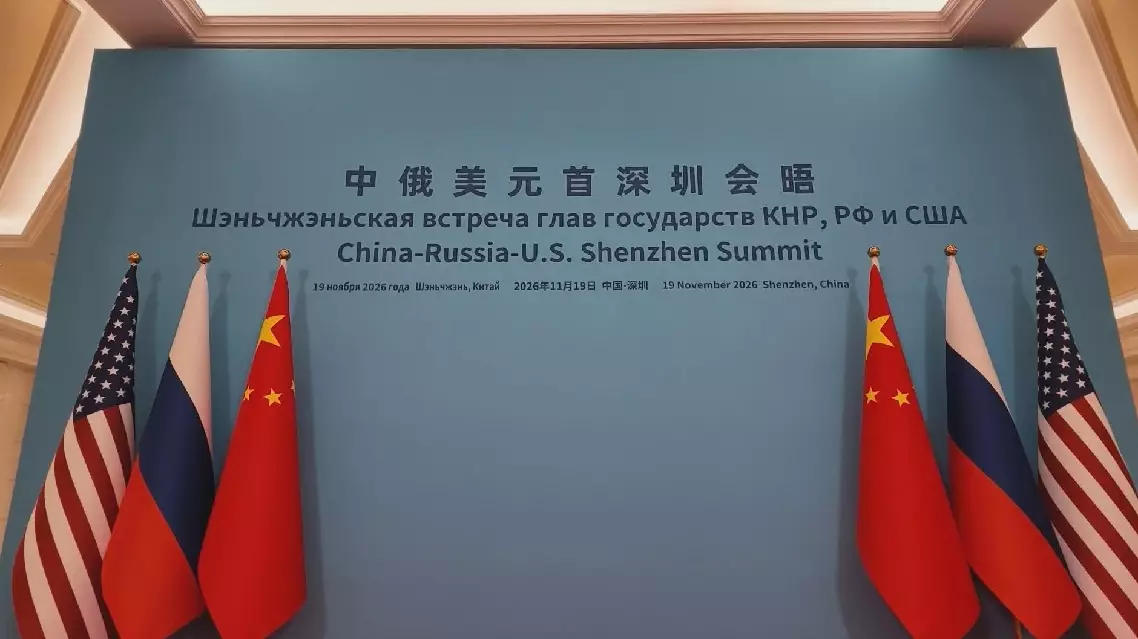
China-Russia-US summit sends positive signals to world: Int'l scholars