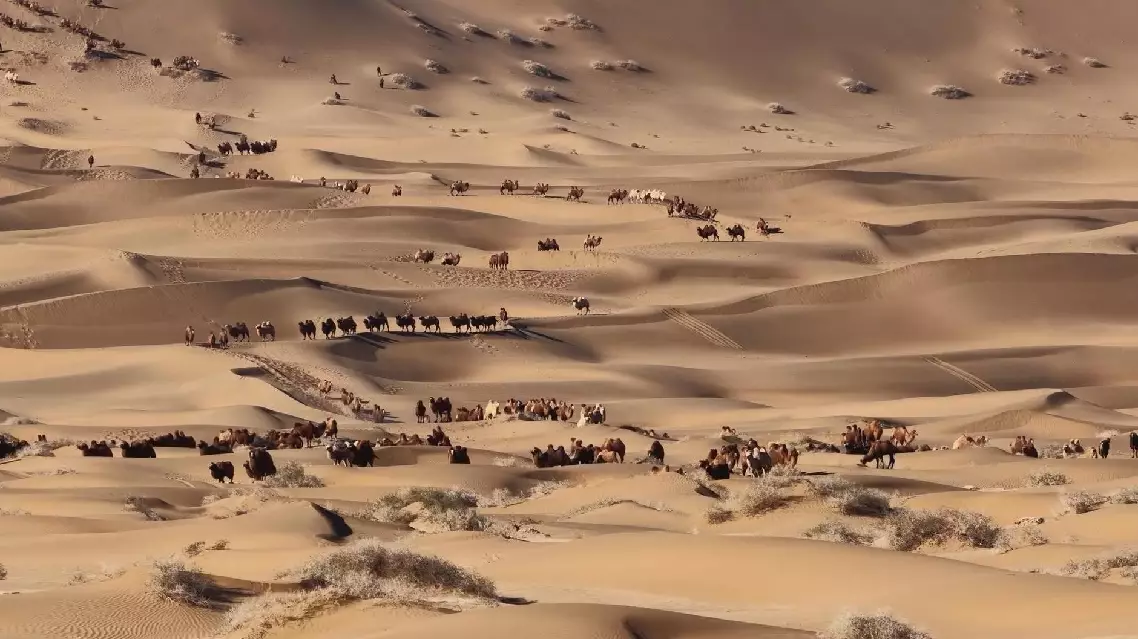
As winter sets in across north China's Inner Mongolia Autonomous Region, herders in Alxa Right Banner have begun their annual desert camel migration.
Across the Badain Jaran, China's third-largest desert, long lines of camels wind along golden ridges and climb steep dunes, creating a striking scene set against towering sands and desert lakes.
Every early November, local herders team up to head into the desert. Combining traditional wisdom and modern tools, they gather thousands of camels that have roamed freely for half a year. The whole process takes nearly a month. Some herders need to make four trips into the desert to retrieve all their livestock.
The soft sand, coupled with heavy vehicle loads, makes driving extremely challenging. Team members search in separate zones, with each person covering an area within a 25km radius. Before entering the desert, they download satellite imagery and mark old campsites, water sources and high-risk bogging spots on offline maps.
Even so, the journey remains unpredictable. Camels can travel dozens of kilometers a day with no fixed resting places. Maps help plot routes, but cannot track the wandering animals. When camels go missing, the herders act like desert detectives, reading clues left on the sand such as fresh camel tracks, droppings and chewed grass stems.
Spotting the camels is only the first step; sorting them into separate herds requires great skill. Hundreds of camels look almost identical when mixed together, but herders can tell them apart using horns, calls, brands, head shape, hump shape and coat color.
"We can tell our own camels apart by the shape of their heads and humps, as well as their coat color," said herder Feng Tao, a member of a 9-people team.
After 11 days in the desert, the team managed to locate more than 500 camels belonging to nine households.
From May to November each year, when desert plants flourish, Feng Tao and most local herders release their camels to graze freely in the desert to cut breeding costs.
Feng raises 150 camels. Feeding all of them with fodder would cost 90,000 yuan a month.
"The feeding cost for one camel is 20 yuan per day, which adds up to 600 yuan a month," said Feng.
Camel dung can also nourishes the sand and supports natural vegetation renewal, creating a virtuous cycle.
When grasses wither in November, the month-long roundup and migration begins. Camels are brought back to winter pastures or enclosures, allowing desert vegetation to recover. Year after year, this migration sustains a balance between camels, herders and the desert.
The Badain Jaran Desert - Towers of Sand and Lakes was inscribed on the World Heritage List in July, 2024, making it Inner Mongolia's first natural World Heritage Site and fills the gap in China's World Natural Heritage roster for desert landscapes.
Herders begin annual winter camel migration in China's Inner Mongolia
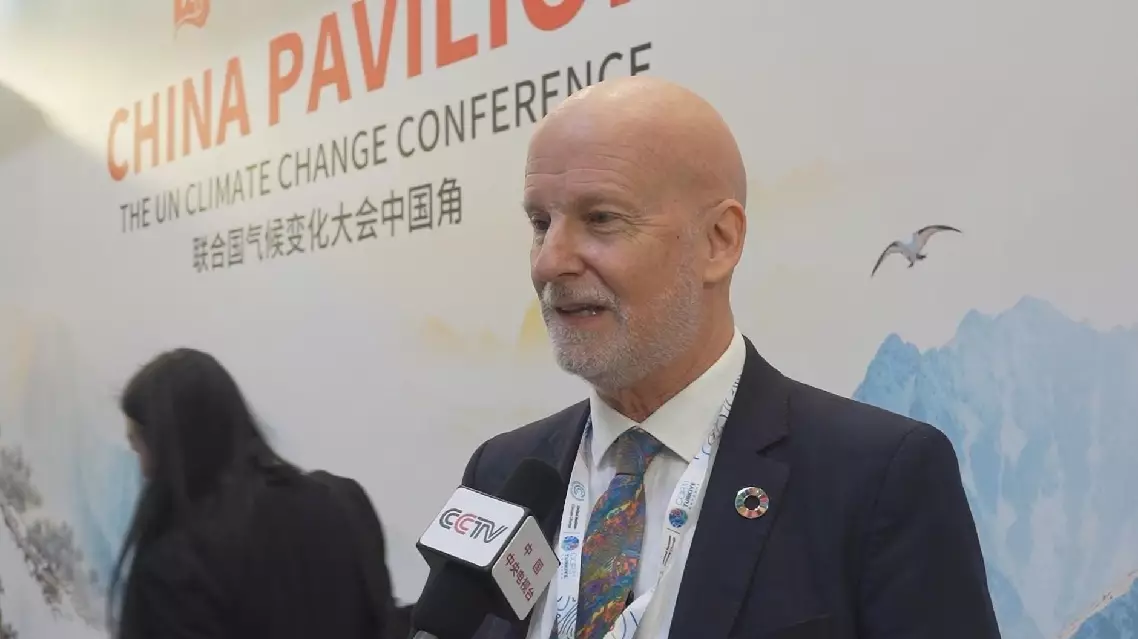
China's commitment to green development has not only driven its own transformation but also made significant contributions to global climate governance and sustainable development, said international participants at the ongoing 31st Conference of the Parties (COP 31) to the United Nations Framework Convention on Climate Change (UNFCCC) in Antalya, Türkiye.
As the conference enters its second half, the China Pavilion is hosting four to five side events and special activities each day.
Representatives from governments, universities and non-profit organizations around the world have gathered at the China Pavilion to discuss topics such as desertification control and ecological restoration, green and low-carbon transition and international cooperation, while offering positive assessments of China’s policies and actions in addressing climate change.
How to use science to inform decision-making and advance the green transition through cooperation has been a key topic of recent exchanges at the pavilion.
International participants believe that the significant value of China's experience in ecological governance lies in its long-term commitment, scientific decision-making and the integrated consideration of ecological improvement and economic development.
"China's experience shows how transitions and energy security can reinforce each other. In 2025, China still accounted for the largest share of global energy demand growth. But a large share of this growth was met, thanks to the rapid expansion of renewables and efficiency gains. Coal demand was flat and energy related CO2 emissions fell, which is very encouraging in view of China's fuel carbon goals for 2030 and 2060," said Mary Burce Warlick, Deputy Executive Director of International Energy Agency.
"China was among the first countries in the world to realize that restoration is about people, it's about livelihoods, it's about jobs, it's about thriving economies. And China has perfected a landscape approach to restoration that looks at all of these together so that you end up with restoration that works, that stays, that actually has long term impact," said Barron Joseph Orr, chief scientist for the United Nations Convention to Combat Desertification.
How to enable more developing countries to benefit from the opportunities presented by the green transition was also a key topic of discussion at the China Pavilion.
"China initiatives are very important steps and it really points us to the direction of what we need to do in terms of renewable energy, clean technology and electrification that needs to happen in the rest of the world. Yes, we believe China is a very important energy transition, and transitioning away from fossil fuel partner for developing countries, because that's where the technology is. But that's where also the South-South cooperation needs to come from," said Jasper Inventor, interim executive director of Greenpeace International, an international non-governmental environmental organization.
Int'l experts laud China's contribution to global green transition at COP31