Chinese scientists have confirmed that a population of Homo erectus inhabited the rainforests of southern China between approximately 324,000 and 184,000 years ago, providing the youngest known fossil evidence of the species in the country.
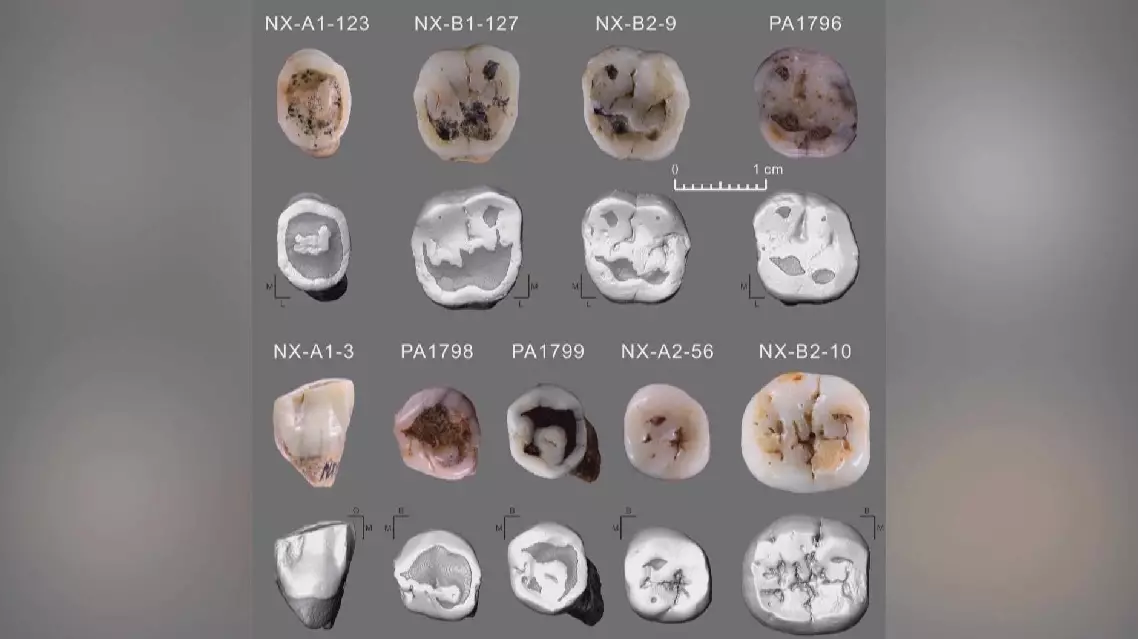
The findings, published online in the journal Nature on Thursday, are based on nine ancient human teeth unearthed in the city of Chongzuo, the Guangxi Zhuang Autonomous Region.
The study was conducted by researchers from Shandong University's School of Archaeology, the Institute of Vertebrate Paleontology and Paleoanthropology (IVPP) at the Chinese Academy of Sciences, and other institutions.
Its findings provide the first confirmed fossil evidence of Homo erectus in the subtropical rainforests of southern East Asia, helping fill a gap in the reliable fossil record of the species in southern China during the late Middle Pleistocene. They also offer new insights into the distribution, mobility and evolutionary relationships of different hominin populations in East Asia.
Combining dental morphology and ancient protein analysis, researchers identified eight of the teeth as Homo erectus and established their ages using multiple dating techniques.
A ninth tooth, designated specimen PA1796, has a distinct morphological profile that does not match that of Homo erectus, Neanderthals or modern humans. It also lacked protein markers associated with Homo erectus. The researchers suggest it may belong to a Denisovan-related lineage or represent another unidentified archaic human group, raising the possibility that multiple hominin populations once coexisted in the Chongzuo area.
The results also shed new light on the ecological adaptability of Homo erectus.
The species has traditionally been associated with relatively open environments, such as savannas and open woodlands, according to Zhang Yingqi, a researcher at the IVPP. However, isotopic analysis of the teeth, together with animal fossils from the same sites, indicates the Chongzuo population lived in a dense, closed-canopy rainforest.
Further strontium isotope analysis suggests some individuals moved between different regions, indicating that Homo erectus was both capable of adapting to dense rainforest environments and traveling substantial distances.
New study identifies China's latest-known Homo erectus fossils