Following the APEC Economic Leaders' Meeting in Shenzhen, Vietnamese President To Lam visited southwest China's Yunnan Province from Thursday to Friday, calling for stronger economic ties, upgraded infrastructure connectivity, and deeper people-to-people exchanges between the two countries.
Yunnan, which shares a long border with Vietnam, serves as a vital gateway for bilateral cooperation. This growing synergy is already evident in consumer markets: Vietnamese coffee is gaining significant traction in China, while Yunnan's flowers are becoming increasingly popular among Vietnamese consumers.
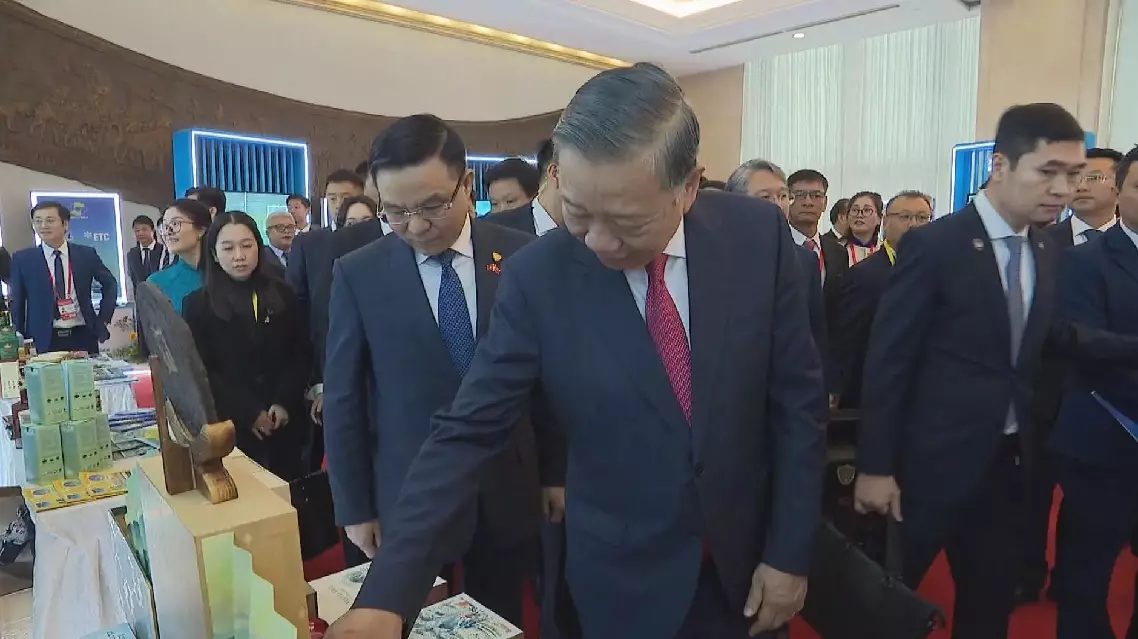
At a product showcase in Kunming, Yunnan's provincial capital, To Lam took a keen interest in signature products from both countries.
Speaking at the Vietnam-Southwest China Strategic Development Connection Forum in Kunming on Friday, To Lam emphasized the need to align policies, upgrade infrastructure, and deepen cooperation in trade and technological innovation. He specifically urged both sides to accelerate the development of cross-border railway links.
"I have traveled by train from Beijing, passing through five provinces before reaching Guangxi [Zhuang Autonomous Region]. China has done a very good job in this regard. We need to move quickly on these projects to make travel more convenient for people, promote tourism and facilitate the transportation of goods," To Lam said while recalling his earlier visit to China in April.
To Lam's remarks have given businesses from both countries greater confidence in exploring new opportunities.
"We will continue to expand our coffee shop network. While our cafes are currently concentrated in east China, we plan to gradually expand into the south and southwest regions you just mentioned, including Guangxi and Guangzhou [City]," said Li Wuqiang, offline sales manager in China for Vietnamese coffee brand Trung Nguyen Legend.
"Our products are well suited to Vietnamese consumers, so Vietnam is one of the key markets we are focusing on and developing. Capitalizing on today's meeting, we quickly connected with local cosmetics distributors and have started discussions on potential cooperation," said Zhong Wei, director of public relations at Yunnan Botanee Bio-technology Group.
China has been Vietnam's largest trading partner for more than two decades, while Vietnam has emerged as China's fourth largest. Official data showed that bilateral trade is expected to exceed 400 billion U.S. dollars this year, setting a new record.
Beyond the economy, To Lam underscored the enduring importance of people-to-people exchanges. During his visit, he met with Chinese and Vietnamese youth representatives participating in a joint "Red Study Tour" program, which seeks to deepen young people's understanding of both countries' shared revolutionary history and longstanding friendship.
"I believe we should continue to strengthen our cooperation, particularly in the field of vocational education and training. Given that both our nations are socialist countries, we are committed to making common progress and achieving shared development in the future," said Yang Yue, a Chinese youth representative who participated in the program.
Before leaving Yunnan, To Lam planted a tree at a local wetland park, in a gesture reflecting the two countries' shared hopes for lasting friendship and closer cooperation.
Vietnamese president visits China's Yunnan, calling for closer cooperation