Hit by the U.S.-Canada trade war, Canadian timber producers are turning to China and other APEC economies to diversify their markets and reduce their reliance on the United States, as the country's forestry sector ranks among the hardest hit by U.S. tariffs.
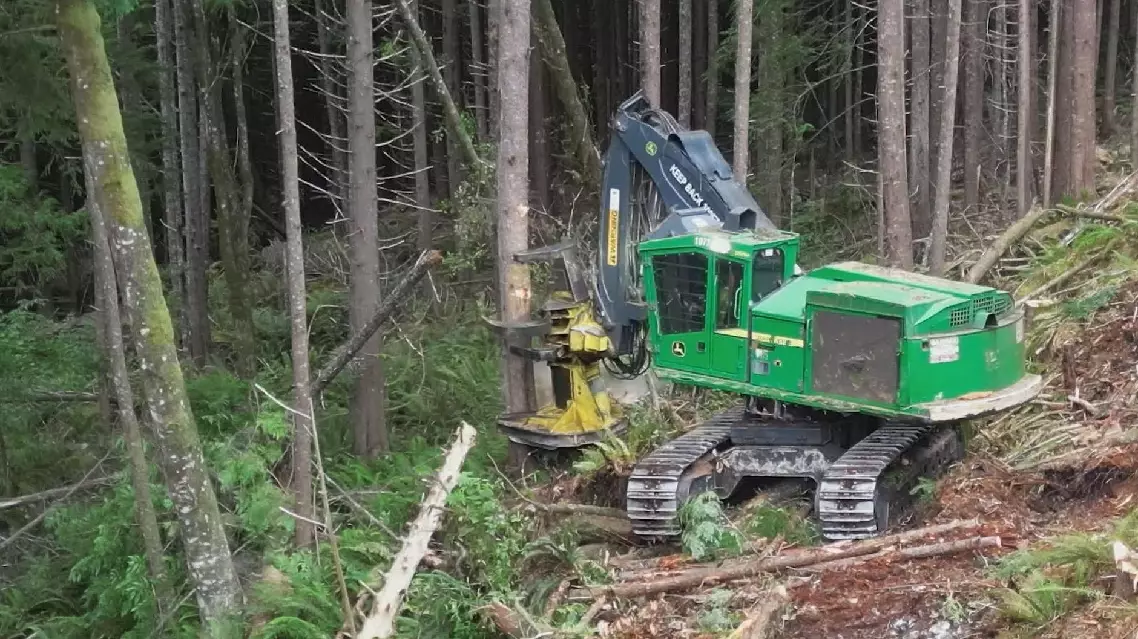
Commercial logging has been a key part of Vancouver Island's history since the early 1800s, with sustainability at its core. For every tree cut down on the island, three new ones are planted.
"It's generational. I mean, we are planting third-growth trees. Basically, it's just a massive farm where the crop takes a little longer to grow, but it does come back every time," said Richard Mcleod, supervisor at Western Forest Products.
Logging operations largely take place on the north part of the island.
In the south, a next generation of sustainable wood products begins at the 26-hectare Saanich Forestry Center. The center raises young trees from seedlings, putting them in conditions that will help them survive into adulthood once they are transfered to a logging forest.
"Our objectives are to produce the healthiest, robust, and resilient seedlings for establishment as a new forest. So we baby them and then we stress them out, but it allows them to adapt to the more severe conditions that they will be planted on," said Christina Lavoie, manager at the Saanich Forestry Center.
Canada's forestry industry is a huge economic engine, worth around 61 billion U.S. dollars and employing some 200,000 people, but it is facing tremendous headwinds.
The industry exports around 26 billion U.S. dollars' worth of products each year, and its biggest market, the United States, buys more than 50 percent of Canada's softwood lumber. That trade has been severely impacted by the U.S.-Canada trade war, with Washington imposing a range of tariffs on Canadian lumber and wood products, some of them as high as 50 percent.
"The U.S. market is the most important market to Canada. It's been a massive impact on the industry. You've had mill closures. When the mills close, it's the communities that get affected," said Bruce St. John, president of the Canada Wood Group, an organization that promotes Canada's forestry products.
In his view, however, there is still plenty of hope for the industry. Even before the trade war, Canada's forestry industry had already expanded its focus to other APEC economies across Asia, including China.
"China is a very important market to us. We're working on a lot of different [projects], building products and systems in China in terms of growing it, we see China as a huge opportunity for us," St. John said.
Despite the challenges, Canada's forestry companies are focused on building a more resilient and diversified market over the long term.
"I think that diversification is important for any business, whether it's on products or markets. For us, what we've seen in the last few years, it is more important than any time. We're not just going to sit back and try to do things the way we've always done it. We want to take advantage of what we see as opportunity," said Don McGregor, vice president of sales and wholesale supply for Western Forest Products.
Canadian timber turns to Asian markets as U.S. tariffs bite