China's manned deep-sea submersible, Jiaolong, has undergone significant upgrades to its imaging and propulsion systems, featuring domestically produced core components that bolster the vessel's reliability and deep-sea exploration capabilities.
The submersible recently completed multiple 7,000-meter dive tests during the second leg of China's 100th ocean expedition in the South Pacific.
To capture clearer and more comprehensive images of the seabed, Jiaolong's camera systems have been upgraded to new levels.
"What we are seeing here is a newly upgraded 180-degree wide-angle 4K camera. Its main advantage is that it allows us to observe and film across a 180-degree field of view underwater. Meanwhile, we have three 4K cameras with 36x zoom. In simple terms, this means they can zoom in incredibly close during underwater observations. For instance, when exploring cold seep areas, we can see even the tiny hairs on the mussels with absolute clarity," said Zhang Yi, a pilot of Jiaolong.
The imaging upgrades are complemented by the installation of high-energy-density lithium battery packs and an improved hydraulic system. Notably, the thrusters that drive the submersible underwater have been replaced with domestically produced alternatives.
"The four thrusters you see here at the stern of the Jiaolong are our domestically produced models. These domestic thrusters deliver greater thrust, which means the submersible can move faster underwater, allowing it to cover greater distances and explore a much wider area in a single dive. The second advantage is that they operate much more quietly. In the past, the high noise would interfere with underwater communications and the operation of certain detection equipment. Now, with the noise significantly reduced, underwater communications for the Jiaolong is much smoother," said Liu Kun, head of the mechanical, hydraulic, and propulsion systems for Jiaolong.
The performance of these upgraded equipment was rigorously tested during the recent expedition. In the Philippine Basin, Jiaolong conducted three dives, two of which exceeded 7,000 meters, reaching a maximum depth of 7,056.9 meters.
"Jiaolong performed exceptionally well during this 7,000-meter sea trial, particularly regarding its underwater operations. We dove to 7,000 meters twice, and the equipment experienced zero failures underwater. Many of the upgraded components have achieved full localization, meaning our core technologies are fully under our control, and spare parts can be replenished promptly. This gives us great confidence and, at the same time, ensures a much safer environment for the scientists joining us on these dives," said Tang Jialing, another pilot of the submersible.
Since its initial sea trial in 2009, Jiaolong has completed nearly 500 dives. The high-definition seabed footage and deep-sea samples it retrieved have provided crucial first-hand data for China's oceanographic research, continually expanding humanity's understanding of the deep ocean.
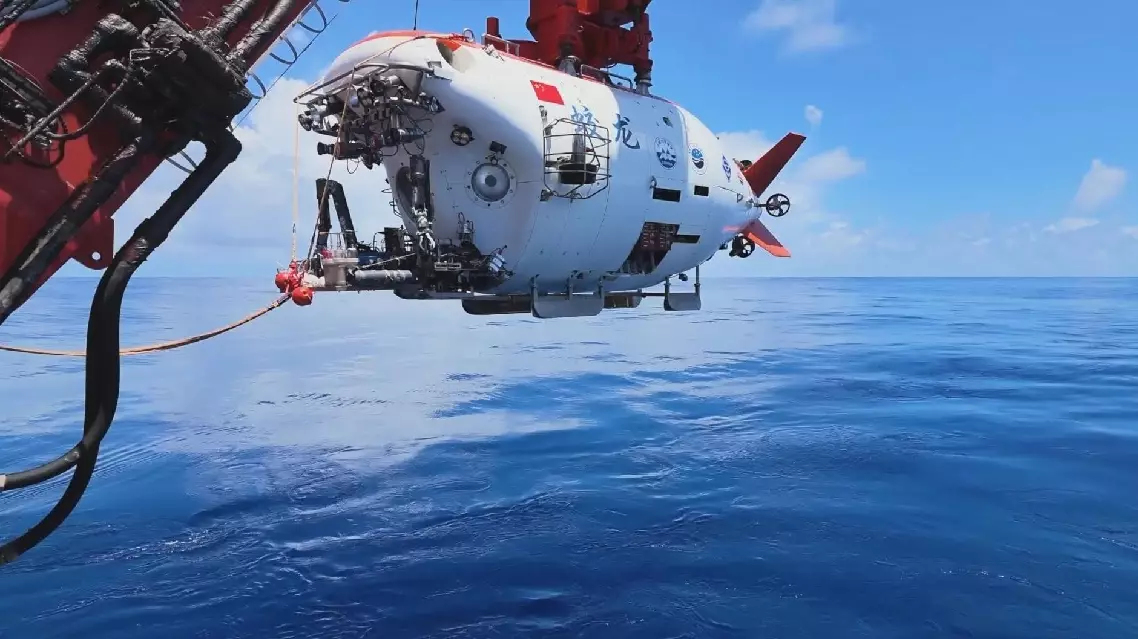
Indigenous upgrades boost deep-sea capabilities of China's Jiaolong submersible