JAKARTA, Indonesia (AP) — Indonesian police on Tuesday dismissed two senior officers from the country’s elite counterterrorism squad over an alleged treason plot to undermine President Prabowo Subianto’s government.
The dismissals came amid an investigation that began with allegations of illegal wiretapping targeting the president and other public figures before expanding to examine the alleged plot.
National Police spokesperson Trunoyudo Wisnu Andika said the Police Professional Ethics Commission found that Brig. Gen. Muhammad Tedjo Kusumo and an officer under his command, Guntur Yayus Putra, had committed a “disgraceful act” and ordered their dishonorable discharge after separate hearings. Both men plan to appeal, Andika said.
Kusumo, a former intelligence director of the counterterrorism unit known as Densus 88, was among six suspects accused of conspiring to commit treason to keep then-National Police chief Gen. Listyo Sigit Prabowo in office and influence Indonesia’s political landscape.
President Prabowo’s office has described the alleged surveillance operation as a possible act of treason, and National Police Chief Gen. Suyudi Ario Seto said Tuesday that a separate treason investigation continues, with investigators examining seized electronic devices.
The government earlier ordered 20,000 troops to Jakarta as a precaution, although there has been no visible large-scale military deployment in the capital.
Besides Kusumo, police named Listyo Sigit, Slamet Uliandi, Eko Hadi Santoso, Ahrie Sonta Nasution and Iman Imanuddin as suspects.
Kusumo and Putra are the third and fourth suspects in the case to be expelled from the force through internal disciplinary proceedings.
An ethics commission on Nov. 10 ordered the dismissal of Nasution, head of the National Police Legal Division, after finding him guilty of serious professional misconduct. It was followed by the dismissal of Santoso last week. They also plan to appeal.
While assigned to the Densus 88 task force, both Kusumo and Putra had conspired “to conduct surveillance and tail individuals who had no connection to duties related to counterterrorism threats and were, in fact, government officials,” Andika told a news conference in the capital, Jakarta, late Tuesday.
Investigators allege that Kusumo, who served in the post from May to October, monitored and followed several prominent figures who were also targets of an illegal wiretapping operation.
“The surveillance involved prospective candidates for national police chief, state officials and party officials,” Susatyo Purnomo Condro, director of general crimes at the National Police’s Criminal Investigation Agency, told a separate news conference.
He said investigators believe the surveillance was intended to gather information and monitor the activities of influential figures, including officials within the presidential circle.
Investigators concluded that the surveillance activities, including those targeting figures linked to the presidential palace, formed part of the alleged criminal offense of treason, Condro said.
Indonesia, the world's most populous Muslim-majority country, launched a crackdown on militants after the 2002 Bali bombings that killed 202 people, mostly foreign tourists. Authorities say the country has experienced no major terror attacks since 2023.

Indonesia's President Prabowo Subianto speaks to the media after submitting the names of two vice presidential candidates to the People's Consultative Assembly, as House Deputy Speaker Sufmi Dasco Ahmad, left, and Habiburokhman, second from left, chairman of the House's Commission III, look on at the parliamentary complex in Jakarta, Indonesia, Monday, Nov. 23, 2026. (AP Photo/Tatan Syuflana)

FILE - Indonesian President Prabowo Subianto salutes as he arrives before he delivers his annual State of the Nation Address ahead of the country's Independence Day, at the parliament building in Jakarta, Indonesia, Aug. 14, 2026. (AP Photo/Dita Alangkara, File)
MIDDLETOWN, Iowa (AP) — The U.S. Army plans to detonate its entire stockpile of lead azide in Iowa on Wednesday morning, warning that the dangerously degrading bomb-making chemicals could explode at any time because of cooling weather.
“Inaction is no longer an option,” said Maj. Gen. Eric Shirley, the Army’s leader of the operation.
Officials sought to assure residents Tuesday that they’ve taken steps to put barriers around the blast zone and limit the plume from the detonation.
“We don’t believe that the public should be in a panic,” said Acting Secretary of the Army Adam Telle.
The controlled detonation of five tons of degraded lead azide at the Iowa Army Ammunition Plant in Middletown has set off concerns about potential health and environmental effects and frustration over a lack of information.
The Army rescheduled the detonation in southeastern Iowa to Wednesday because of more favorable wind conditions and to allow more time for extra safety measures to be put in place, according to court filing by the government.
The controlled detonation of 68 barrels was initially planned for last Friday. The Army said they need to blow up the stockpile to prevent a possible chain-reaction explosion, which would be more dangerous.
In a legal filing late Monday, the Justice Department said the wind on Wednesday is expected to be east to west or southwest, and away from high population areas and large bodies of water. The forecast is for winds of 5 to 10 mph (8 to 16 kph) as the day starts cloudy and later turns mostly sunny, according to the National Weather Service.
An emergency notification sent to cellphones of people in the area Tuesday morning said the detonation was planned for 9 a.m. Wednesday and some people within 5 miles (8 kilometers) southwest of the plant may be evacuated.
The “imminent threat alert,” which listed FEMA as the contact agency, told those up to 20 miles (32 kilometers) away to remain indoors with windows closed “to avoid airborne lead dust, noise and vibration.”
The new date will give the Army extra time to set up additional “blast barriers” around the bunkers where the lead azide will be detonated, and to apply ballistic gels and foams designed to reduce particulate matter from controlled explosions, according to a document filed in the 8th U.S. Circuit Court of Appeals.
The Army also will douse the materials with thousands of gallons of water during the detonation to help absorb the explosion and reduce lead dust, the filing said.
“This is a consensus decision,” acting Army Secretary Adam Telle posted on social media Monday night. “Every expert agency agrees, and both Iowa’s current and incoming Governors say the call belongs to the experts.”
The Army won approval for the detonation from the federal appeals court in a saga that has sowed confusion and included an unusual twist from President Donald Trump.
A three-judge panel of the appeals court said Monday that the U.S. Environmental Protection Agency adequately incorporated safeguards in an emergency permit to minimize the dispersal of dust. Those conditions address the concerns of environmental groups that sued to stop the detonation, the court said.
The court pointed to barriers put up around the area where the barrels are stored along with weather restrictions. It also noted requirements for advance public notification, updated air modeling and environmental monitoring and sampling.
The judges said the record also reflected that the Army evaluated “a full range” of alternatives, including using other chemicals to neutralize the lead azide and thermal treatment.
In an unusual twist, Trump, commander in chief of the Army, said on social media earlier in the day that in addition to the court's go-ahead, he wanted Gov.-elect Rob Sand to approve the detonation. Sand, a Democrat who doesn't take office until January, has said the decision is fully up to the Trump administration.
The detonation of the lead azide was initially planned for last Friday, but the Army has since changed the date three times following an outpouring of public concern.
Environmentalists sued last week to stop the detonation at the site near Middletown, not far from the Mississippi River about 90 miles (140 km) south of Cedar Rapids. The court temporarily halted the permit, prompting the Army to argue it didn’t need authorization after all, given that it was an emergency.
An attorney for the environmentalists emphasized that their legal challenge centers on the validity of the EPA permit, not the Army’s decision to move forward with the detonation under the emergency provision.
Earthjustice managing attorney Rachel Rintelmann said the lawsuit has alerted the public to the threat.
Current Gov. Kim Reynolds activated the state emergency management office on Friday. The state also created a dedicated website for information about the operation.
Reynolds said in a statement Tuesday that after speaking with military leaders, including Defense Secretary Pete Hegseth, she supports the planned detonation.
“I believe, based on the information I’ve been given, that the danger is immediate, and I trust the Army will do everything in its power to protect the people who could be affected,” Reynolds said.
Some residents near Middletown have been sealing their windows and doors as a precaution to keep out any lead dust that might result from the detonation. Others who live farther away were raising concern on social media about the possible paths the plume could take depending on the wind.
Officials acknowledge that lead is toxic and have recommended that people stay indoors when the detonation happens and clean off outdoor surfaces with water afterward to limit exposure to any lead particles.
Middletown Mayor Rodney Johnson said the detonation must take place “so we can move on with our lives.”
“Improper storage and disposal is where things go wrong,” he said on social media.
Leaders of states that border Iowa also expressed concern. Missouri Gov. Mike Kehoe said state agencies are working to establish additional monitoring of air and water quality, public health and agriculture resources.
In court filings over the weekend, Army Col. Aaron Teller, a munitions emergency response specialist, explained that less liquid inside the barrels means the solution inside is more susceptible to freezing, which increases the sensitivity of the crystals that have formed around the inside of the rim and underside of the lids.
“Even a small amount of friction can break the crystal formation, causing an explosive chain reaction,” he said.
In March, staff at the Iowa Army Ammunition Plant found several dozen barrels of degraded lead azide, which is used in munitions production. Crystallization of the material created an unstable and dangerous situation, prompting the Army to assemble experts in munitions chemistry, engineering and environmental safety to come up with a plan.
According to EPA documents, alternatives such as neutralizing and decomposing the drums’ contents with other chemicals were considered. But officials said handling the drums would increase the probability of an accidental, fatal detonation.
Officials contend the risk of an uncontrolled explosion is growing, particularly as temperatures drop in the coming days.
Montoya Bryan reported from Albuquerque, New Mexico. Associated Press writers Konstantin Toropin in Washington, D.C., Scott Bauer in Madison, Wisconsin, Jacques Billeaud in Phoenix, Christopher Weber in Los Angeles and Dave Collins in Hartford, Connecticut, contributed.
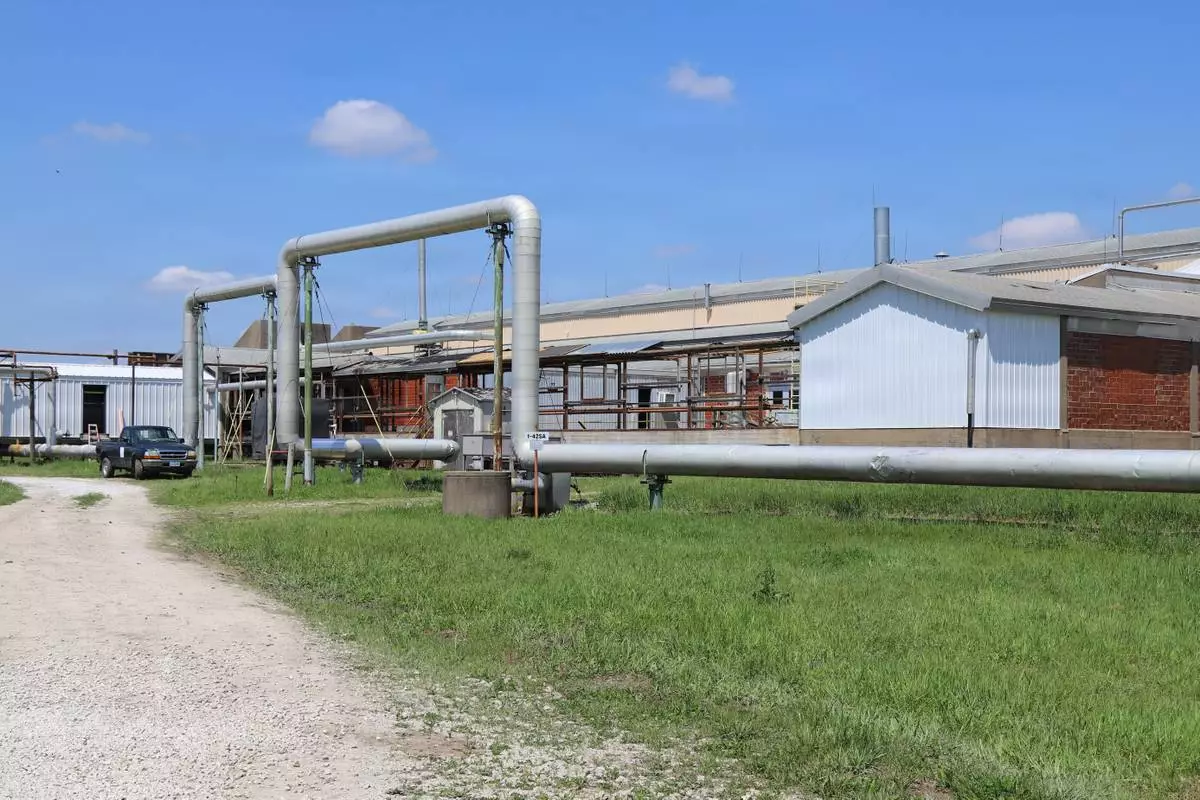
This photo provided by the U.S. Army shows the Iowa Army Ammunition Plant in Middletown, Iowa, on May 14, 2024. (Shawn Eldridge/U.S. Army via AP)