PHILADELPHIA (AP) — A Philadelphia-based history preservation group has filed a lawsuit against the Trump administration over what it claims is a “whitewashed depiction” of slavery following changes made to an exhibit at the site of President George Washington’s home.
The lawsuit, filed Monday in federal court in Pennsylvania, names the Interior Department and Secretary Doug Burgum, and the National Park Service and Acting Director Jessica Bowron.
Avenging the Ancestors Coalition says the changes made earlier this year to the President's House/Slavery Memorial violate the Equal Protection component under the Fifth Amendment and the Administrative Procedure Act, which, in part, authorizes the court to set aside agency action that is arbitrary, capricious, an abuse of discretion or doesn't follow the law.
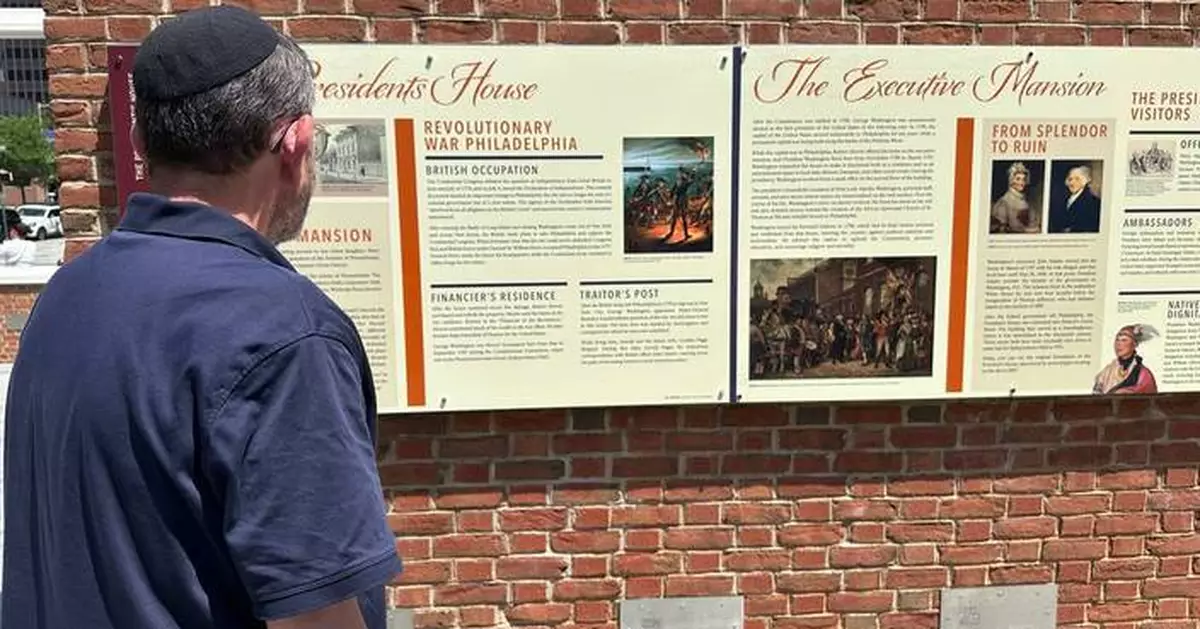
Panels put in place in 2010 at the exhibit originally told the story of how nine slaves lived in the home along with George and Martha Washington in the 1790s, when Philadelphia was briefly the nation’s capital.
The Trump administration began removing those panels earlier this year. Philadelphia filed a lawsuit and a lower court forced the federal government in February to stop while the city appealed the changes. A federal Appeals Court panel reversed that and ruled July 3 that the work could continue.
The Park Service later began installing interpretive panels for a new exhibit at the President’s House site, according to the lawsuit.
The new panels “dilute and de-emphasize” the original meaning of the exhibit, the complaint said. The original exhibit also featured descriptions of the hardships faced by the nine slaves, including physical and sexual violence, which the lawsuit claims were watered down or completely omitted in the new exhibit.
“Moreover, the original glass panels that were removed have not been replaced or restored, and the motion-activated videos remain turned off.”
Since the start of President Donald Trump’s second term, his administration has been targeting diversity, equity and inclusion initiatives throughout the federal government, in historic and cultural institutions, education, medicine and in private businesses.
An executive order signed by Trump in 2025 called for federally owned or controlled historic sites to not display information to “disparage Americans past or living” and to focus on the “greatness of the achievements and progress of the American people.”
The Black Journey: African American Walking Tour of Philadelphia, another plaintiff in the latest lawsuit, asks the federal court to return the memorial to its original condition and to permanently restrain the Trump administration from enforcing or implementing the orders that led to the changes made this year.
The National Park Service and the Interior Department did not immediately respond Tuesday to requests for comment.
The Interior Department said in a statement this summer that the new “panels are full of historical context and highlight the momentous events that took place in the President’s House and the other sites at Independence National Historical Park.”
“They acknowledge the evils of slavery, including its injustices and hypocrisies, and, by telling the stories of the nine slaves that Washington kept in the President’s House, remind us of their essential humanity,” the statement said.
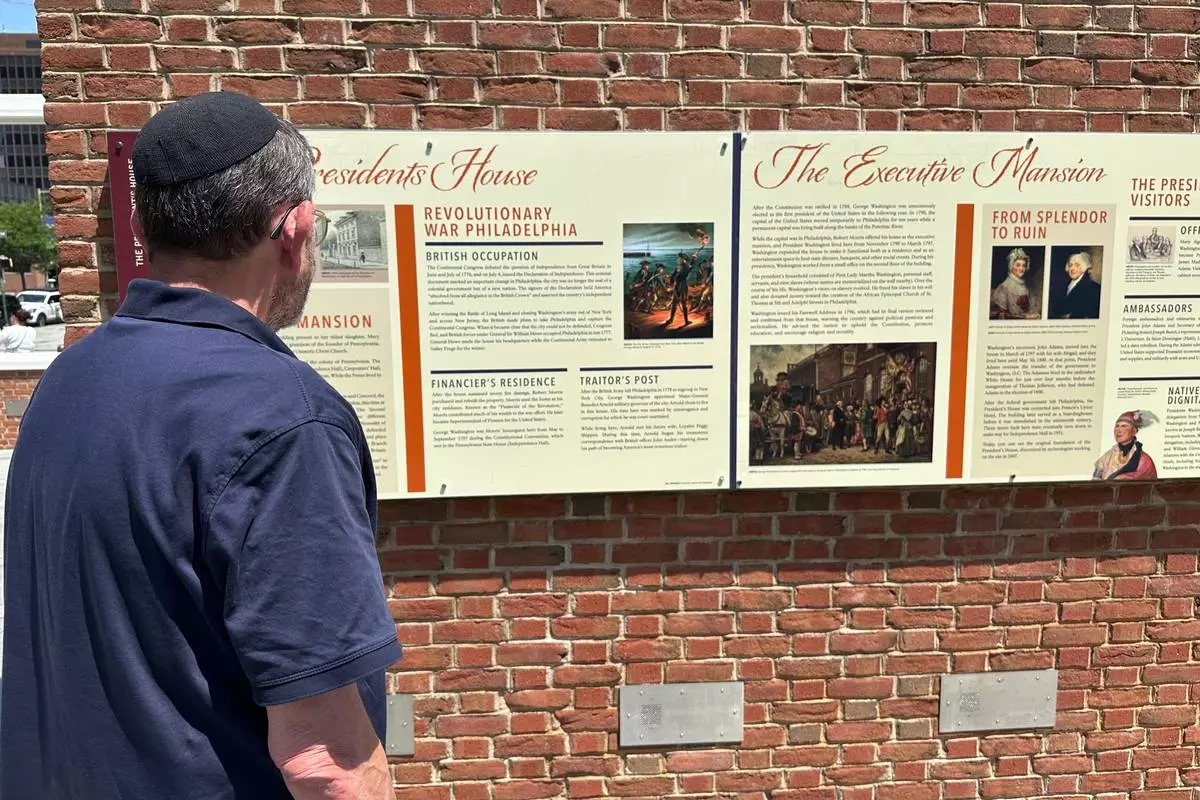
FILE - Visitors view the reinstalled educational panels about slavery at the site of President George Washington's home in Philadelphia, July 15, 2026. (AP Photo/Tassanee Vejpongsa, File)
NEW YORK (AP) — Ellen Nimmons, a longtime international editor at The Associated Press known for a steadfast commitment to high standards and disarming dedication to her colleagues’ development and well-being, has died.
Nimmons died Monday after a brief illness, her daughter Bridget Fitzgerald said. She was 78.
Nimmons, who retired four years ago, began working for AP in 1977 as a reporter, first in Minneapolis and then in Boston. She went on to work as a New York-based editor for national and international news, lending her expert touch to coverage of big global stories including the deaths of popes, kings and queens; a massacre in Bosnia; the aftermath of 9/11; and the falls of Saddam Hussein and Moammar Gadhafi.
Nimmons spent more than 15 years overseeing the daily report on the International Desk, then served from 2017 until her retirement in 2022 as a global news manager on the Nerve Center, a hub for news coordination, client engagement and audience development.
By the time she retired, she had earned the respect and affection of countless international journalists whose training she oversaw.
“As a young journalist, I lived in a mixture of awe and fear of Ellen. She had such high standards. But once you learned to adopt those standards for yourself, she’d welcome you to the team and let her guard down,” said Ravi Nessman, AP's global director of text, who spent years as a foreign correspondent being edited by Nimmons. “It was an honor we didn’t take lightly.”
She was remembered Tuesday as a demanding editor who earned her colleagues’ respect and gave it in return, along with an endless supply of her personal brand of warmth.
“She was intimidatingly unflappable, incredibly smart and always had everything under complete control,” said Paul Haven, AP's vice president of news gathering, who worked under Nimmons in the 1990s.
While tough on foreign correspondents' copy, Nimmons cared deeply about their welfare. She kept up with their personal lives, reveling in their adventures and watching over them from afar.
“Ellen was a giant heart wrapped in a no-nonsense exterior,” said Ted Anthony, AP's director of new storytelling and newsroom innovation and a former international correspondent in Asia. “When I was going through some of the toughest periods of my professional life in Islamabad, Kabul and Baghdad after 9/11, she was my lifeline. She checked in on me and ordered me: ‘If you’re not OK, you’re going to call me no matter what. Got it?'”
“She taught me so much about editing but a lot more about life.”
Born in Vermont, Nimmons grew up in Greenfield, Massachusetts, and earned a bachelor's degree in journalism and political science from Syracuse University.
Before joining AP, she was city editor for the Concord Monitor in New Hampshire.
Robert H. Reid, a former AP correspondent who led coverage of the wars in Iraq and Afghanistan and covered major stories from the fall of the Shah of Iran to the Balkan conflicts, remembered Nimmons' deft coordination of fast-breaking news events from afar.
“Her sound news judgment, calm demeanor and detailed knowledge of international affairs were invaluable in helping guide coverage of the most challenging stories,” Reid said.
“She would not shy away from telling field reporters that they were missing the point or editors that their expectations were misguided,” Reid said. “Her contribution to AP’s international coverage cannot be overstated.”
Many who worked with Nimmons remembered and cherished her presence — someone whose praise and pointed remarks could be heard without amplification across the newsroom, providing a running commentary on the news and her colleagues covering it. For the casual observer, it was a patter; for those who knew her, it was a continuous burst of journalistic energy that reflected how seriously she took her job.
“She was smart, funny and outrageous while at the same time caring deeply for AP’s journalism and all of us as human beings,” said Amanda Barrett, AP's vice president for standards and inclusion.
Nimmons believed strongly in feminist causes and with a group of friends she helped fund the first free abortion clinic in New Hampshire in the 1970s, Fitzgerald, her daughter, said. “Her radical activist political days had to be bookended around professional AP neutral journalism,” she said.
It was hard to find a topic that Nimmons felt neutral about. Colleagues spoke of her wide-ranging passions — for travel, culture, journalism and, above all, her family.
Nimmons was married to Jim Fitzgerald, a longtime writer and editor in AP's New York City bureau. He died in 2017. Nimmons is also survived by a second daughter, Caitlin Fitzgerald, and her daughters' families.
In her final AP email to dozens of colleagues in 2022, Nimmons ended with a signature finish.
“I will miss most of you.”
This story has been updated to correct the amount of time Nimmons spent overseeing the daily report on the International Desk. It was more than 15 years, not 5 years.
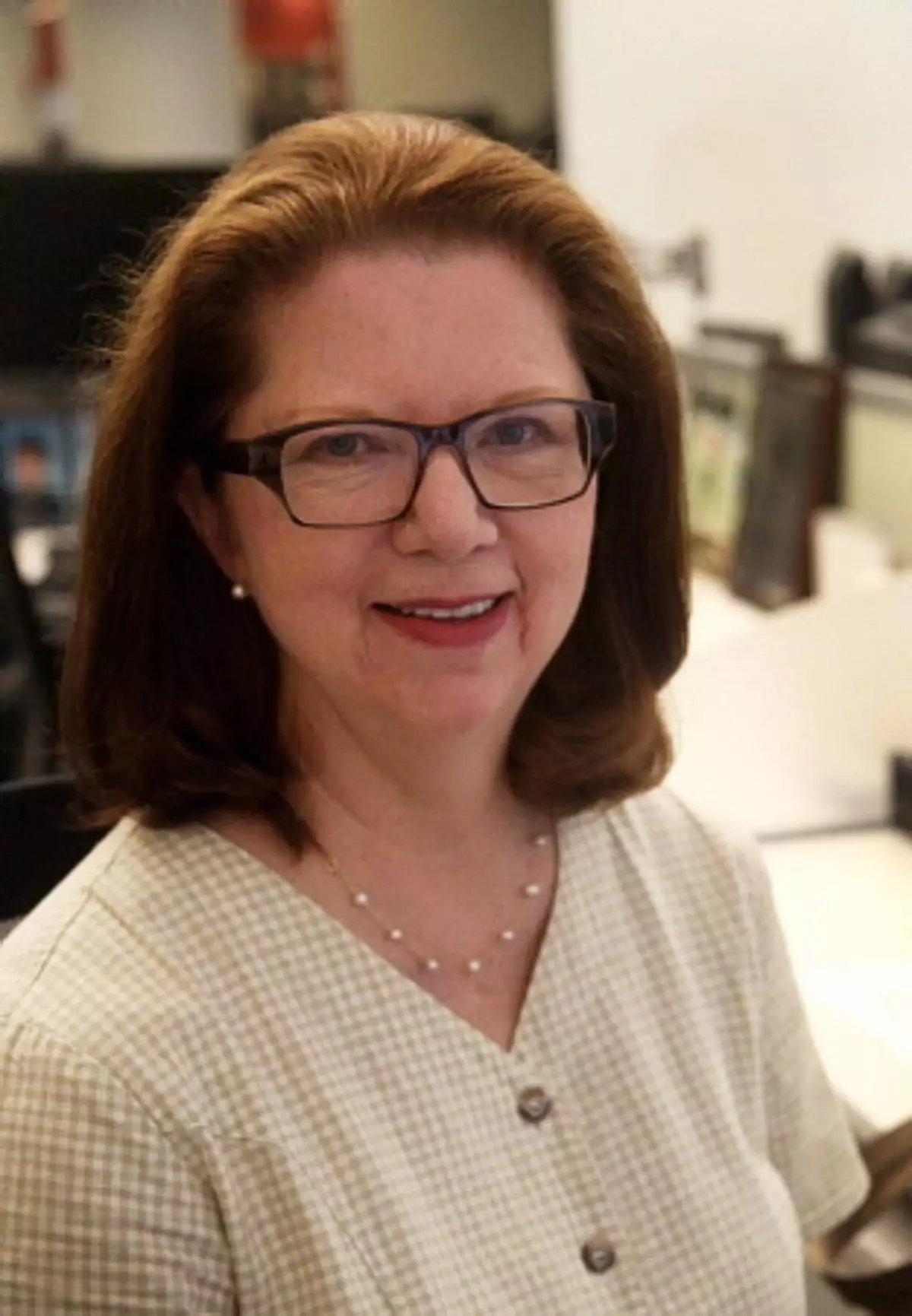
In this undated photo, Ellen Nimmons poses for a portrait. (AP Photo)