WASHINGTON (AP) — Kilmar Abrego Garcia, a Salvadoran national mistakenly deported as part of the Trump administration's immigration crackdown, is self-deporting to Spain on Tuesday, according to a person familiar with the matter.
Abrego Garcia's expected departure, which would come after months of legal wrangling over his case, could bring to a conclusion what has become a defining saga of the second Trump administration's mass deportations agenda.
Abrego Garcia was fighting against a second deportation to a series of African countries proposed by Department of Homeland Security officials. A judge told Abrego Garcia to self-deport on Tuesday, according to the person familiar with the matter, who spoke on condition of anonymity because they were not authorized to publicly discuss the case.
Maryland Sen. Chris Van Hollen, who met with Abrego Garcia while he was pressing for his release from a Salvadoran mega-prison, described Abrego Garcia as a “free man” and said he is traveling to a country of his choice.
“I am relieved that he will be safe, in a country of his choosing, and free – including from this Administration’s constant persecution,” he said in a statement.
Abrego Garcia's deportation in early 2025 came as the Trump administration was ramping up its immigration crackdown, promising to deport 1 million people annually. Through an infusion of billions of dollars approved by Congress, the administration later supercharged its immigration enforcement capabilities, increasing its cadre of immigration officers, expanding detention capabilities and pushing to deport an increasing number of people.
Attorneys who represented Abrego Garcia in both the Maryland immigration proceedings and his criminal case in Tennessee didn’t immediately respond to messages seeking comment. A spokesperson for We Are CASA, an advocacy group that has supported Abrego Garcia and his family, declined to comment.
“Our priority continues to be keeping the family safe,” said the spokesperson, Jossie Flor Sapunar.
DHS did not immediately respond to a request for comment.
The 31-year-old Abrego Garcia has an American wife and child and has lived in Maryland for years, but he immigrated to the U.S. illegally as a teenager. In 2019, an immigration judge ruled that he could not be deported to El Salvador because he faced danger there from a gang that had threatened his family. The judge allowed him to live and work in the U.S. under Immigration and Customs Enforcement supervision, but he was not given residency status.
He was arrested in Baltimore in March 2025 and deported to a Salvadoran prison in what an official later called an “administrative error.”
Facing public pressure and a court order, President Donald Trump’s administration brought him back in June 2025, but only after securing an indictment charging him with human smuggling in Tennessee. A federal judge dismissed that case in May, finding that the Justice Department’s pursuit of criminal charges was designed to punish Abrego Garcia for challenging his deportation. The government is appealing.
The Trump administration vowed to deport him to a third country, threatening to send him to Uganda, Eswatini, Ghana, and, most recently, Liberia.
Abrego Garcia had argued that if he were going to be deported, it should be to Costa Rica, which previously agreed to take him. But Todd Lyons, the former acting director of U.S. Immigration and Customs Enforcement, said in a March 2026 memo that deporting Abrego Garcia to Costa Rica would be “prejudicial to the United States.”
Abrego Garcia should be sent to Liberia because the U.S. has spent governmental resources and political capital in negotiating for it to accept third country nationals, Lyons wrote. The push for deportation to Liberia continued even after the U.S. signed an agreement with Costa Rica to accept deportees who cannot legally be returned to their home countries.
The case took an unusual turn Oct. 6, 2026, when, five minutes before a hearing expected to determine whether U.S. Immigration and Customs Enforcement could detain and deport Ábrego Garcia to the West African country of Liberia, attorneys for both sides left the courtroom, along with Abrego Garcia.
When they returned 15 minutes later, it was announced the hearing was canceled. The two sides then gathered for another 90 minutes before leaving the courthouse without explanation. Abrego Garcia’s attorney said only the court case was not ready to proceed and he instructed reporters to watch the docket to learn the status of the case.
Associated Press reporters Hallie Golden and Rebecca Santana contributed.
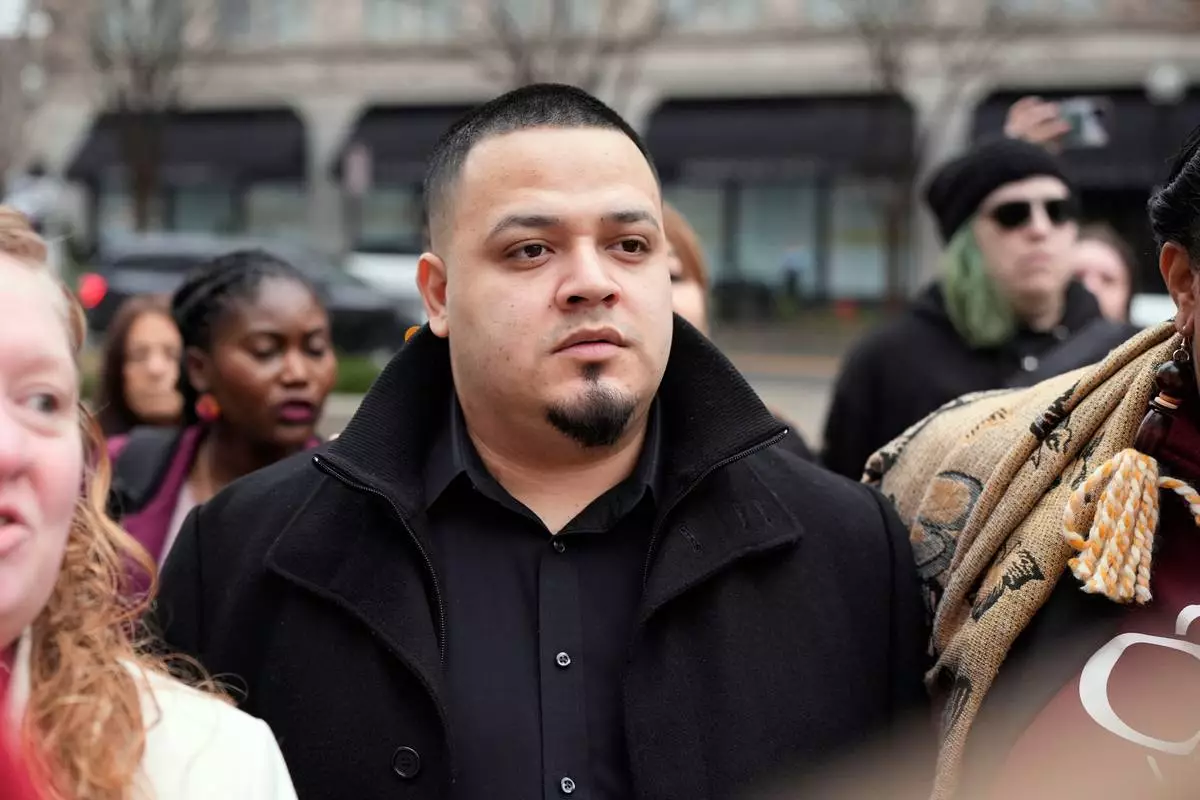
FILE - Kilmar Abrego Garcia arrives at the federal courthouse, Feb. 26, 2026, in Nashville, Tenn. (AP Photo/George Walker IV, File)
KILLEEN, Texas (AP) — Nidal Hasan, the Army soldier who fatally shot 13 people in the attack at the Texas Army post in 2009, told a federal court Tuesday that he plans to file a petition to delay his execution by firing squad.
In the filing, which was signed by Hasan himself, he says that he “intends to demonstrate that the military court’s judgment and his resulting sentence of death were obtained and are maintained in violation of his federal constitutional and statutory rights.”
Hasan was found guilty of multiple counts of murder and attempted murder related to those killed and the more than 30 who were wounded by gunfire in the attack.
This comes as military officials said Tuesday that three survivors of the shooting at Fort Hood will not be allowed to witness Hasan's execution.
On Nov. 10, the Army said the three cannot attend the execution scheduled for Dec. 3 because none of them was the direct victim of those charges, citing regulations governing military executions. An email sent Tuesday and shared with The Associated Press by recipients said military officials rejected their request for reconsideration, citing security and space issues.
The three argued that the Army should apply a broader definition of “victim” from the Uniform Code of Military Justice that says a victim can be someone who suffered “direct physical, emotional or pecuniary harm.” They argued that the military's refusal to allow them to attend was saying they had not been victims because they were not struck by bullets.
A previous plan to livestream the military execution, the first since 1961 and the first by firing squad since World War II, was rescinded after bipartisan backlash.
The letter signed by the commandant of Fort Leavenworth, the military prison where Hasan is being held, said the three cannot appeal again.
“Please understand that this is not meant as a judgment on any emotional injury you or others suffered as a result of CP Hasan’s crimes,” it said.
Retired Colonel Kathy Platoni, who would have been Hasan's supervisor during a planned deployment to Afghanistan, said the denial felt like a betrayal.
“I would desperately like to attend,” Platoni said from her home in Ohio. “To look Hasan in the eye and say, ‘You didn’t get me.'”
The Army noted in a statement that regulations specify who can witness a military execution, and reiterated the size and space restrictions.
“Efforts have been made over the years, from the trial to notifications to memorials and now to the execution, to recognize the impacts and support the victims,” the Army statement said.
Platoni said the survivors from her unit deployed to Afghanistan 29 days after the attack, because, “we still served our country, and if we didn’t, (Hasan) would have won.”
She said the building where Hasan initially opened fire had been crowded with returning soldiers and those preparing to deploy. She had been moved to another building when the attack began.
“The looks on the faces of my friends and colleagues as they carried in the dying and wounded that day … it will haunt me for the rest of my life,” she said.
She said they carried in the badly wounded captain who had rushed Hasan with a chair to try to stop the shooting.
“I was throwing computers to the ground trying to get the tablecloths because we needed blankets. We didn’t have medical supplies or even water,” she said. “I still have that blood-stained uniform, from kneeling down next to that young man, trying to get him to stay with us. That will be with me forever.”
Julia Wilson, who was nine months pregnant when Hasan opened fire, said her request to witness was also denied. She said the way the military has handled the case has caused her anguish.
“We have faced institutional betrayal after institutional betrayal,” Wilson said. “We remain on that battlefield because of that … if they don’t fix it we’re never going to leave that battlefield. We’ll never heal.”
Platoni had been on the list of victims and survivors kept by the military’s victim liaison since Hasan’s 2013 court marshal trial. Everyone on that list received notification in March that there had been movement in scheduling the execution, Platoni said.
Platoni said she did not think space was really the issue. The military told victims and survivors that about 160 witnesses would be allowed to attend the execution, and through her work with survivors and families of victims she believed about 90 people had decided to go. Platoni conceded that those details may have changed.
An Army official, who spoke on condition of anonymity to discuss sensitive plans, said that the military is not planning to release any details about the firing squad or protocols, including the number of service members involved.
Retired Major C. Alan Hopewell testified at Hasan's trial. He confirmed Hasan's identity after he was shot by two service members attempting to halt his rampage. One of those officers had asked Hopewell to accompany her to the execution.
He said Tuesday that he would accept the denial but with mixed feelings.
“I’m disappointed that our status as victims is not recognized,” Hopewell said. “A bullet missed me and hit my car. I guess if the bullet had hit me … they would consider me a victim and let me attend.”
Hopewell, Platoni and Wilson said that even after the execution they will continue to push for the Fort Hood shooting to be redefined as an act of domestic terrorism instead of workplace violence.
Hopewell recently underwent surgery unrelated to the shooting and said he's not certain his doctors would have cleared him to witness the execution. Nonetheless, he had hoped the Army would grant him the right.
“I guess it feels more like a duty, like a fulfillment of my responsibility to those soldiers who were killed and injured, who were threatened,” Hopewell said.
Lauer reported from Philadelphia. Associated Press reporter Konstantin Toropin in Washington, D.C., contributed.
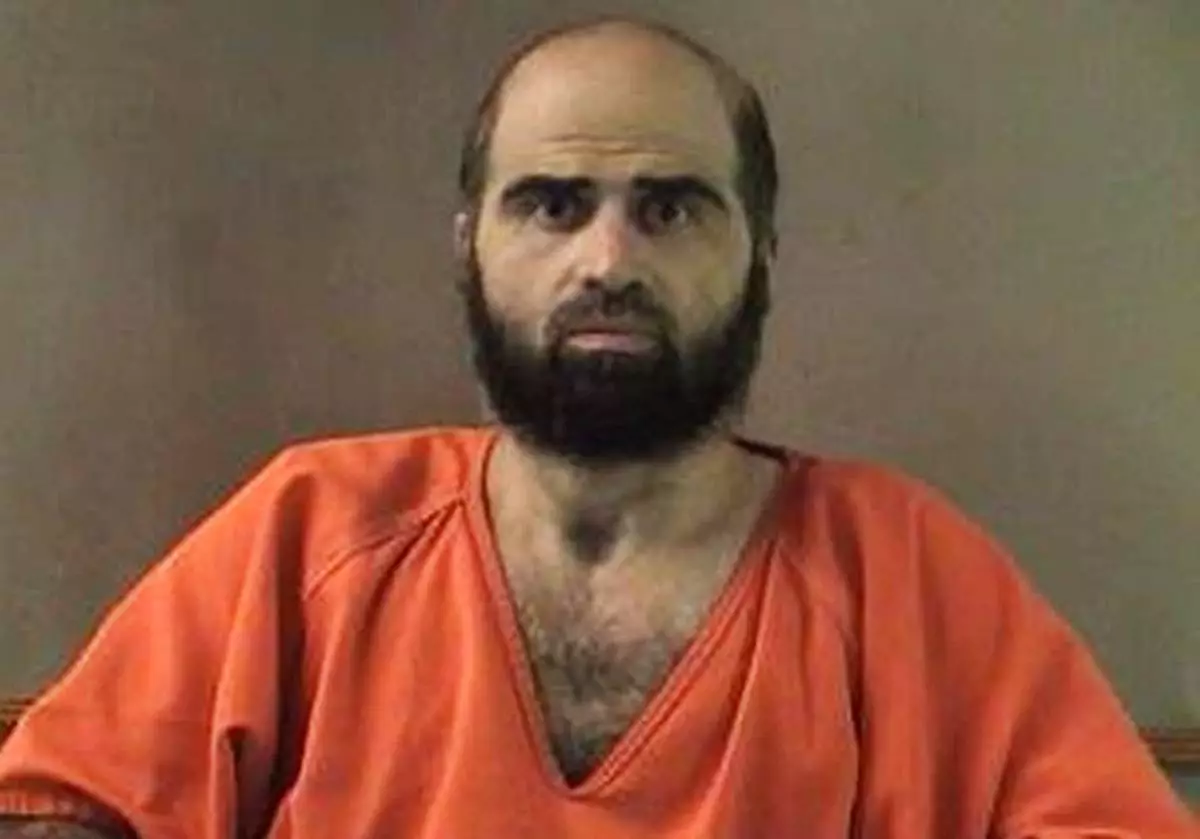
FILE - This undated photo provided by the Bell County Sheriff's Department shows former Army psychiatrist Maj. Nidal Hasan. (Bell County Sheriff's Department via AP, File)
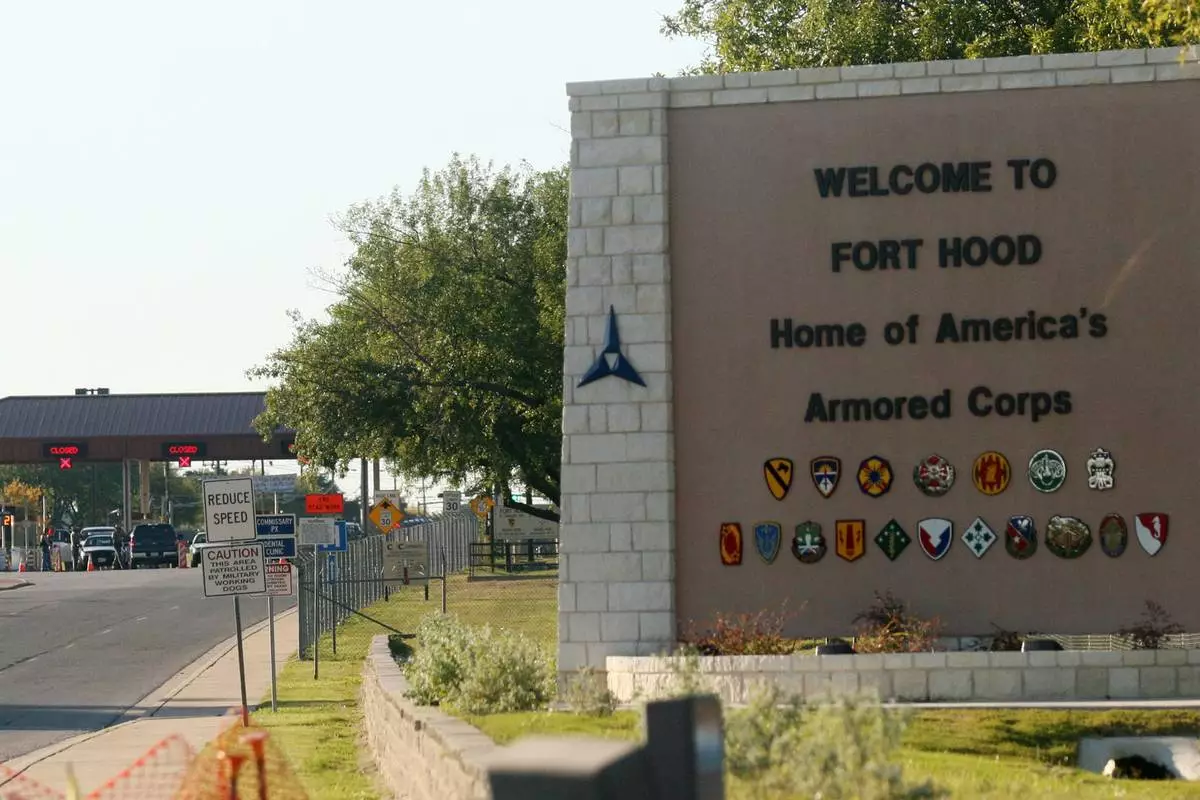
FILE - An entrance to Fort Hood Army Base is seen in Fort Hood, Texas, Nov. 5, 2009. (AP Photo/Jack Plunkett, File)