China's Shenzhou-24 crew lifted off from Jiuquan and joined the three Shenzhou-23 astronauts aboard the Tiangong space station on Wednesday, bringing the first foreign astronaut aboard the orbital outpost and setting the stage for scientific work in orbit.
Crowds had gathered before dawn at the Jiuquan Satellite Launch Center in northwest China to see off the Shenzhou-24 crew. When the ceremony began at 05:28 Beijing time, a band played "Ode to the Motherland," a staple of China's astronaut send-off ceremonies.
Shenzhou-24 astronauts Tang Hongbo, Wu Yi and Muhammad Zeeshan Ali of Pakistan reported to the mission commander and received the order to depart. The crowd took up the song as they headed for their vehicle. Escorted by a ceremonial motorcycle convoy, the crew traveled to the launch tower, singing "My Motherland and I" on the way.
At the foot of the tower, they made a pledge, "Our country and our people can rest assured. We will complete the mission and return safely. See you in Beijing!"
At around 06:00, Wu, Ali and Tang boarded Shenzhou-24 and completed their final preparations.
The countdown ended with the call: "Five, four, three, two, one. Ignition. Liftoff!" The Long March-2F Y24 rocket lifted off at 08:18.
About 10 minutes later, Shenzhou-24 separated from the rocket and entered its planned orbit. The astronauts were in good condition, and the launch was declared a success.
"The crew performed extremely well. During the pre-launch and ascent phases, they followed procedures closely in both their actions and callouts. They worked seamlessly as a team," said Wu Dawei, deputy chief designer of the astronaut system at the China Astronaut Research and Training Center.
The flight also marked the first use of a modified spacecraft, with changes to its instruments, layout and payload capacity.
"This is the third spacecraft in the new batch. We have made the instrument system more compact and optimized the layout. Its capacity to carry payloads to and from the space station has also been substantially increased," said Chen Tongxiang, a researcher at the China Academy of Space Technology.
Aboard Tiangong, Shenzhou-23 astronauts Zhu Yangzhu, Zhang Zhiyuan and Lai Ka-ying watched the launch live on a China Media Group (CMG) broadcast transmitted to the station.
At 11:56, Shenzhou-24 docked with the forward port of the station's Tianhe core module after a rendezvous and docking sequence lasting about three and a half hours.
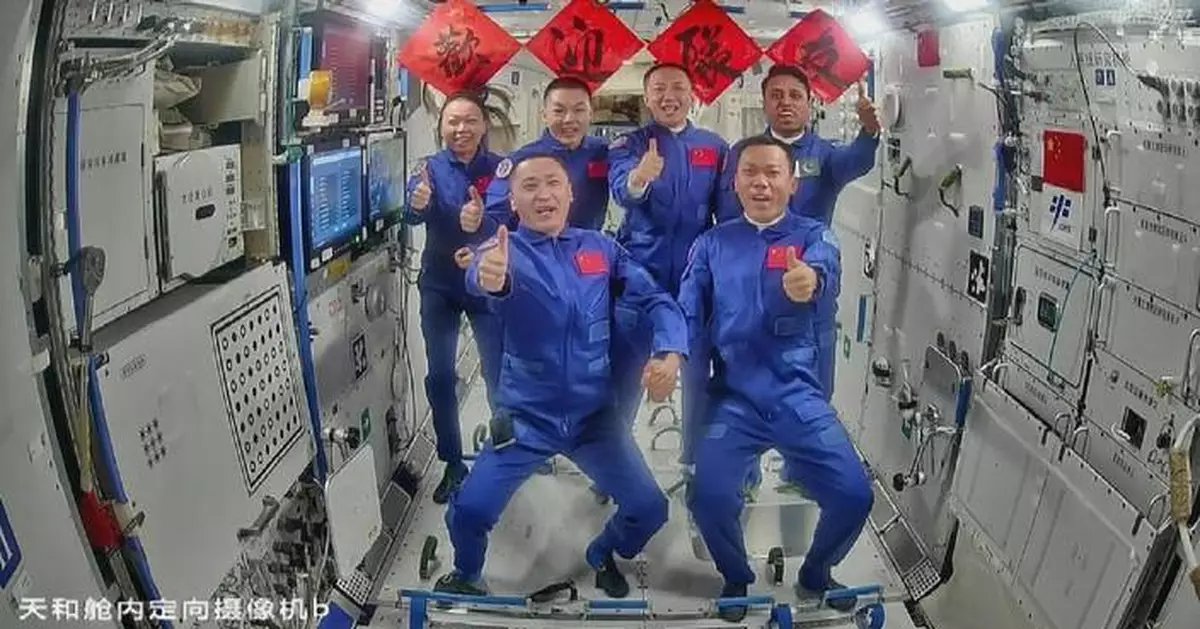
At 14:35, the Shenzhou-23 crew opened the hatch to welcome the three new arrivals. It was the ninth in-orbit crew rendezvous in China's spaceflight history. Ali became the first foreign astronaut to enter Tiangong, marking the first "space handshake" between Chinese and foreign astronauts aboard the station.
As the six astronauts gathered for a group photograph, they said, "China's space station is always worth looking forward to!"
Pakistan's ambassador to China, Syed Ali Asad Gillani, welcomed the milestone.
"This is a very historic moment in Pakistan. The entire Pakistani nation feels very proud. It feels thrilled. It feels very joyous. It feels very energized to look at this historic feat," Gillani said.
The Shenzhou-24 mission is scheduled to conduct 90 scientific experiments and technology tests in fields including space life sciences, materials science, microgravity fluid physics and combustion, fundamental physics, space medicine and new space technologies.
Alongside the crew's daily work, Ali is focusing on joint China-Pakistan space science experiments. His tasks include installing experimental samples and units, and conducting tests in orbit.
Following the joint mission, Ali is scheduled to return to Earth aboard the Shenzhou-23 spacecraft alongside two Shenzhou-23 crew members, while Tang and Wu will remain in orbit for roughly six months. Shenzhou-23 commander Zhu Yangzhu, who has already spent six months in orbit, will remain aboard Tiangong to complete an experiment focusing on the effects of a year-long stay in space.
"China's space station offers extensive resources for scientific experiments, stable operating capabilities, a mature transport system between Earth and space, and a comprehensive astronaut selection and training system. We are also carrying out China's lunar exploration program. We are willing to deepen cooperation with more countries and regions on joint astronaut selection and training and space science experiments, advancing space technology together for the benefit of all humanity," said Zhou Yaqiang, senior engineer and chief systems designer of the China Manned Space Agency.
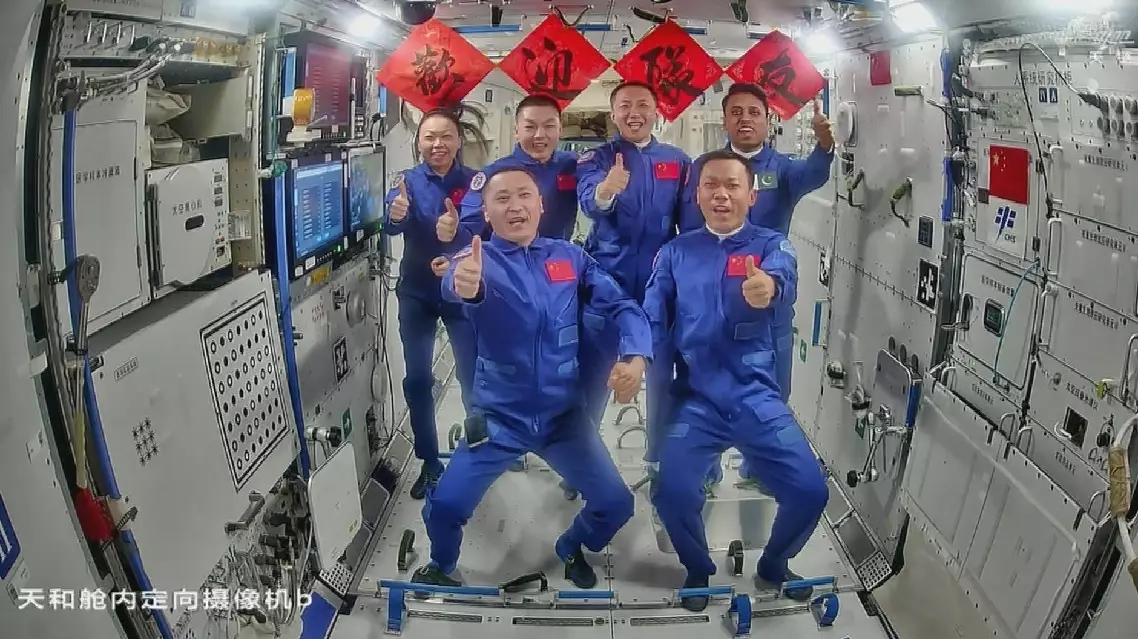
Shenzhou-24 crew boards Tiangong space station, bringing first foreign astronaut aboard