PwC’s Hong Kong Workforce Hopes and Fears Survey 2026 shows that nearly 70% of surveyed Hong Kong employees hold positive views on the impact artificial intelligence (AI) brings to the workplace. The survey suggests the finding points to growing confidence among local employees in AI amid accelerating AI adoption.

Photo source: reference image
In terms of usage, 70% of respondents used AI for work every week over the past 12 months, higher than the global average of 64%, and representing a 9‑percentage‑point rise from the 61% recorded in the 2025 survey. Generative AI (GenAI) has also gained wider traction: the share of Hong Kong employees using GenAI tools daily climbed from 22% in 2025 to 27% this year.
The survey also finds that AI adoption has delivered tangible improvements to work outcomes. Among respondents, 65% said AI helped enhance work quality; 56% reported it boosted creativity; 40% believed it increased their value to employers; and 38% noted it made day‑to‑day work more efficient.
Nevertheless, respondents generally perceived AI’s positive influence on job security, compensation, and overall efficiency to be relatively limited. The survey indicates enterprises still have room for improvement in further integrating AI and unlocking its full value.

Photo source: CGTN
Overall, 52% of surveyed employees said they had experienced more workplace changes over the past year, yet only around 35% held positive views about the effects of these organisational shifts. The survey urges companies to maintain clear communication with employees and deliver necessary support while pressing ahead with development shifts.
Against rapid workplace transformation, Hong Kong employees display markedly greater anxiety over job security compared with their peers elsewhere. 32% lack confidence in their job stability over the coming 12 months, well above the global average of 15% and the Asia‑Pacific average of 16%. Another 33% feel they are easily replaceable, versus 24% globally and 25% across Asia‑Pacific. Meanwhile, merely 42% of respondents considered the skills required for their roles hard to develop or master, lower than the global figure of 56% and the Asia‑Pacific reading of 58%.
Compensation and job security remain key considerations for Hong Kong employees. 69% ranked “pay and benefits” among their top‑three workplace priorities, followed by “job security” (48%) and “reasonable workload and work‑life balance” (41%). Despite these concerns, Hong Kong employees retain broadly positive perceptions of their current roles: 63% reported being satisfied with their jobs, while only 11% said they were very or highly likely to switch employers within the next 12 months.

Photo by Bastille Post
PwC’s Hong Kong Workforce Hopes and Fears Survey 2026 was conducted between May and June 2026. To access the full report, please visit: https://www.pwchk.com/en/services/consulting/people-and-organisation/publications/hopes-fears-hongkong-report-nov2026.html
PwC Hong Kong has today released two reports that provide comprehensive insights into consumer market dynamics in China. Strategic imperatives to advance category management and private brands emphasises the need for greater use of category management and private brands to develop China’s retail sector. Meanwhile, PwC’s Voice of the consumer 2025 global survey China report - The new Chinese consumer: food, health, and sustainability aims to guide retailers through intense competition and changing consumer behaviours.

AP Photo
A positive outlook despite a challenging retail market
Retailers in China are navigating a challenging landscape characterised by weak consumer sentiment and fierce price competition. Many are grappling with the transition from traditional brick-and-mortar operations to an omni-channel presence, while also seeking ways to significantly reduce their dependence on ‘slotting fee’ income models – where retailers charge brands for a particular physical or online location.
In these two reports, PwC has identified four key factors which will positively shape the future of China’s consumer market. Foremost is the rise of an upper middle-income population poised to fuel demand. According to EIU estimates, households with disposable annual income of over US$25,000 in China surged to 64 million in 2024 and are projected to nearly double in 2029. China ranks 2nd globally, with 26.8 million households (equivalent to 77 million individuals) with annual income surpassing US$35,000 in 2024, offering lucrative opportunities for premium and luxury brand operators. PwC expects greater demand for high-quality, differentiated food and non-food products and services going forward. At the same time, by 2029, with 33% of households earning US$10,000 annually or less, there are also opportunities for retailers to develop private brands for affordable and reasonable quality products.
The second factor is the rapid expansion of successful international and domestic grocery retailers, which signifies robust confidence in China’s consumer market. According to PwC’s report, these retailers have grasped the importance of category management and private brand development, setting an example for their peers to follow. Together they can unleash the spending potential of consumers by delivering products and services which excite them.
The third factor, according to PwC’s The new Chinese consumer: food, health, and sustainability, is that Chinese consumers surpass their global peers in embracing health, sustainability and international products, thus creating opportunities for new categories and products.
Lastly, the financial markets anticipate a strengthening of the Chinese Yuan by 2026. A stronger Yuan, coupled with a stabilised housing market, would boost consumer confidence and invigorate domestic consumption.
Huge potential to grow private brands and advance category management
Category management involves strategic decisions on supplier relations, pricing, assortment planning, merchandising and private brand management at a category level. This is becoming a strategic imperative for unlocking consumer power amid an economic slowdown, as it focuses on having the right product at the right price both online and offline, with improved assortment precision and data-driven pricing strategy at a category level.
A strong retailer-supplier relationship is necessary to develop a shared vision based on its category role (e.g. traffic, margin) and to co-develop innovations. PwC’s study of category management in China covers twelve grocery retailers with 159 stores in six cities. It looks at four product categories[1] and demonstrates that Chinese retailers trail their Western counterparts in category management maturity when it comes to robust manufacturer relationships; mature private brands; and the strategic use of “category captains.”
Increasing private brand penetration is a global strategic priority to improve financial performance and customer loyalty. Currently, private brand penetration in China, according to our study of the four categories, is at a modest 4.4%, indicating ample room for growth. US retailers, by comparison, have increased private brand sales by 23.6% over the past four years to US$271 billion, achieving a penetration rate of 20.7%. EU countries average 38%.
“Retailers in China have made tremendous progress during the last few decades. The next few years will call Chinese retailers to continue innovating in product development and in business practices to serve consumers better and improve business performance. They should also seek to adopt innovative practices that have worked for other retailers – in China and elsewhere. The future is very exciting.” Professor Ananth Raman, UPS Foundation Professor of Business Logistics, Co-Unit Head, Technology and Operations Management, Harvard Business School.
Understanding the new Chinese consumer
PwC is marking the 16th anniversary of its Voice of the consumer global survey, which covers 21,075 consumers across 28 countries and territories this year. The China report presents a comprehensive survey of consumer trends covering the Chinese Mainland and Hong Kong. These trends will shape the future of the food, health, and sustainability sectors across both markets.
This year’s findings are a blend of global trends with regional distinctions. The Mainland Chinese, Hong Kong and global respondents engage with GenAI, healthcare apps or wearables, and social media to a remarkably similar degree.
However, Chinese consumers prioritise products that offer nutritional benefits (34% Chinese Mainland vs 27% Global), meet diet-specific needs (23% Chinese Mainland vs 11% Global), or that are organic (25% Chinese Mainland vs 13% Global). They also turn their environmental consciousness into action more than their global peers. They actively seek information from different sources (including social media, product packaging and even retail store displays) on the company’s corporate sustainability credentials. They are also willing to pay a premium for sustainable food (63% Chinese Mainland vs 44% Global). While they embrace products made or produced in China, they are also receptive to quality imported goods. A successful retail strategy lies in the ability to source new products locally and globally and to co-create innovative products with manufacturers, emphasising environmental considerations.
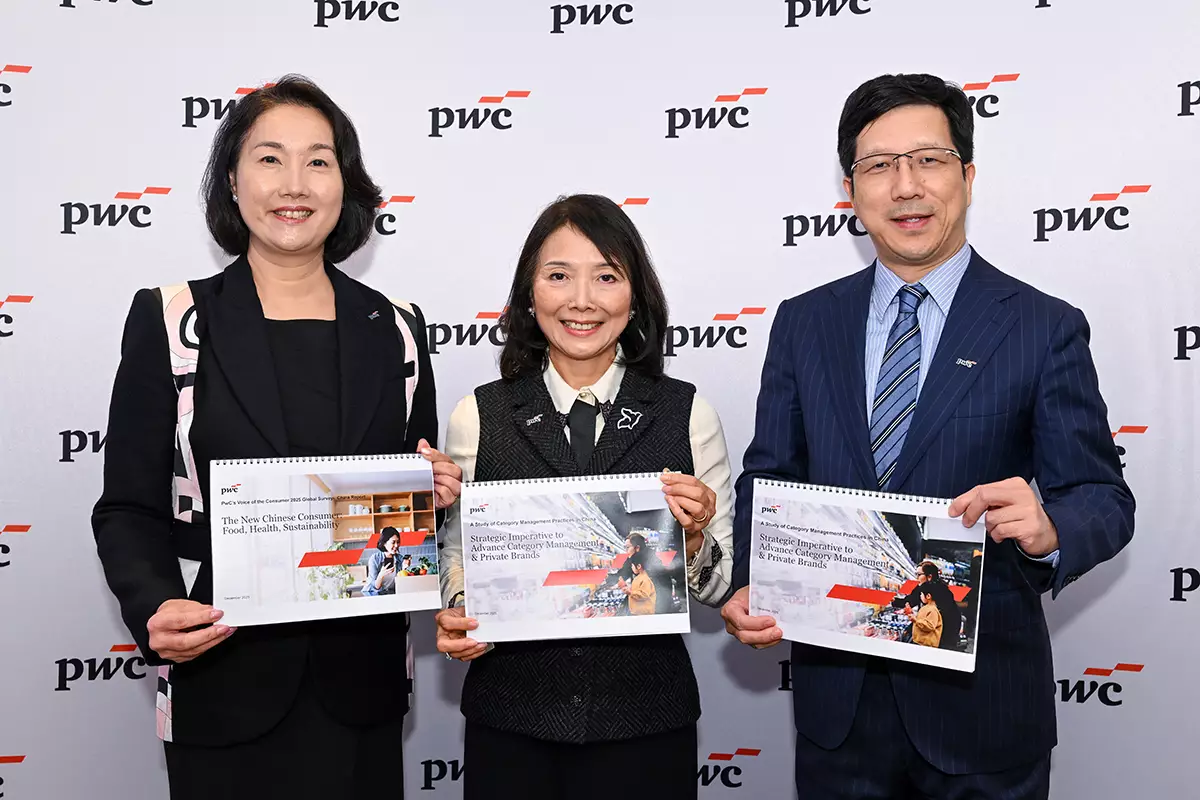
The team of PwC Hong Kong
PwC China Consumer Markets Industry Leader, Carrie Yu said, “China’s consumer market holds immense promise. There is a growing middle-income population with a focus on health and sustainability. Empowered by technology and AI, Chinese retailers can accelerate the development of category management and private brands. This requires a multi-year strategy and a joint effort between retailers and manufacturers.”
PwC China Consulting Markets Leader, Jasper Xu said: For Chinese retailers and their brand partners, turning data into a shared strategic category management asset is the critical bridge to closing maturity gaps – particularly in private brand expansion and collaborative innovation. By unifying data from a variety of POS, inventory, and customer behaviour data sources, category teams can shift from reactive decisions to proactive strategy - gaining clear visibility to strengthen retailer-supplier partnerships. This isn’t just one-sided data utility – it is about turning integrated insights into a mutual strategic asset: one that lets retailers unlock consumption potential amid economic slowdowns, and lets brand partners align innovation with real market needs, driving growth for both parties.”
PwC Hong Kong Consumer Markets Tax Leader, Jenny Tsao said, “China is vigorously boosting domestic consumption and foreign direct investments. The new tax incentive policy - tax credit for reinvestment of profits by foreign investors; the upcoming Hainan Free Trade Port island-wide independent customs operation; and the continuing enforcement of the tax incentive and opening-up policies in the cooperation zones of the Greater Bay Area - brings a lot of business opportunities and is welcomed by multi-national enterprises and the consumer markets. Meanwhile, businesses will enhance their internal tax controls to deal with challenges brought by the new policy of collection of information from online platform operators and tax compliance of e-commerce industry players; the tightened review of export VAT refund compliance; and the applicability to enjoy tax treaty benefit for dividends, interests and royalty payments. Corporations will review their investment structures, business models and tax management to meet the new obligations and achieve tax efficiency.”