BRUSSELS (AP) — European leaders have chosen the former head of Spain’s central bank, Pablo Hernández de Cos, to succeed Christine Lagarde as president of the European Central Bank as the key EU institution confronts inflation driven by the war in Iran and worries about high government debt and borrowing costs in Europe.
Leaders from the 21 European member countries that use the euro also filled two other top posts at the ECB, which decides borrowing costs for the 359 million people in the eurozone.
European Council President António Costa said on X that the body agreed on the three appointments at a summit in Brussels.
De Cos’ nomination still must pass review by the European Parliament and the ECB’s governing council, but those steps are formalities.
The appointment puts an experienced central banker with a reputation for backing lower interest rates and monetary stimulus in charge at a time when several European governments are struggling with heavy debt loads and rising borrowing costs. De Cos, 55, served on the ECB rate-setting council from 2018 to 2024 through his post as head of the Spanish central bank.
A review of his speeches by Commerzbank analysts “suggests that de Cos is among the monetary policy doves,” or policymakers who lean toward lower rates to support growth.
De Cos won out over another main contender for the post, former Netherlands central bank head Klaas Knot, who was regarded as a hawk, or someone who favors higher rates to ward off inflation.
In 2020, De Cos joined the council majority under Lagarde in backing 1.85 trillion euros ($2 trillion) in pandemic stimulus to keep rates low and support the economy during widespread closures and travel restrictions. De Cos praised the massive pandemic stimulus in a speech that year, saying it “has been clearly successful in curbing financial market deterioration in all euro area countries” as well as lowering borrowing costs for eurozone governments and corporations.
Commerzbank analyst Marco Wagner said that “especially against the backdrop of rising government debt in numerous countries ... many governments are likely to prefer a dovish ECB president.” France in particular is struggling with high debt and burdensome interest costs. However, with inflation at 4%, above the bank’s target of 2%, the bank could still raise rates at its Dec. 17 meeting presided over by Lagarde.
In some circumstances the ECB can intervene to lower borrowing costs for governments hit by market turmoil it views as unjustified, but analysts say the central bank is unlikely to bail out French politicians who can’t agree on how to reduce their deficit.
De Cos is currently general manager of the Bank for International Settlements, an international organization of central banks in Basel, Switzerland.
Lagarde, 70, said Oct. 30 that she would resign on Feb. 7, nine months before the end of her eight-year term. She has said she decided to resign early to be able to speak more freely about matters not related to monetary policy, but her resignation also enables EU leaders to choose a successor while pro-EU French President Emmanuel Macron is still in office and guards against the possibility that right-wing presidential candidate Marine Le Pen might win the election and influence the choice.
The eurozone leaders also filled two upcoming vacancies on the bank’s six-member executive board, which runs the bank’s day-to-day operations. They chose German economist Markus Brunnermeier, a professor at Princeton University, to replace Philip Lane, whose term ends in May. Lane held the influential post of chief economist, proposing rate moves for the full governing council to consider and decide upon.
They also chose Laurence Boone, head of corporate and investment banking in France for Spanish bank Santander, for a seat being vacated by Germany’s Isabel Schnabel, who is resigning in January.
The ECB sets interest benchmarks for the 21 countries that use the euro, influencing borrowing rates throughout the economy: everything from overnight loans between banks to credit cards, home mortgages and government bonds.
Lower rates can spur a slumping economy, while higher ones restrain inflation when it’s above the bank’s target of 2% annually.
The bank’s ability to act swiftly — in contrast to the often drawn-out negotiations among the 27 European Union national governments — has given it a leading role in combating Europe-wide crises such as the pandemic and the peak period of the eurozone’s debt crisis in 2010-12.
The president leads meetings of the bank’s rate-setting council at its headquarters in Frankfurt.
Lagarde is regarded as having steered a pragmatic middle course based on building consensus among the national bank heads who sit on the rate-setting council. She resisted being pigeonholed as a hawk or a dove, saying she was an “owl,” the bird associated with wisdom in Greek and Roman mythology.
McHugh reported from Frankfurt, Germany.
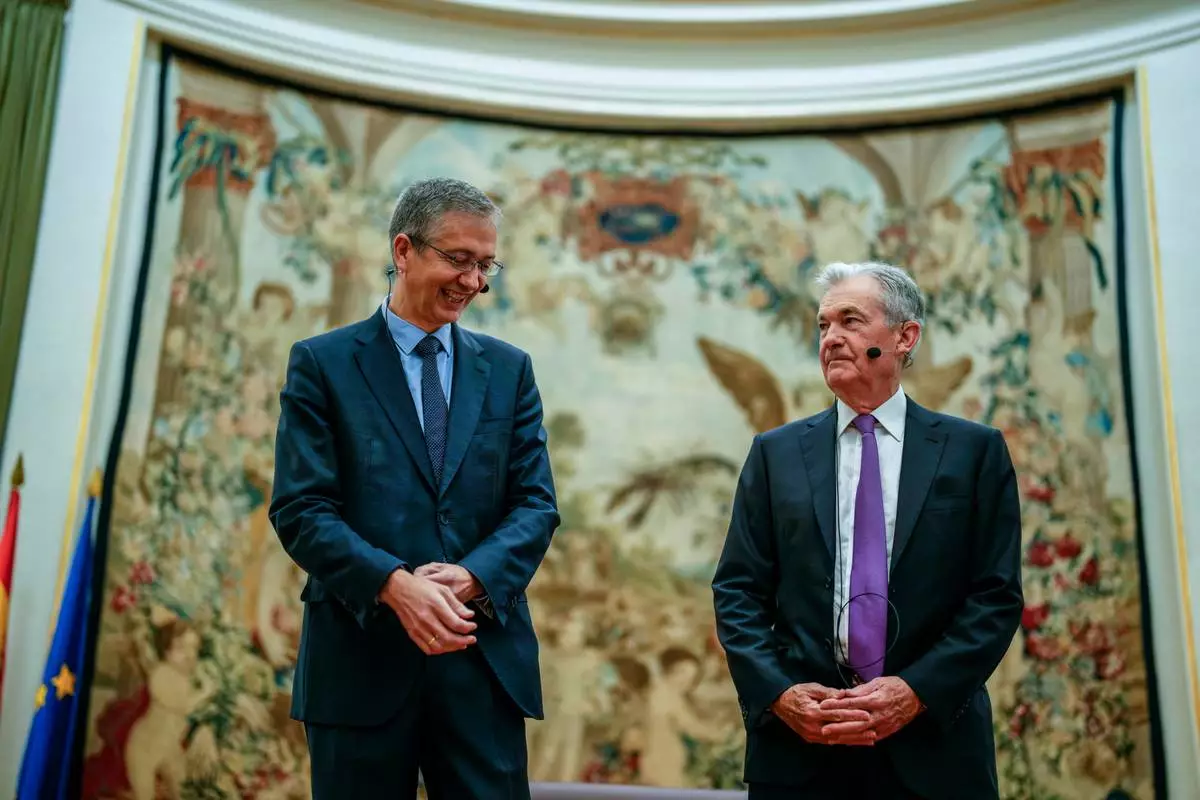
FILE - Federal Reserve Chairman Jerome Powell, right, and the former Governor of the Bank of Spain, Pablo Hernandez de Cos pose for a photo before a meeting at the Spain's Central Bank in Madrid, Spain, June 29, 2023. (AP Photo/Manu Fernandez, File)

FILE - Spain's Central Bank Governor Pablo Hernandez de Cos, right, listens during a news conference, as Constantinos Herodotou looks on, in Nicosia, Cyprus, Feb. 6, 2024. (AP Photo/Petros Karadjias, File)
BARCELONA, Spain (AP) — The campaign hymn blared through the meeting hall in Badalona, a working-class city on Barcelona's northern flank with a large immigrant population. Its lyrics set the tone for the rally of Spain’s far-right party.
Passionately sung by a husky baritone, the song “National Priority” depicts common Spaniards barely holding their own in a warlike struggle for their country — before the messianic cavalry arrives in the form of the Vox party and its bearded, barrel-chested leader, Santiago Abascal.
It reflects one of Vox’s key policy pledges: if empowered after Sunday's national election, the government will start prioritizing the needs of Spanish citizens over foreign residents and immigrants. Its other big pledge echoes what has already been put into effect in the U.S.: the expulsion of migrants.
The message resonated with attendees, who waved Spanish red-and-yellow and Vox’s green flags.
Pablo Guerrero, a 43-year-old and father of six who works in sales, said he was drawn to Vox for its unabashed defense of Spain’s Catholic roots. A young man applauding enthusiastically wore a soccer jersey of Spain’s star player, Lamine Yamal, himself a first-generation Spaniard born to immigrants from Africa.
“I started by getting past all the taboos that people associated with Vox,” Carla Sabater, a 25-year-old law student, told The Associated Press. “And when I really saw what its leaders were saying, I saw it was just like any other party to vote for, but one that could bring real change.”
For decades since the repression of Francisco Franco’s 20th-century dictatorship, Spaniards convinced of liberal democracy's benefits have kept far-right parties from government. But in recent years, anti-immigration populism across Europe and the U.S. has presented an alternative that started appealing to some in Spain, which has seen surges of migrants this year as the government granted amnesty to 1 million undocumented people. That leaves Vox with an opportunity to grab its share of power, shifting Spain's political paradigm.
Like Marine Le Pen’s National Rally that is aiming to take power in France’s election next year, Vox has transformed from a group with fringe appeal to garnering broader support over the past decade. The coming year will also feature elections in Italy, Greece and Poland.
Vox is banking on its hardline immigration stance to win over voters and enable it to play kingmaker for Spain’s traditional Popular Party conservatives. In exchange for backing PP leader Alberto Núñez Feijóo as Spain’s next prime minister, Vox would join a coalition government and push for a crackdown on migrants.
A PP-Vox government would “mean another step in the normalization of the far right across Europe,” Steven Forti, professor of political science at the Autonomous University of Barcelona, told the AP.
In Spain's 2023 election, incumbent Prime Minister Pedro Sánchez warned that Vox could enter government with the PP as a means to rally broad support. His playbook this time is similar.
“A government of the PP that includes Vox would not be just another government; it would mean an enormous step backwards. It would mean rolling back the clock 40, 50 years,” Sánchez said in a recent interview with El País.
The comment was a barely veiled reference to the last time an ultranationalist party was in power. Under Franco, political rivals were executed and persecuted, elections were eliminated and an almost theocratic conservative Catholic regime was enforced.
But bandying about Franco’s ghost holds ever less sway for younger voters, many of whom have only the faintest idea of life under that repressive regime, said political analyst Montserrat Nebrera, a former senior member of the PP in Catalonia.
“People have lost their fear of what Vox is capable of and, despite its proposals, they think it will stay within the bounds of the traditional democratic state,” Nebrera told the AP. “Whether that will prove to be true is another matter. But that is the idea that is percolating among voters: that it is not a big deal after all.”
Abascal has rejected the label “far right,” saying that the term is meant to denigrate Vox as well as the parties of Le Pen or Viktor Orbán in Hungary. He calls Vox’s positions those of “common sense.”
But political scientists agree that its policies put it to the right of traditional right-wing parties on the political spectrum, for example, in Vox’s refusal to support laws to protect women from gender violence. And while Abascal himself came from the PP, some other high-ranking Vox members came from the pro-Franco Falange party.
Sánchez is virtually alone among European leaders in defending migration as a means to grow the economy while culturally enriching the nation and upholding universal human rights. Last week five European countries, including center-right Germany and the Socialist-led Denmark, announced an agreement to send migrants to Rwanda.
Vox has pounced on migratory crises afflicting Spain’s borders. Abascal has called the crossing of tens of thousands of mostly young Moroccans into Spain’s north African exclave of Ceuta in July an “invasion." He kicked off his campaign in the Canary Islands, which have seen a surge in arrivals of people, mostly from Senegal, by boat this month.
While Spain’s business community and Catholic bishops backed Sánchez’s amnesty program, Abascal slammed it as encouraging more people to come. Some voters saw the subsequent surges of migrants to Ceuta and the Canary Islands as validation of his claim.
At the rally, the public had turned out to hear Vox’s new star and ideologue, Carlos Hernández Quero. The young historian breaks with Vox’s tailored, macho aesthetic: he is skinny and sports an earring and a scruffy beard and hairdo. He spent half an hour arguing that the arrival of millions of migrants has harmed the job prospects of Spain’s working class, soaking up welfare benefits and driving up demand for housing.
“The Left has become public enemy number one because it has destroyed public services that are supposed to help those who most need them. It has all been ruined,” Hernández Quero said. “And that is because immigration has undermined our welfare system.”
Sánchez is counting on worries over housing costs to override immigration concerns at the ballot box. He has also warned that Vox will take aim at progressive abortion and euthanasia laws as well as green energy policies.
David Paredes, a member of Sánchez's Socialist party, told the AP that “people aren’t talking about immigration” when he canvassed for votes in Barcelona. He said they appreciate that foreigners help fill jobs in healthcare and sectors like construction that benefit everyone.
Spain's leader since 2018, Sánchez boasts that he has overseen Europe's fastest growing economy while increasing the minimum wage. But many voters haven't felt the benefits amid a cost-of-living crunch, and some seem willing to give Vox a shot.
“We must put people from here first, before people who come from elsewhere,” said Jenny Rodríguez, a 34-year-old shop clerk attending the rally. “And then we want immigration to be brought under control.”

Far-right Vox party supporters waves Spanish flags during an electoral rally in Madrid, Friday, Nov. 13, 2026, on the first day of the campaign ahead of general elections. (AP Photo/Francisco Seco)

Far-right Vox party supporters wave Spanish flags during an electoral rally in Madrid, Friday, Nov. 13, 2026, on the first day of the campaign ahead of general elections. (AP Photo/Francisco Seco)

A far-right Vox party supporter wears a t-shirt with the photograph of Spain's Prime Minister and Socialist Party Secretary-General Pedro Sanchez that reads: "Traitor. Go away!" prior an electoral rally in Madrid, Friday, Nov. 13, 2026, on the first day of the campaign ahead of general elections. (AP Photo/Francisco Seco)

A far-right Vox party supporter holds a smartphone with the photo of the party's leader Santiago Abascal during an electoral rally in Madrid, Friday, Nov. 13, 2026, on the first day of the campaign ahead of general elections. (AP Photo/Francisco Seco)

Santiago Abascal, leader of the far-right Vox party, arrives to an electoral rally in Madrid, Friday, Nov. 13, 2026, on the first day of the campaign ahead of general elections. (AP Photo/Francisco Seco)