BARCELONA, Spain (AP) — The campaign hymn blared through the meeting hall in Badalona, a working-class city on Barcelona's northern flank with a large immigrant population. Its lyrics set the tone for the rally of Spain’s far-right party.
Passionately sung by a husky baritone, the song “National Priority” depicts common Spaniards barely holding their own in a warlike struggle for their country — before the messianic cavalry arrives in the form of the Vox party and its bearded, barrel-chested leader, Santiago Abascal.
Click to Gallery

Far-right Vox party supporters waves Spanish flags during an electoral rally in Madrid, Friday, Nov. 13, 2026, on the first day of the campaign ahead of general elections. (AP Photo/Francisco Seco)

Far-right Vox party supporters wave Spanish flags during an electoral rally in Madrid, Friday, Nov. 13, 2026, on the first day of the campaign ahead of general elections. (AP Photo/Francisco Seco)
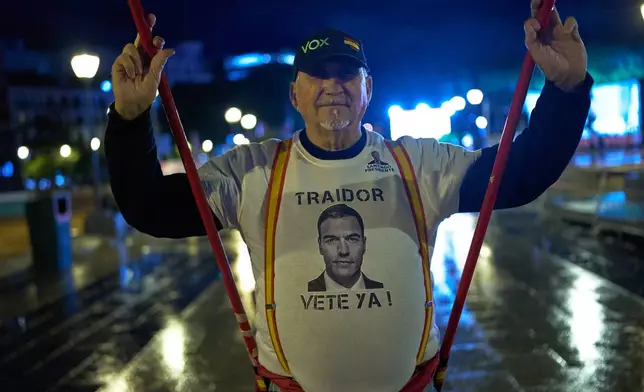
A far-right Vox party supporter wears a t-shirt with the photograph of Spain's Prime Minister and Socialist Party Secretary-General Pedro Sanchez that reads: "Traitor. Go away!" prior an electoral rally in Madrid, Friday, Nov. 13, 2026, on the first day of the campaign ahead of general elections. (AP Photo/Francisco Seco)

A far-right Vox party supporter holds a smartphone with the photo of the party's leader Santiago Abascal during an electoral rally in Madrid, Friday, Nov. 13, 2026, on the first day of the campaign ahead of general elections. (AP Photo/Francisco Seco)

Santiago Abascal, leader of the far-right Vox party, arrives to an electoral rally in Madrid, Friday, Nov. 13, 2026, on the first day of the campaign ahead of general elections. (AP Photo/Francisco Seco)
It reflects one of Vox’s key policy pledges: if empowered after Sunday's national election, the government will start prioritizing the needs of Spanish citizens over foreign residents and immigrants. Its other big pledge echoes what has already been put into effect in the U.S.: the expulsion of migrants.
The message resonated with attendees, who waved Spanish red-and-yellow and Vox’s green flags.
Pablo Guerrero, a 43-year-old and father of six who works in sales, said he was drawn to Vox for its unabashed defense of Spain’s Catholic roots. A young man applauding enthusiastically wore a soccer jersey of Spain’s star player, Lamine Yamal, himself a first-generation Spaniard born to immigrants from Africa.
“I started by getting past all the taboos that people associated with Vox,” Carla Sabater, a 25-year-old law student, told The Associated Press. “And when I really saw what its leaders were saying, I saw it was just like any other party to vote for, but one that could bring real change.”
For decades since the repression of Francisco Franco’s 20th-century dictatorship, Spaniards convinced of liberal democracy's benefits have kept far-right parties from government. But in recent years, anti-immigration populism across Europe and the U.S. has presented an alternative that started appealing to some in Spain, which has seen surges of migrants this year as the government granted amnesty to 1 million undocumented people. That leaves Vox with an opportunity to grab its share of power, shifting Spain's political paradigm.
Like Marine Le Pen’s National Rally that is aiming to take power in France’s election next year, Vox has transformed from a group with fringe appeal to garnering broader support over the past decade. The coming year will also feature elections in Italy, Greece and Poland.
Vox is banking on its hardline immigration stance to win over voters and enable it to play kingmaker for Spain’s traditional Popular Party conservatives. In exchange for backing PP leader Alberto Núñez Feijóo as Spain’s next prime minister, Vox would join a coalition government and push for a crackdown on migrants.
A PP-Vox government would “mean another step in the normalization of the far right across Europe,” Steven Forti, professor of political science at Autonomous University of Barcelona, told the AP.
In Spain's 2023 election, incumbent Prime Minister Pedro Sánchez warned that Vox could enter government with the PP as a means to rally broad support. His playbook this time is similar.
“A government of the PP that includes Vox would not be just another government; it would mean an enormous step backwards. It would mean rolling back the clock 40, 50 years,” Sánchez said in a recent interview with El País.
The comment was a barely-veiled reference to the last time an ultranationalist party was in power. Under Franco, political rivals were executed and persecuted, elections were eliminated and an almost theocratic conservative Catholic regime was enforced.
But bandying about Franco’s ghost holds ever less sway for younger voters, many of whom have only the faintest idea of life under that repressive regime, said political analyst Montserrat Nebrera, a former senior member of the PP in Catalonia.
“People have lost their fear of what Vox is capable of and, despite its proposals, they think it will stay within the bounds of the traditional democratic state,” Nebrera told the AP. “Whether that will prove to be true is another matter. But that is the idea that is percolating among voters: that it is not a big deal after all.”
Sánchez is virtually alone among European leaders in defending migration as a means to grow the economy while culturally enriching the nation and upholding universal human rights. Last week five European countries, including center-right Germany and the Socialist-led Denmark, announced an agreement to send migrants to Rwanda.
Vox has pounced on migratory crises afflicting Spain’s borders. Abascal has called the crossing of tens of thousands of mostly young Moroccan into Spain’s north Africa exclave of Ceuta in July an “invasion." He kicked off his campaign in the Canary Islands, which have seen a surge in arrivals of people, mostly from Senegal, by boat this month.
While Spain’s business community and Catholic bishops backed Sanchez’s amnesty program, Abascal slammed it as encouraging more people to come. Some voters saw the subsequent surges of migrants to Ceuta and the Canary Islands as validation of his claim.
At the rally, the public had turned out to hear Vox’s new star and ideologue, Carlos Hernández Quero. The young historian breaks with Vox’s tailored, macho aesthetic: he is skinny and sports an earring and a scruffy beard and hairdo. He spent half an hour arguing that the arrival of millions of migrants has harmed the prospects of Spain’s working-class jobs, soaking up welfare benefits and driving up demand for housing.
“The Left has become public enemy number one because it has destroyed public services that are supposed to help those who most need them. It has all been ruined,” Hernández Quero said. “And that is because immigration has undermined our welfare system.”
Sánchez is counting on worries over housing costs to override immigration concerns at the ballot box. He has also warned that Vox will take aim at progressive abortion and euthanasia laws as well as green energy policies.
David Paredes, a member of Sánchez's Socialist party, told the AP that “people aren’t talking about immigration” when he canvassed for votes in Barcelona. He said they appreciate that foreigners help fill jobs in healthcare and sectors like construction that benefit everyone.
Spain's leader since 2018, Sánchez boasts that he has overseen Europe's fastest growing economy while increasing the minimum wage. But many voters haven't felt the benefits amid a cost-of-living crunch, and some seem willing to give Vox a shot.
“We must put people from here first, before people who come from elsewhere,” said Jenny Rodríguez, a 34-year-old shop clerk attending the rally. “And then we want immigration to be brought under control.”

Far-right Vox party supporters waves Spanish flags during an electoral rally in Madrid, Friday, Nov. 13, 2026, on the first day of the campaign ahead of general elections. (AP Photo/Francisco Seco)

Far-right Vox party supporters wave Spanish flags during an electoral rally in Madrid, Friday, Nov. 13, 2026, on the first day of the campaign ahead of general elections. (AP Photo/Francisco Seco)
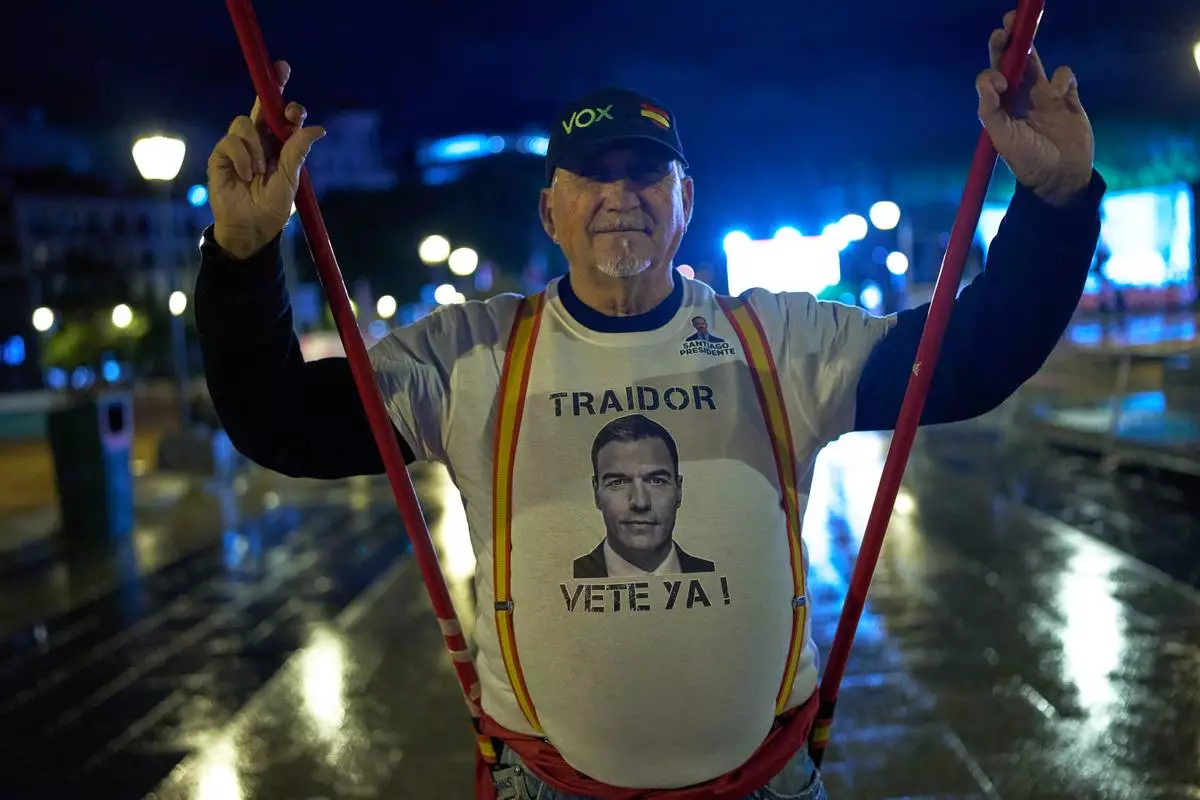
A far-right Vox party supporter wears a t-shirt with the photograph of Spain's Prime Minister and Socialist Party Secretary-General Pedro Sanchez that reads: "Traitor. Go away!" prior an electoral rally in Madrid, Friday, Nov. 13, 2026, on the first day of the campaign ahead of general elections. (AP Photo/Francisco Seco)

A far-right Vox party supporter holds a smartphone with the photo of the party's leader Santiago Abascal during an electoral rally in Madrid, Friday, Nov. 13, 2026, on the first day of the campaign ahead of general elections. (AP Photo/Francisco Seco)

Santiago Abascal, leader of the far-right Vox party, arrives to an electoral rally in Madrid, Friday, Nov. 13, 2026, on the first day of the campaign ahead of general elections. (AP Photo/Francisco Seco)