SHANGHAI--(BUSINESS WIRE)--Nov 27, 2026--
Robbyant, an embodied AI company within Ant Group, today announced the open-source release of LingBot-Map 2.0, a streaming 3D reconstruction model, and LingBot-Navi, a spatial-memory navigation model. Designed to solve long-distance mapping drift and cross-task amnesia, the models allow robots to build maps on the move, self-calibrate in real time, and navigate complex physical environments with increasing efficiency.
This press release features multimedia. View the full release here: https://www.businesswire.com/news/home/20261126690702/en/
Autonomous mobility is essential for physical AI, from warehouse logistics to last-mile delivery. Yet current systems face two major bottlenecks: long-distance mapping accumulates drift that external correction tools fail to feed back into the model's internal memory, and isolated navigation models force robots to re-explore familiar spaces from scratch for every new task.
LingBot-Map 2.0: Correcting Internal Memory, Not Just Output Trajectories
Building on LingBot-Map 1.0 (released in April 2026), LingBot-Map 2.0 introduces native internal error correction during inference, eliminating the reliance on external place-recognition modules or pose-graph optimization backends.
Powered by Geometric Context Reshaping (GCR), a mechanism inspired by memory reconsolidation in the human brain, the model reuses extracted local geometry and realigns high-level historical memory without re-encoding images. Because GCR updates the model's internal memory layer rather than merely adjusting output trajectories, every correction anchors a reliable spatial reference for future movement. Performance is further bolstered by LingBot-Vision, Robbyant’s visual foundation model, which provides sub-pixel boundary detection to minimize geometric errors at the source.
Key Benchmark Highlights:
LingBot-Navi: Accelerating Task Efficiency with Reusable Spatial Memory
Built on LingBot-Map 2.0’s 3D perception, LingBot-Navi introduces persistent spatial memory that carries over between missions. Instead of wiping its map after completing an action, the model retains object and location data, retrieving relevant context when given a natural language command to plan direct routes without redundant exploration.
With every operation, LingBot-Navi refines robots’ understanding of the environment, steadily increasing execution speed. It also supports on-device deployment, keeping user commands and scene data local for low latency and data privacy.
Key Benchmark Highlights:
Together, LingBot-Map 2.0 and LingBot-Navi strengthen the capabilities of Robbyant’s universal embodied AI brain — from spatial perception to efficient navigation.
Technical reports, related code, the Pure Streaming model weights for LingBot-Map 2.0, the model weights for LingBot-Navi, and a dataset covering 511 real-world captured scenes are now fully open-sourced to support further community research:
Project page: https://technology.robbyant.com/lingbot-map-v2
GitHub: https://github.com/Robbyant/lingbot-map-v2
Hugging Face: https://huggingface.co/collections/robbyant/lingbot-map-v2
Project page: https://technology.robbyant.com/lingbot-navi
GitHub: https://github.com/Robbyant/lingbot-navi
Hugging Face: https://huggingface.co/robbyant/lingbot-navi
Dataset: https://huggingface.co/datasets/robbyant/LingBot-Navi
About Robbyant
Robbyant is an embodied intelligence company within Ant Group, dedicated to advancing embodied intelligence through cutting-edge software and hardware technologies. Robbyant independently develops foundational large models for embodied AI and actively explores next-generation intelligent devices, aiming to create robotic companions and caregivers that truly understand and enhance people’s everyday lives and deliver reliable intelligent services across key use cases, such as elderly care, medical assistance, and household tasks.
To learn more about Robbyant, please visit: www.robbyant.com
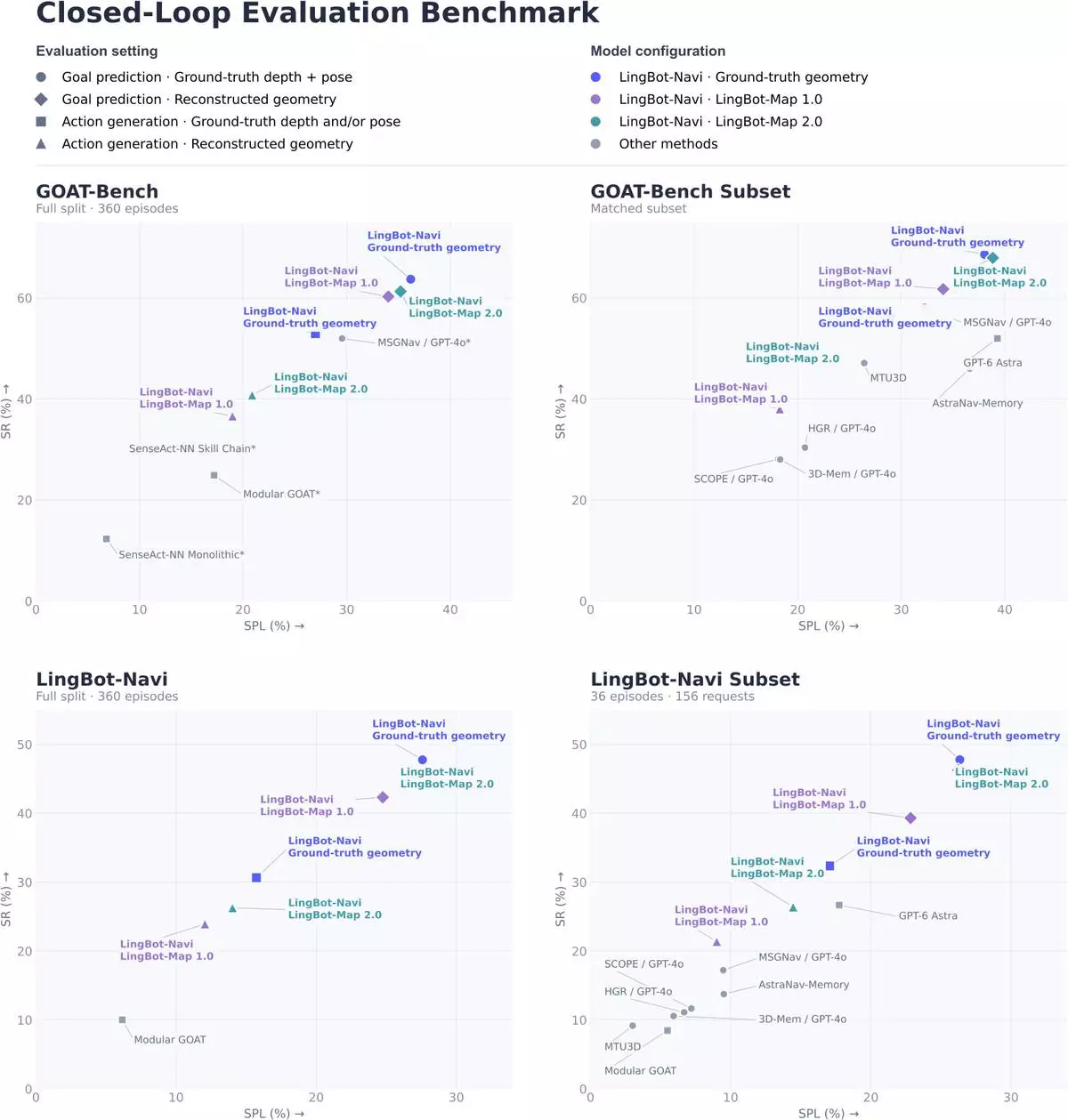
LingBot-Navi with LingBot-Map 2.0 achieves the best navigation performance in closed-loop simulation tests on both the GOAT-Bench public benchmark and Robbyant’s proprietary evaluation dataset.
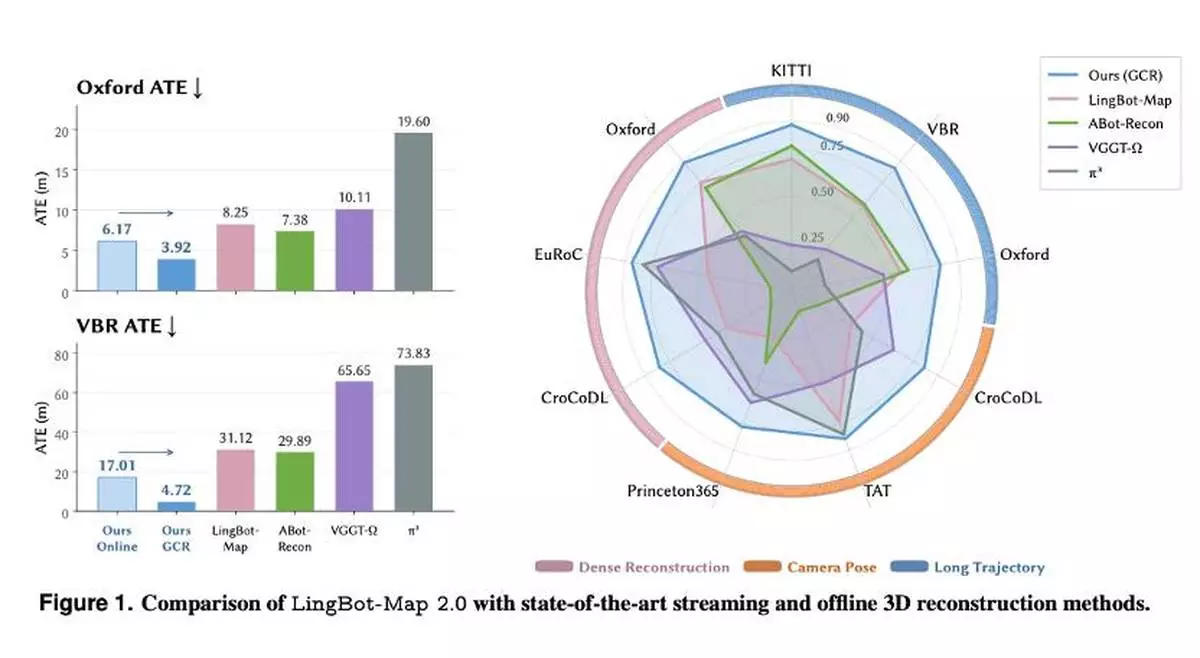
LingBot-Map 2.0 achieves leading performance in the VBR long-trajectory error test and across nine public benchmark evaluations.