SAN JUAN, Puerto Rico (AP) — Leaders on the tiny Caribbean island of Nevis are mulling a $1 billion deal recently made public that would award a private developer nearly 12% of the country’s territory, a proposal that has sparked intense debate on an island best known as Alexander Hamilton's birthplace.
Opponents fear land seizures and environmental violations under what some have described as a “neocolonial system.” Supporters say it would boost a frail economy as St. Kitts and Nevis winds down a citizenship-by-investment program under EU pressure that has generated some $2.5 billion tax-free for the government over more than a decade.
Established in 1984, it is believed to be the world's first such program. Nearly half of last year's budget depended on such revenue. At one point, the program represented more than 25% of the twin-island nation's gross domestic product, Nevis Premier Mark Brantley told The Associated Press on Sunday.
“It will be difficult to replace that overnight,” he said. “Every country in the world is seeking foreign investment, even the great United States of America.”
His solution? A Bitcoin tycoon from Belgium who envisions a semiautonomous utopia along Nevis’ southern coast, à la Monaco or Dubai.
The proposed special economic zone, a first for the Caribbean, represents some 2,670 acres (1,080 hectares) in southern Nevis and would be run by Destiny International Ltd. and South Nevis Ltd. The territory would be tax-free and have its own civil code, although it would still fall under St. Kitts and Nevis' Constitution and local laws regarding citizenship, justice, immigration and other sectors. The proposed deal states that public access to beaches, waters and heritage sites would be guaranteed.
If approved, the special sustainability zone would have its own security and a ”Code of Destiny” for civil matters and criminal procedures. Property owners could propose changes, and a Nevis official would ensure environmental standards are being met.
Critics of the proposed deal say they are upset the bill authorizing the zone was approved last year without public hearings, although Brantley asserted the approval process was no different from that of other bills.
He also noted that his administration is the first since Nevis became independent to publicly release a proposed deal with developers.
“We have put all 222 pages of the proposed agreement into the public domain,” Brantley said. “People are debating and pulling it apart … but the very ability to do so is a result of the transparency we have exercised.”
On Friday, Destiny announced that it had reached “broad agreement” with St. Kitts and Nevis officials regarding the deal and Nevis legislators are scheduled to debate it on Monday ahead of public consultations.
The company said it has signed letters of intent with four five-star hotels.
“Citizens of St Kitts and Nevis will have first priority for jobs, from construction to hospitality, and local businesses will have opportunities to supply goods and services,” the company said.
Skidmore, Owings & Merrill is the architectural firm tasked with the proposed development. It has designed buildings including the Burj Khalifa and One World Trade Center.
The government has stressed that any land deal would be voluntary, but some Nevisians say they already have been offered deals for property not for sale, and that they have not been able to obtain documents from the Land Registry for land on which they live. Brantley, the premier, said that if people are having issues, they should contact an attorney, stressing that the Land Registry has documents on all titled land, and that the government “has not sold one single square inch” of land to developers. All land transactions, he said, would be private and voluntary.
The two companies, known collectively as Destiny, are required to invest $250 million in the first five-and-a-half years, with $50 million due to the Nevis Island Administration by 2031. The first $10 million would go toward expanding and renovating the island’s hospital.
Destiny has pledged 10% of net profits to the Nevis government and another 10% to a jointly managed account, although details on who would manage the development fund and determine how the funds would be used have not been decided, Brantley said.
The Nevis government also would receive $10,000 for every new home sold, and 5% of net profits stemming from the zone would be paid directly to Nevisians. Brantley said the specifics of that plan are still being worked out.
In addition, Nevis would receive $1 million a year in scholarship money for students to study abroad. Recipients would have to return and work in Nevis for at least five years.
Olivier Janssens, the founder of Destiny, told AP on Sunday that he plans to give $100 a month to each Nevisian until the development becomes profitable, at which point the proposed 5% in revenue for Nevisians would kick in, and that he is working with the government to help lower residential power bills.
If the deal is approved, the government also would lease 2,141 acres (866 hectares) of seabed area for a marina, with the developers pledging a coral restoration project.
Last year, before details of the deal were made public, former St. Kitts and Nevis Prime Minister Timothy Harris called the proposal a “colossal betrayal of the people” and accused the government of creating the legislation “in secrecy and for the self-interests of those held captive by foreign elements.”
He also described the proposed deal as “repulsive, repugnant and retrogressive.”
Meanwhile, InvestCaricom said in a statement in August that while zones and incentive regimes have previously worked in the Caribbean, “they have also failed, repeatedly, and the failure modes are consistent.”
Scale mismatch is one example it cited, saying very small islands have limited quantities of tenants, workers, power and freight.
Critics also note that such a development would strain the island’s resources, with Nevis imposing several water-rationing measures in the past decade as droughts in the region persist.
Janssens noted that 70% of energy has to come from renewable power and that developers plan to collect rainwater and invest in reservoirs.
“No project is perfect,” Brantley said. “If not Destiny, then what? ... What do you suggest in terms of diversification, economic expansion and development of our little island of Nevis?"
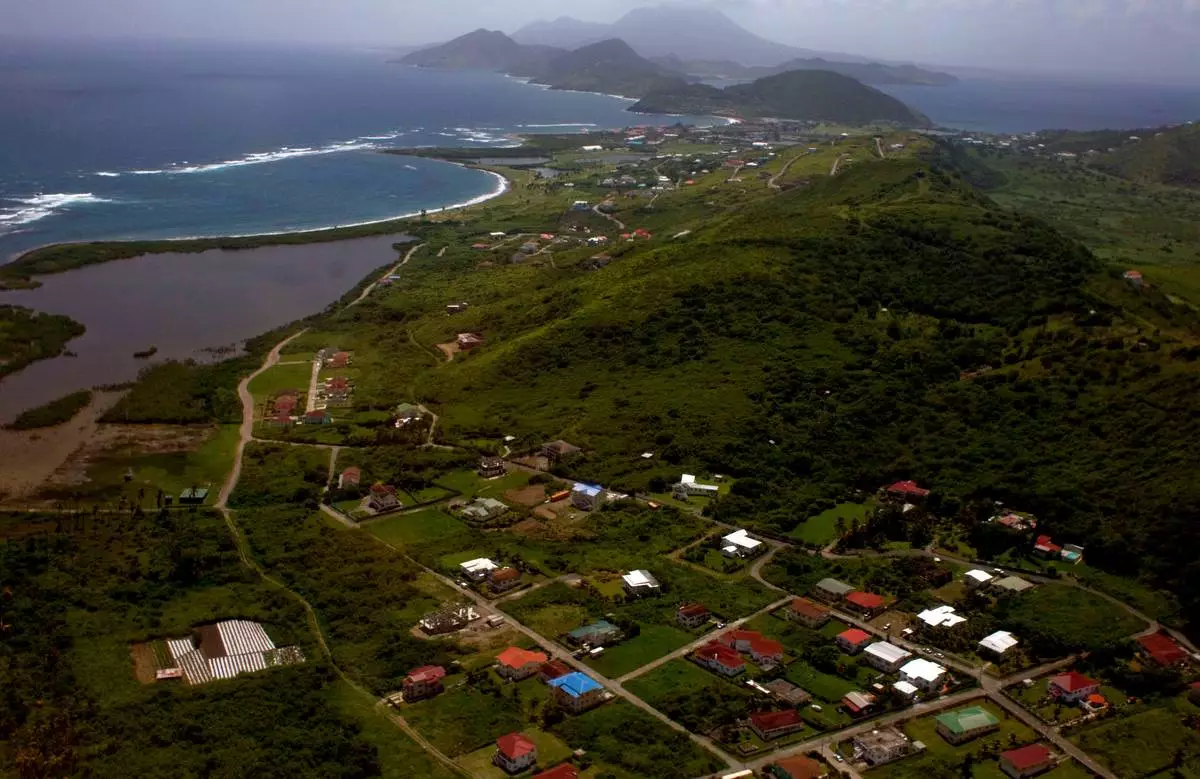
FILE - An aerial view of the Caribbean island St. Kitts, Sept. 23, 2011. (AP Photo/Ramon Espinosa, File)