

Skip to Content Facebook Feature Image

France names winners of anti-Trump climate change grants

News

France names winners of anti-Trump climate change grants
News

News

France names winners of anti-Trump climate change grants

2017-12-12 12:35 Last Updated At:12:35

Eighteen climate scientists from the U.S. and elsewhere hit the jackpot Monday as French President Emmanuel Macron awarded them millions of euros in grants to relocate to France for the rest of Donald Trump's presidential term.

The "Make Our Planet Great Again" grants — a nod to Trump's "Make America Great Again" campaign slogan — are part of Macron's efforts to counter Trump on the climate change front. Macron announced a contest for the projects in June, hours after Trump declared he would withdraw the U.S. from the Paris climate accord.

More than 5,000 people from about 100 countries expressed interest in the grants. A majority of the applicants — and 13 of the 18 winners — were U.S.-based researchers.
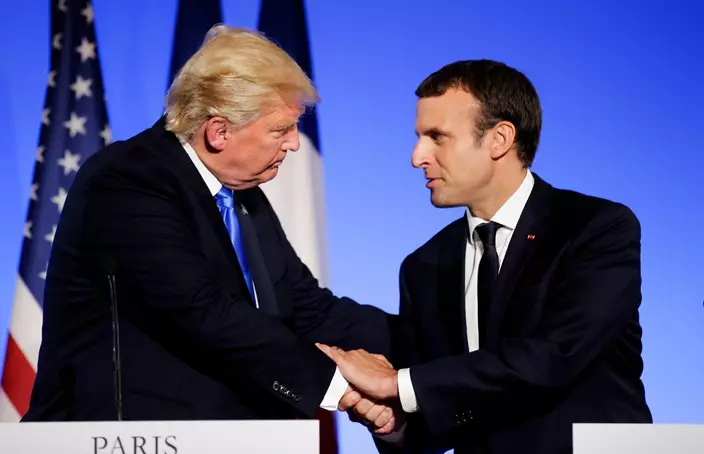
FILE - In this July 13, 2017 file photo, U.S President Donald Trump, left, shakes hands with French President Emmanuel Macron after a press conference at the Elysee Palace in Paris.  (AP Photo/Markus Schreiber, File)

FILE - In this July 13, 2017 file photo, U.S President Donald Trump, left, shakes hands with French President Emmanuel Macron after a press conference at the Elysee Palace in Paris.  (AP Photo/Markus Schreiber, File)

Macron's appeal "gave me such a psychological boost, to have that kind of support, to have the head of state saying I value what you do," said winner Camille Parmesan, of the University of Texas at Austin. She will be working at an experimental ecology station in the Pyrenees on how human-made climate change is affecting wildlife.

In an interview with The Associated Press, Parmesan described funding challenges for climate science in the U.S. and a feeling that "you are having to hide what you do."

Trump has expressed skepticism about global warming and said the Paris accord would hurt U.S. business by requiring a reduction in climate-damaging emissions.

"We will be there to replace" U.S. financing of climate research, Macron told the winners in Paris on Monday.

"If we want to prepare for the changes of tomorrow, we need science," he said, promising to put in place a global climate change monitoring system among other climate innovations.

The research of the winning recipients focuses on pollution, hurricanes and clouds. A new round of the competition will be launched next year, alongside Germany. About 50 projects will be chosen overall, and funded with 60 million euros ($70 million) from the state and French research institutes.

Initially aimed at American researchers, the research grants were expanded to other non-French climate scientists, according to organizers. Candidates need to be known for working on climate issues, have completed a thesis and propose a project that would take between three to five years.

The time frame would cover Trump's current presidential term.

French officials have not revealed the value of the grants, but said the amount varies by project. Senior researchers were eligible for awards of up to 1.5 million euros ($1.7 million), the president's office said.

Some French researchers have complained that Macron is showering money on foreign scientists at a time when they have been pleading for more support for domestic higher education.

Macron unveiled the first winners at a startup incubator in Paris called Station F, where Microsoft and smaller tech companies announced projects to finance activities aimed at reducing emissions.

Monday's event is a prelude to a bigger climate summit Tuesday aimed at giving new impetus to the Paris accord and finding new funding to help governments and businesses meet its goals.

More than 50 world leaders are expected in Paris for the "One Planet Summit," co-hosted by the U.N. and the World Bank. Trump was not invited.

Other attendees include Arnold Schwarzenegger, who took a spin on a Parisian electric bike Monday to call attention to health problems caused by pollution.

The Hollywood star and former California governor argued that Trump's rejection of the Paris climate accord doesn't matter, because companies, scientists and other governments can "pick up the slack" to reduce global emissions.

THE HAGUE, Netherlands (AP) — Myanmar insisted Friday that its deadly military campaign against the Rohingya ethnic minority was a legitimate counter-terrorism operation and did not amount to genocide, as it defended itself at the top United Nations court against an allegation of breaching the genocide convention.

Myanmar launched the campaign in Rakhine state in 2017 after an attack by a Rohingya insurgent group. Security forces were accused of mass rapes, killings and torching thousands of homes as more than 700,000 Rohingya fled into neighboring Bangladesh.

“Myanmar was not obliged to remain idle and allow terrorists to have free reign of northern Rakhine state,” the country’s representative Ko Ko Hlaing told black-robed judges at the International Court of Justice.

African nation Gambia brought a case at the court in 2019 alleging that Myanmar's military actions amount to a breach of the Genocide Convention that was drawn up in the aftermath of World War II and the Holocaust.

Some 1.2 million members of the Rohingya minority are still languishing in chaotic, overcrowded camps in Bangladesh, where armed groups recruit children and girls as young as 12 are forced into prostitution. The sudden and severe foreign aid cuts imposed last year by U.S. President Donald Trump shuttered thousands of the camps’ schools and have caused children to starve to death.

Buddhist-majority Myanmar has long considered the Rohingya Muslim minority to be “Bengalis” from Bangladesh even though their families have lived in the country for generations. Nearly all have been denied citizenship since 1982.

As hearings opened Monday, Gambian Justice Minister Dawda Jallow said his nation filed the case after the Rohingya “endured decades of appalling persecution, and years of dehumanizing propaganda. This culminated in the savage, genocidal ‘clearance operations’ of 2016 and 2017, which were followed by continued genocidal policies meant to erase their existence in Myanmar.”

Hlaing disputed the evidence Gambia cited in its case, including the findings of an international fact-finding mission set up by the U.N.'s Human Rights Council.

“Myanmar’s position is that the Gambia has failed to meet its burden of proof," he said. "This case will be decided on the basis of proven facts, not unsubstantiated allegations. Emotional anguish and blurry factual pictures are not a substitute for rigorous presentation of facts.”

Nobel Peace Prize winner Aung San Suu Kyi represented her country at jurisdiction hearings in the case in 2019, denying that Myanmar armed forces committed genocide and instead casting the mass exodus of Rohingya people from the country she led as an unfortunate result of a battle with insurgents.

The pro-democracy icon is now in prison after being convicted of what her supporters call trumped-up charges after a military takeover of power.

Myanmar contested the court’s jurisdiction, saying Gambia was not directly involved in the conflict and therefore could not initiate a case. Both countries are signatories to the genocide convention, and in 2022, judges rejected the argument, allowing the case to move forward.

Gambia rejects Myanmar's claims that it was combating terrorism, with Jallow telling judges on Monday that “genocidal intent is the only reasonable inference that can be drawn from Myanmar’s pattern of conduct.”

In late 2024, prosecutors at another Hague-based tribunal, the International Criminal Court, requested an arrest warrant for the head of Myanmar’s military regime for crimes committed against the country’s Rohingya Muslim minority. Senior Gen. Min Aung Hlaing, who seized power from Suu Kyi in 2021, is accused of crimes against humanity for the persecution of the Rohingya. The request is still pending.

FILE - In this Sept. 7, 2017, file photo, smoke rises from a burned house in Gawdu Zara village, northern Rakhine state, where the vast majority of the country's 1.1 million Rohingya lived, Myanmar. (AP Photo, File)

FILE - In this Sept. 7, 2017, file photo, smoke rises from a burned house in Gawdu Zara village, northern Rakhine state, where the vast majority of the country's 1.1 million Rohingya lived, Myanmar. (AP Photo, File)

Recommended Articles