Today, words like "unmanned", "automated" and "driverless" seem to be conquering the world of technology.
China already has unmanned convenience stores and supermarkets. Driverless cars were also given the green-light to operate on certain test roads recently.
On Saturday, the country launched its first-ever fully-automated subway line.
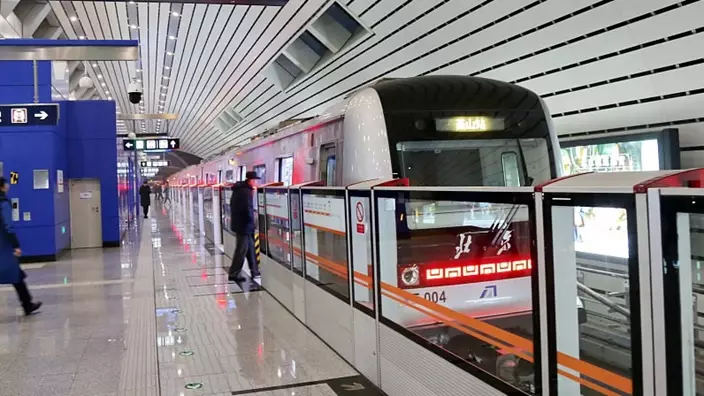
Photo via CGTN
And that's not all. It is also China's first-ever completely domestically-produced line. That includes everything from rolling stocks to signal communication systems, CCTV and rail tracks.
The Yanfang line takes you from Beijing's southwestern suburban areas of Yanshan to Fangshan, from where you can then transfer to trains on Line 9, which are bound for Beijing city center.
According to the subway operator, a whole trip runs through 9 stations, spanning across 14.4 kilometers, costs just 5 yuan.
CONVENIENCE TO SOUTHWESTERN SUBURBS
Fu Jingtao, Yanfang line manager with Beijing MTR Operation Admin Corp., said this line will help bring convenience to people living in Yanshan.
"Previously people had to rely on buses or taxis to get to Fangshan district. But now with this subway line, residents can have a more seamless journey without being too affected by weather or traffic conditions," Fu said.
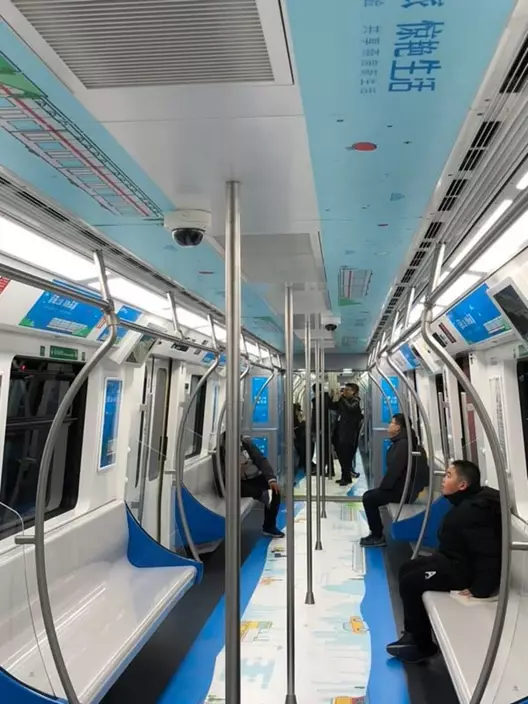
Photo via CGTN
SECURITY MEASURES
To be sure, there will still be an attendant on board to monitor track conditions and attend to emergencies.
Although, his or her role will merely be to supervise, and not to operate.
The subway operator said the Yanfang line was designed by the Grades of Automation level 3 (GoA 3) standard.
According to the International Association of Public Transport, GoA 3 is the fourth level of its five-level standard – there's a GoA 0 meaning no automation at all – meaning this is just one step away from fully automation.
"When passengers become more accustomed to this, we will upgrade it to GoA 4, which is said to be the highest level of urban rail transit operation systems," said Mao Xinde, who is the automation operation system project director for Beijing Traffic Control Technology.
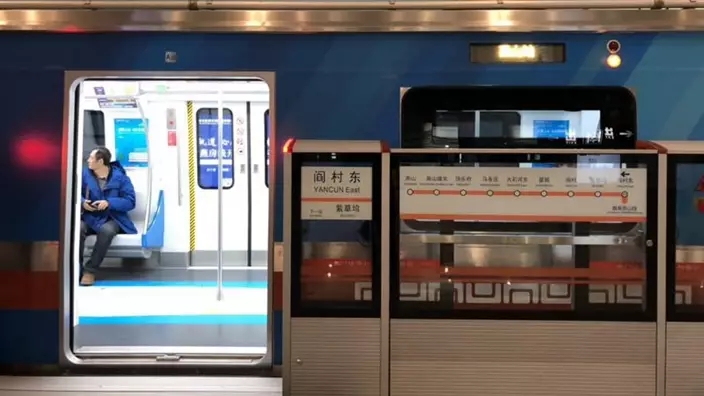
Photo via CGTN
WHAT'S DIFFERENT ABOUT THIS
Automated subway trains are not a new concept.
Paris reportedly started using a driverless subway in 1998, and Copenhagen in 2002.
The core difference for the Yanfang line, according to Mao, lies within its signal system.
"Compared to what is imported, ours is based on operational habits in China. We have integrated data in the vehicle-ground transmit network, to make this automatic operation system more in accordance to our rail transit industry's operational needs," he said.
Mao added that the Yanfang line is equipped with 4G-based train control.
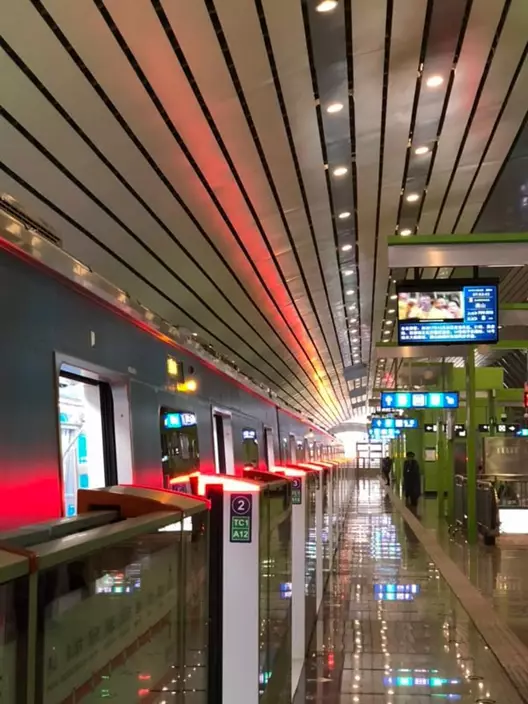
Photo via CGTN
TRIP TO THE SUBURBS
Interestingly, this line has attracted not only those wishing to head to Beijing city center, but also urban passengers who wish to explore the suburbs.
"I wanted to see a petroleum factory in Yanshan because that's what Yanshan is known for. I also wanted to try this line out, because it is China's first domestic-made automated subway," said a female passenger.
Yanshan is a suburb built around a petroleum and chemical enterprise, with Sinopec Beijing Yanshan Company's petrochemical complex situated there.
The Yanfang line is one of the three new lines launched on Saturday. Altogether, with these lines, Beijing will have 22 lines, with a total length of 608 kilometers.
Beijing plans to extend the subway to 30 lines with a length of 900 kilometers by 2020.
CAPE CANAVERAL, Fla. (AP) — NASA’s moonbound astronauts have reason to celebrate, and not just because their launch went so well. Their toilet is now working.
The so-called lunar loo malfunctioned as soon as the Artemis II crew reached orbit Wednesday evening. Mission Control guided astronaut Christina Koch through some plumbing tricks and she finally got it going.
The bad news is that it’s so cold inside the Orion capsule — 65 degrees Fahrenheit (18 degrees Celsius) — that the four astronauts are digging into suitcases for long-sleeved clothes. Mission Control is trying to warm things up.
The three Americans and one Canadian are on track to bust out of orbit around Earth on Thursday night and zoom to the moon for a lunar fly-around. It will be Mission Control’s first translunar injection since Apollo's swan song in 1972.
To set the mood, Mission Control’s wake-up music for the crew was “Green Light” by John Legend featuring André 3000. The song segued into the 3-2-1 of the astronauts' thunderous liftoff, followed by a medley of greetings from NASA teams around the country.
“We are ready to go, and that was awesome,” pilot Victor Glover said.
While awaiting their orbital departure, the astronauts savored the views of Earth from tens of thousands of miles high. Koch told Mission Control that they can make out the entire coastlines of continents and even the South Pole, her old stomping ground.
"It is just absolutely phenomenal," radioed Koch, who spent a year at an Antarctic research station before joining NASA.
The mission is due to end with a Pacific splashdown on April 10. NASA is counting on the test flight to kickstart the entire Artemis program and lead to a moon landing by two astronauts in 2028. Orion's toilet may need some design tweaks before that happens.
Located in the floor with a door and curtain for privacy, the capsule's lone toilet is based on an experimental commode that launched to the International Space Station in 2020. That station potty barely saw any use and has been out of order for years.
Known as the universal waste management system, the compact toilet uses air suction instead of water and gravity to remove waste, similar to earlier space toilets. It’s also designed to better accommodate female astronauts.
Koch and her crewmates had to resort to a bag and funnel system for urinating until she got the toilet working overnight.
Any toilet — even a fitful one — is better than none if you ask any of the six surviving Apollo astronauts.
NASA's Apollo capsules were too small to accommodate a commode, so the all-male crews relied on bags to relieve themselves throughout the lunar journey. These so-called Apollo bags were repurposed during NASA's later space shuttle flights; they served as backup whenever the shuttle toilet acted up.
The Associated Press Health and Science Department receives support from the Howard Hughes Medical Institute’s Department of Science Education and the Robert Wood Johnson Foundation. The AP is solely responsible for all content.
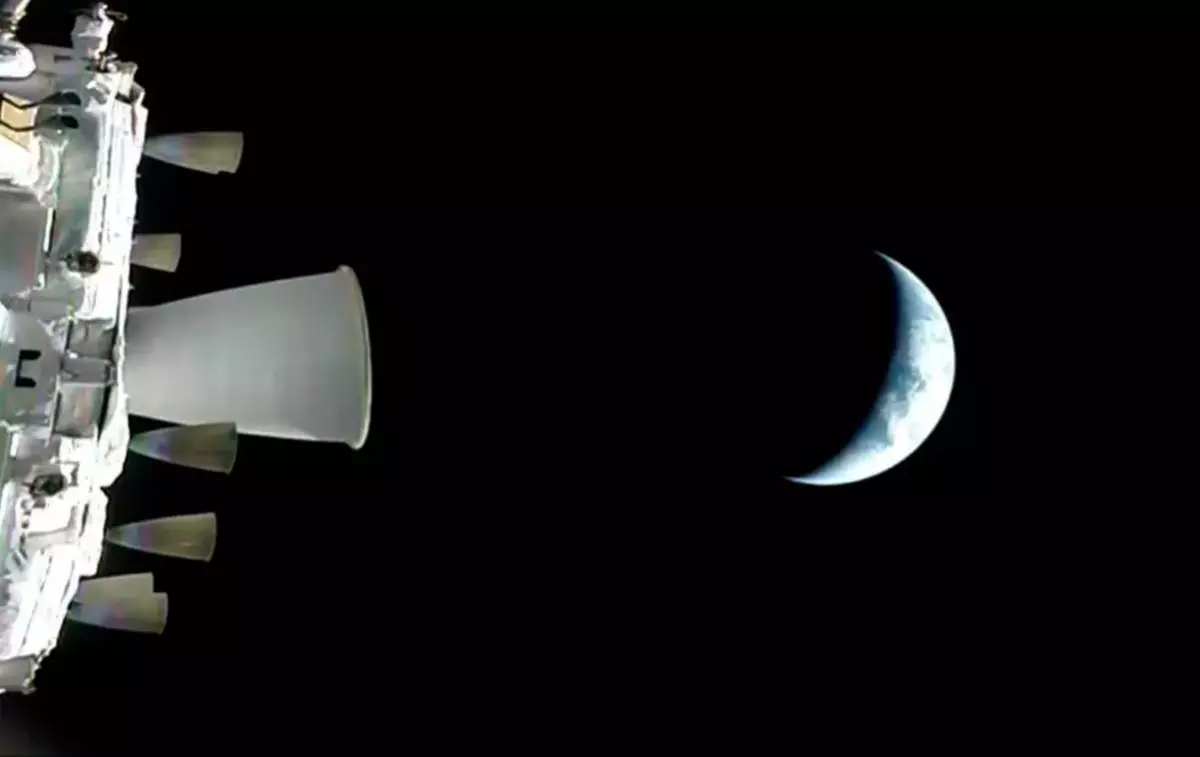
In this photo provided by NASA, a view of the Earth from NASA's Orion spacecraft as it orbits above the planet during the Artemis II test flight, on Thursday, April 2, 2026. (NASA via AP)
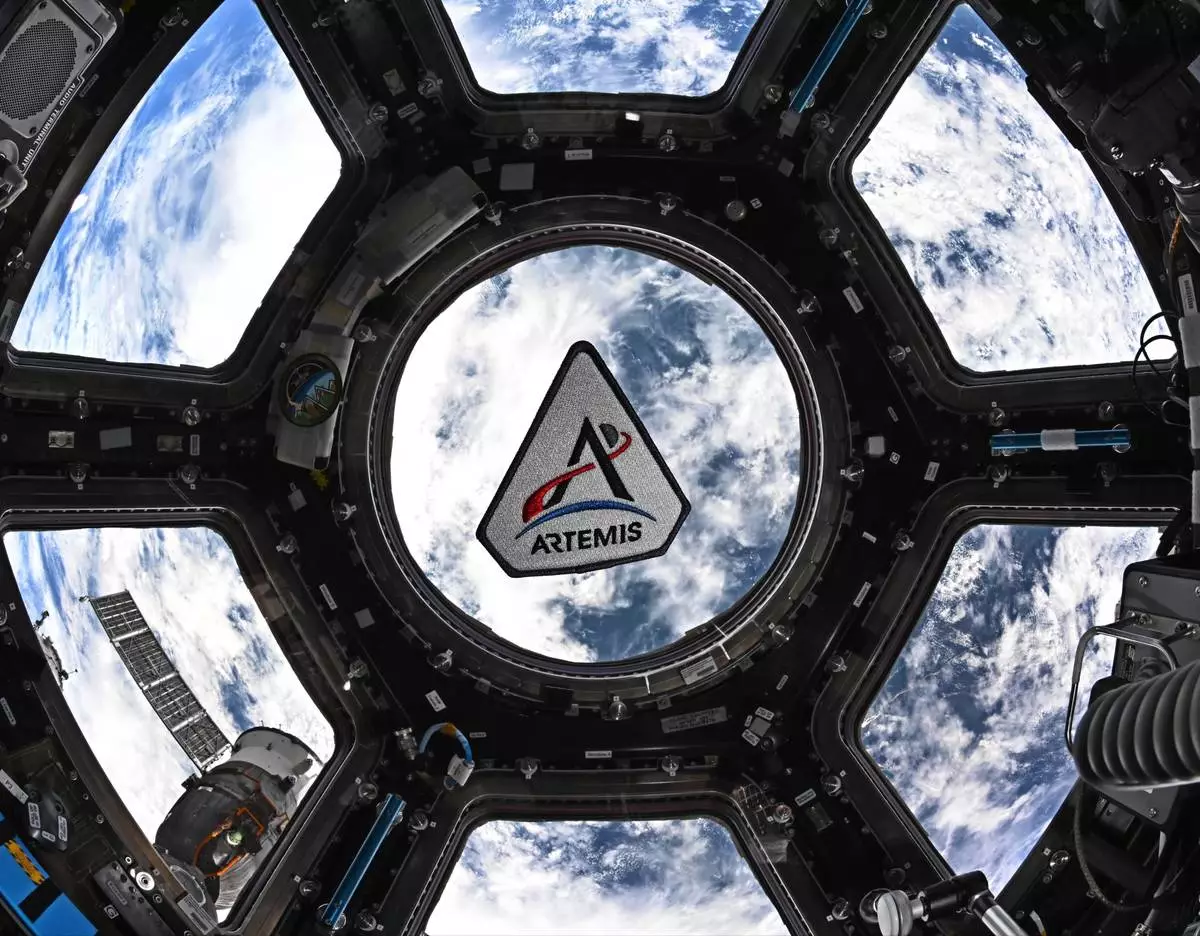
In this photo provided by NASA, an Artemis program patch floating in the International Space Station's cupola, on March 30, 2026. (Jessica Meir/NASA via AP)

Spectators view NASA's Artemis II moon rocket launch from the A. Max Brewer Bridge, Wednesday, April 1, 2026, in Titusville, Fla. (AP Photo/Phelan M. Ebenhack)
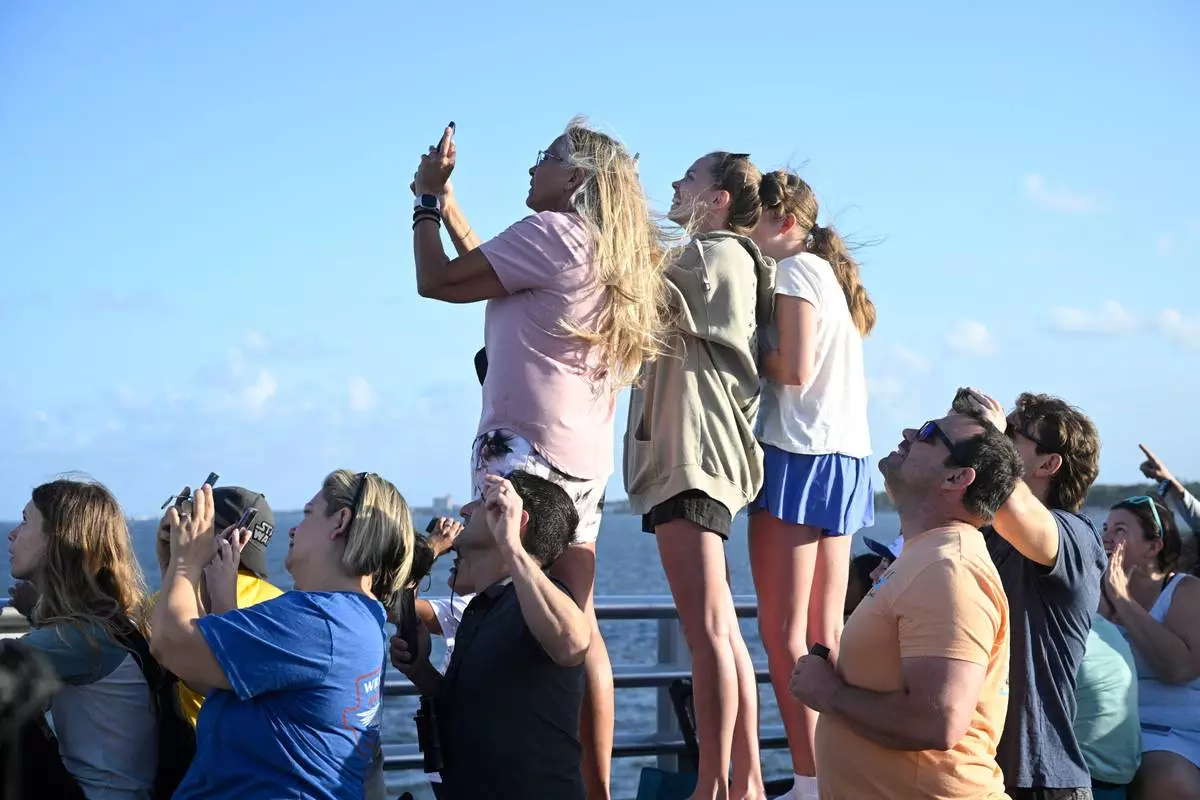
Spectators view NASA's Artemis II moon rocket launch from the A. Max Brewer Bridge, Wednesday, April 1, 2026, in Titusville, Fla. (AP Photo/Phelan M. Ebenhack)
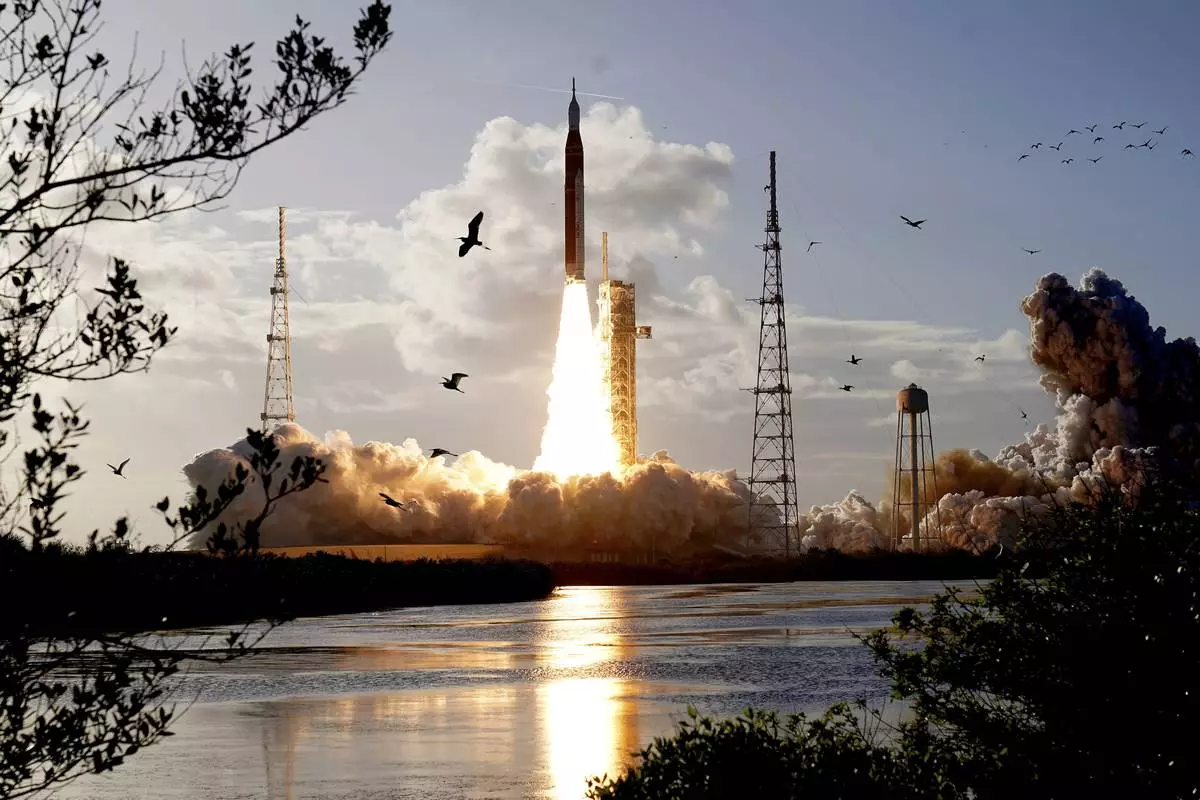
NASA's Artemis II moon rocket lifts off from the Kennedy Space Center's Launch Pad 39-B Wednesday, April 1, 2026, in Cape Canaveral, Fla. (AP Photo/Chris O'Meara)
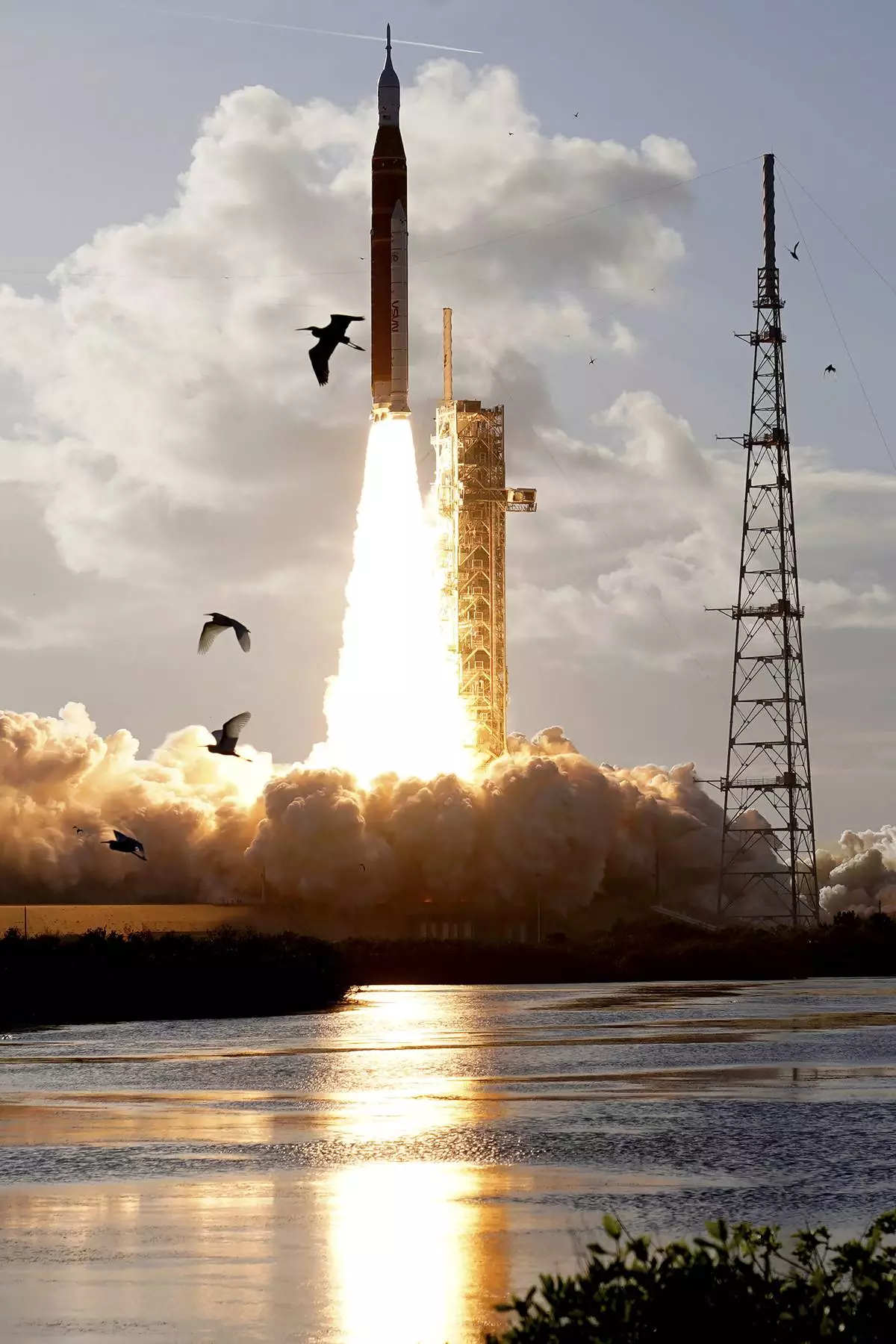
NASA's Artemis II moon rocket lifts off from the Kennedy Space Center's Launch Pad 39-B Wednesday, April 1, 2026, in Cape Canaveral, Fla. (AP Photo/Chris O'Meara)
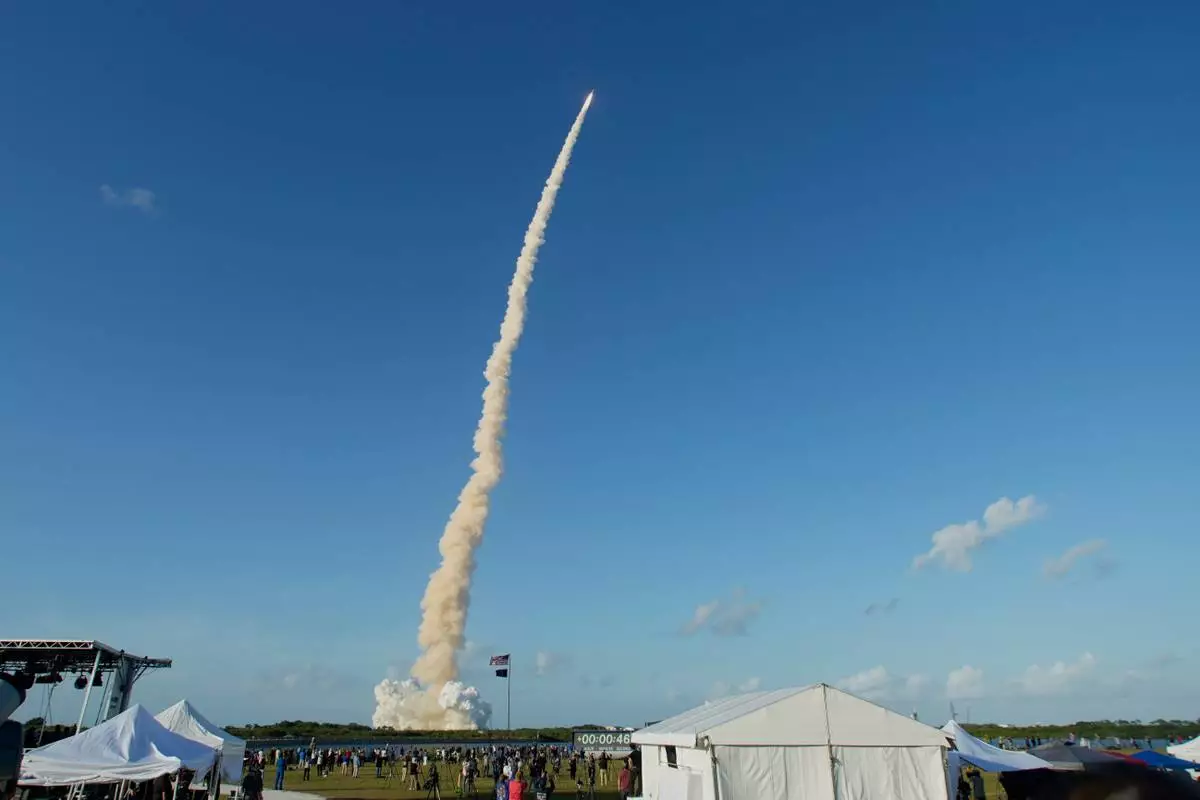
NASA's Artemis II moon rocket lifts off from the Kennedy Space Center's Launch Pad 39-B Wednesday, April 1, 2026, in Cape Canaveral, Fla. (AP Photo/John Raoux)