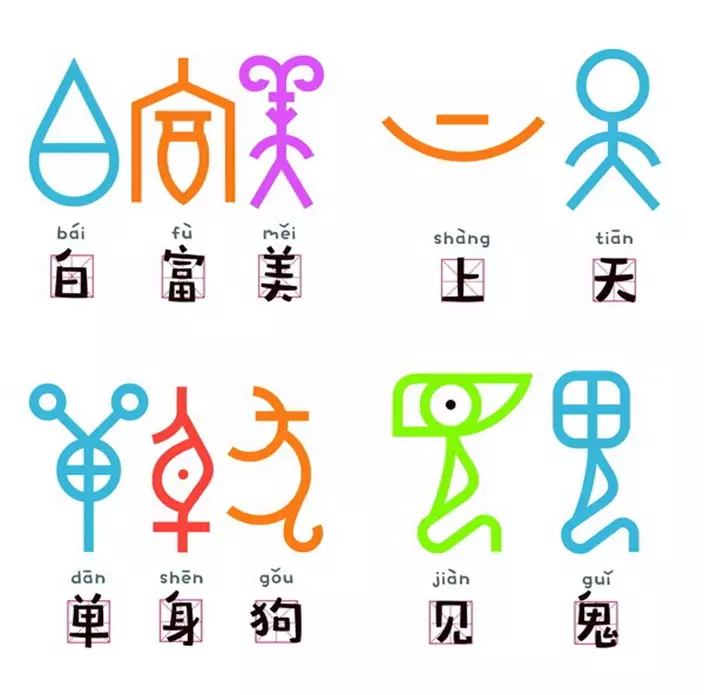
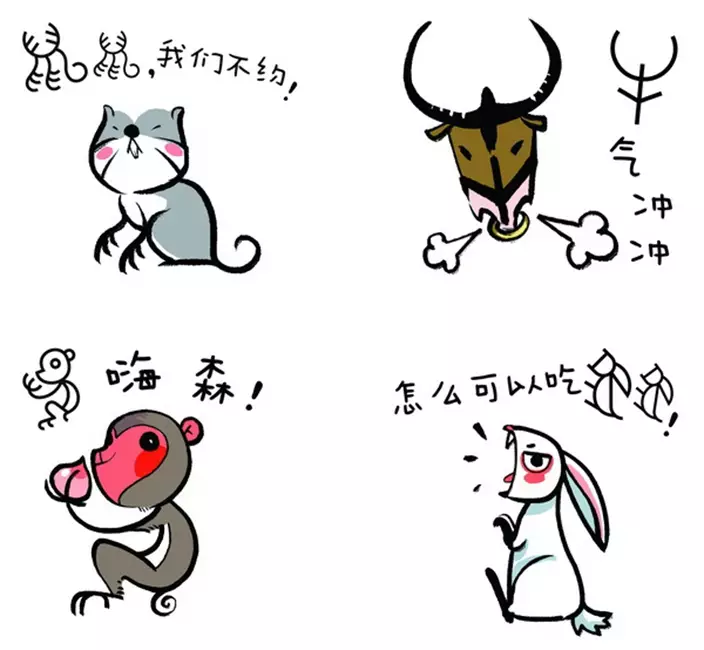
A university professor in Beijing is giving ancient Chinese characters modern meanings with a new series of emojis.
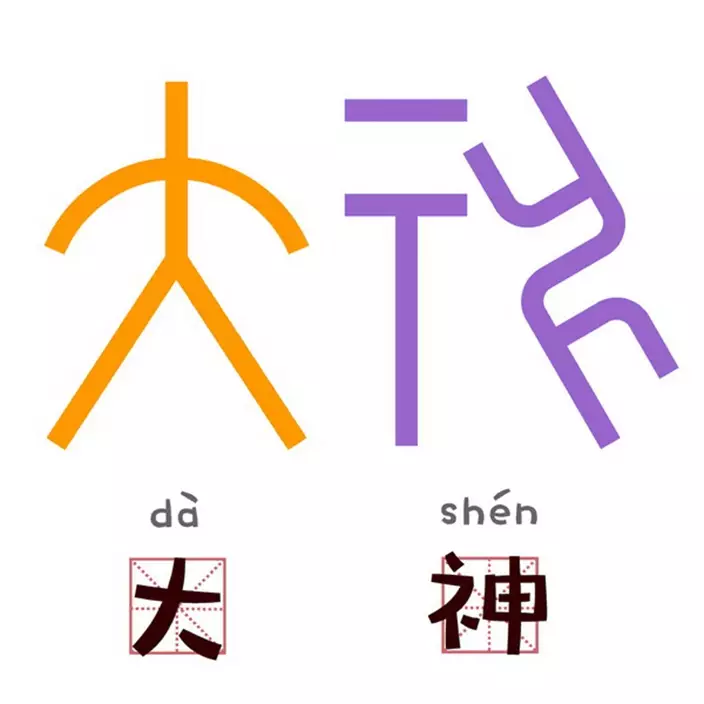
photo by Chen Nan
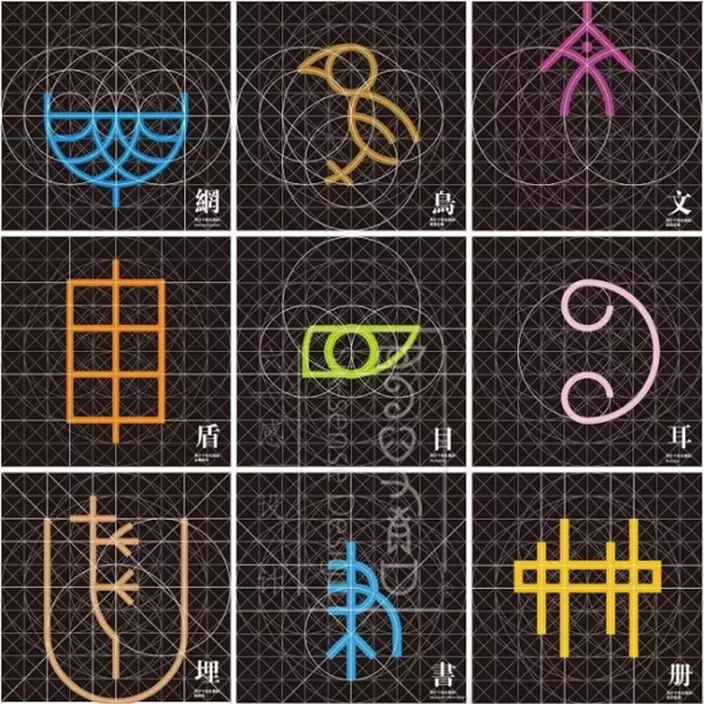
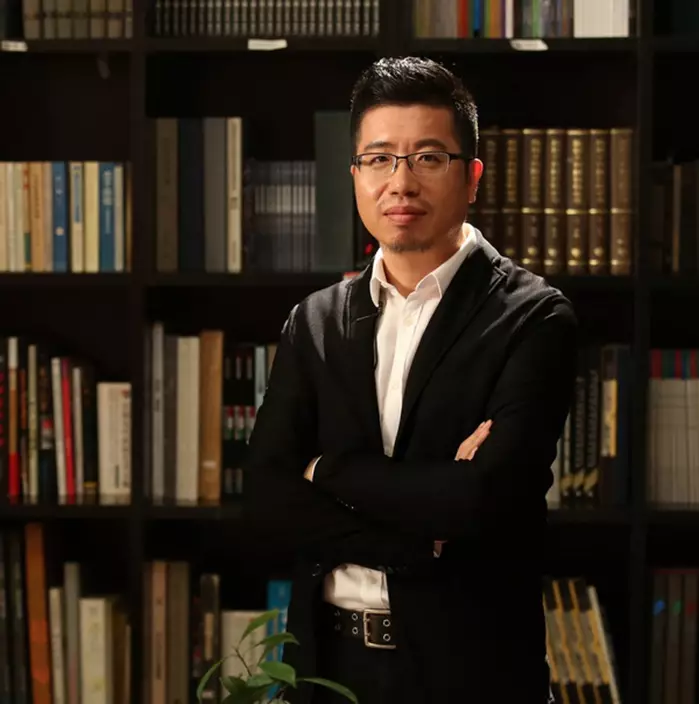
Chen Nan, a doctoral advisor at Tsinghua University's Academy of Arts & Design, retraces his inspiration for the animated emojis to oracle bone scripts.
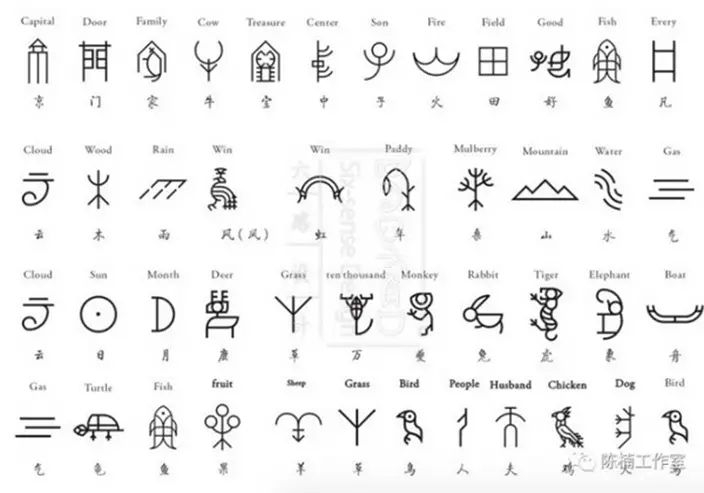
Written on turtle shells and animal bones, the pictographs, dating back 4,000 years, are the earliest known Chinese writing.
photo by Chen Nan
"I think the designs and promotion of oracle bone script should be given new life and fused with the present," Chen told thepaper.cn. "I don't want them to be portrayed as these incomprehensible cultural symbols that remain out of reach."
photo by Chen Nan
The colorful emojis are pictographs that use the syntax of oracle bone script to convey modern words and internet slang. The emojis got a big endorsement from Chinese pop star Lu Han, who recently posted the set on Sina Weibo. The post received more than 31 million views and was reposted over 140,000 times.
photo by Chen Nan
Chen explained he first came up with the redesigned oracle bones with Li Zhengdao, a Nobel laureate in Physics, during a project together in 1999.
The designs were featured on a series of Spring Festival-themed postcards printed by China Post in 2011.
photo by Chen Nan
photo by Chen Nan
photo by Chen Nan
China holds the 12th national memorial ceremony on Saturday to mourn the approximately 300,000 victims of the Nanjing Massacre, which was perpetrated by Japanese invaders in 1937 in what is now the capital of east China's Jiangsu Province.
The memorial ceremony began at 10:00 in front of the Memorial Hall of the Victims in Nanjing Massacre by Japanese Invaders, with the national anthem performed and sung by attendees.
A moment of silence followed in honor of the victims. During this tribute, air-raid sirens resounded across the city of Nanjing, vehicles came to a stop with horns sounding, and pedestrians paused in remembrance.
Following the moment of silence, eight large wreaths were presented to the memorial altar by the Guard of Honor.
Shi Taifeng, a member of the Political Bureau of the Communist Party of China (CPC) Central Committee and head of the Organization Department of the CPC Central Committee, then delivered a speech.
At the memorial ceremony, 88 representatives of Nanjing youth recited the Declaration for Peace, a poem authored by late writer Feng Yitong (1941-2023) in 2014 in memorial of those who perished in the massacre, and six representatives from various social sectors then tolled the Bell of Peace.
As the bell sounded three times, 3,000 white doves, symbolizing the longing for peace, were released and flew over the memorial hall's square.
Parallel commemorative activities were held simultaneously at 17 burial sites of the Nanjing Massacre victims, in 12 communities, and at patriotic education centers across Jiangsu Province that focus on the history of the Chinese People's War of Resistance against Japanese Aggression.
The National Memorial Day for the Victims of the Nanjing Massacre was formally established on Feb. 27, 2014, by the Standing Committee of the 12th National People's Congress, designating Dec. 13 as an annual day of remembrance through legislative procedure. This year's observance carried particular significance, as it coincides with the 80th anniversary of the victory in the Chinese People's War of Resistance against Japanese Aggression and the World Anti-Fascist War.
The Nanjing Massacre lasted over 40 days after Japanese forces captured Nanjing, then China's capital, on Dec. 13, 1937. The atrocities resulted in the deaths of more than 300,000 Chinese civilians and disarmed soldiers, and included the rape of some 20,000 women.
China commemorates Nanjing Massacre victims in National Memorial Ceremony