Would she try to lose weight or keep the current state?
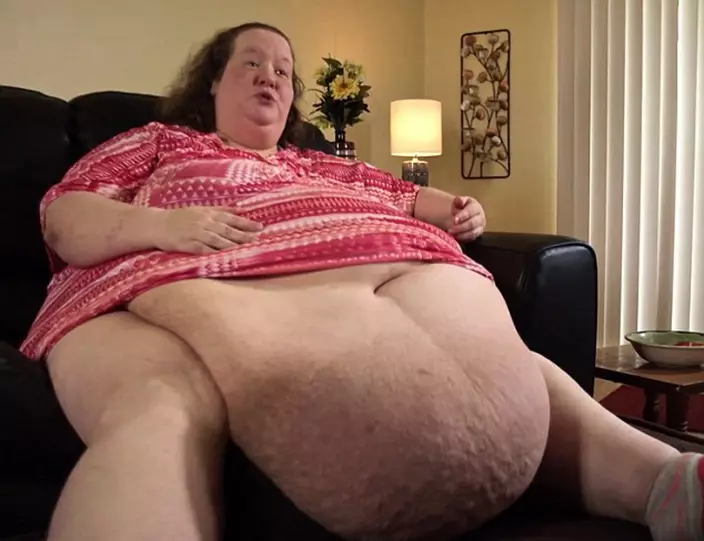
A morbidly obese woman weighing 591 lbs has shared how she became fat after her father died of a heart attack suddenly when she was eight, causing her depressed mother feeding her junk food until she felt sick.
Click to Gallery
Tamy at her childhood, via TLC
Tamy at her childhood, via TLC
Tamy at her teenage, via TLC
Tamy at her teenage, via TLC
Tamy at her teenage, via TLC
Tamy at her teenage, via TLC
via TLC
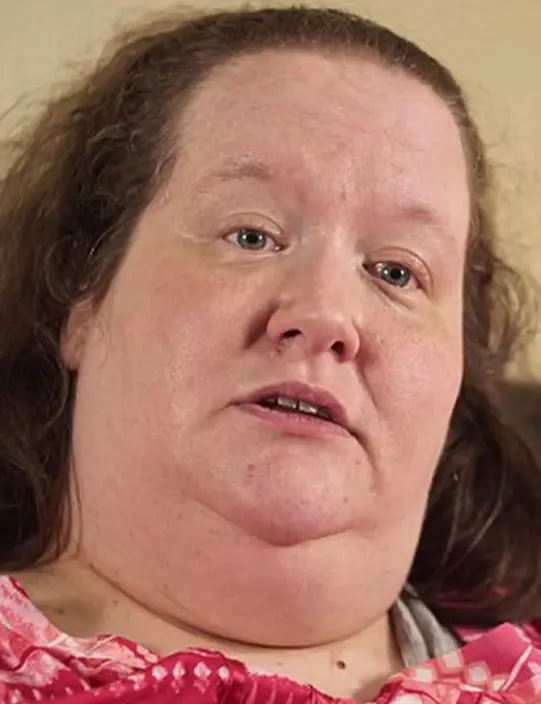
Tamy Lyn Murrell, 45, was a normal-sized kid before eating food for comfort. Her father died of heart attack in the kitchen one day she came home.

Tamy at her childhood, via TLC

Tamy at her childhood, via TLC
A new episode of the TLC series of- My 600lb Life, has told how the mother of one gets obsessed with eating and makes her weight out of control. Tamy's stomach can nearly touch the floor when she stands.

via TLC

via TLC
Tamy recalls her childhood and admits that she wasn't like everybody else because she struggled socially. She tells that she was laughed by other kids since she would get nervous and stutter.
She saw her father collapse to the floor in the kitchen and had lived with her depressed mon since then. As Tamy is the youngest child in the family with a sister 19 years older than her, she basically grew up with just her parent.

Tamy's father, via TLC

Tamy's mother, via TLC
Tamy explains that she started thinking the food was like her friend when she nobody cared about her.
"I could just eat whatever I wanted, when I wanted, and it was my friend. It was my parent, my friend, my loved one," she said. At the time her mum suffered from depression, she was left the grocery shopping, so she bought all of the soda, pies, and ice cream that she wanted.
"I bought it because she would just give me money, and she let me get whatever I wanted," she recalls. "So I ate junk food all of the time, and I would eat to the point of being sick."
She said she doesn't know why she did it. "It was just I wanted it, so I ate it," she said.
via TLC
Tamy weighed about 140lbs at her 14, and two years later, at her 16, she weighs 175lbs. She often bullied over her size.

Tamy at her teenage, via TLC

Tamy at her teenage, via TLC

Tamy at her teenage, via TLC

Tamy at her teenage, via TLC
The depression of her mum didn't get better, so she works as a janitor to support herself. She met her a fellow janitor named James and fell in love.

via TLC

via TLC
James said he tended to like "big girl" and that's why Tamy attracted him. On the other hand, Tamy said James was the first person who ever paid attention to her.
Tamy got pregnant just a month after they started dating.
"For the first time in my whole life things seemed good, but that didn't last long," she talks about their relationship.

via TLC
Even with her true love, Tamy didn't quit eating for comfort. She longs to get out of her loveless marriage and be a better mon, but she fails to do it.
"I feel like I'm not living. I'm just existing. It's horrible," she said. She is affected by the emotional pain caused by intense physical pain because of her massive weight.
The world’s first legally binding agreement to protect marine life in international waters took effect Saturday, marking a historic moment for ocean conservation after nearly two decades of negotiations.
The High Seas Treaty will govern nearly half the planet’s surface – the vast ocean areas beyond any country’s control. These waters face mounting threats from destructive fishing practices, shipping, plastic pollution, overfishing and potential deep sea mining, all compounded by climate change. The ocean absorbs carbon dioxide and produces oxygen, making its health critical for addressing the climate crisis.
The treaty entered into force 120 days after it reached the threshold of ratification by 60 countries in September. As of Friday, 83 countries had ratified it, including the recent addition of major maritime powers such as China and Japan.
The treaty creates the first framework for establishing Marine Protected Areas on the high seas, which make up about two-thirds of the world’s ocean. Currently, only around 1% of these international waters are protected.
From Saturday, ratifying countries must begin working together on ocean science and technology as well as help developing nations build capacity to participate in ocean governance. Companies planning activities that could harm marine life must conduct environmental impact assessments that meet the treaty’s standards. Those conducting research on ocean organisms that could be used commercially, such as for new medicines, must notify other countries and share their findings.
Perhaps most significantly, countries must now promote the treaty’s conservation goals when they participate in other international bodies that regulate ocean activities, such as regional fisheries organizations, the International Maritime Organization and the International Seabed Authority.
While key institutions like the treaty’s secretariat and scientific body are still being developed, countries can begin preparing proposals for Marine Protected Areas immediately. Potential sites include the Emperor Seamounts in the North Pacific, the Sargasso Sea in the Atlantic and the Salas y Gomez and Nazca Ridges off South America.
Conservationists warn governments must act quickly to achieve the global goal of protecting 30% of the world’s oceans by 2030 – a target scientists say is critical for ocean health. Because the high seas make up such a vast portion of the oceans, their protection is essential to reaching that goal.
“The marine protected areas under the treaty will only be as strong as the governments make them,” said Megan Randles, global political lead for Greenpeace’s Ocean Campaign. “We can’t trust big fishing industry players to simply stop fishing in these critical ecosystems. We need governments to use the treaty to force their hands.”
How those protected areas will actually be monitored and enforced is undecided. Countries are exploring various options, from satellite technology to coordinating patrols between multiple nations to using other UN agencies to help with oversight, said Rebecca Hubbard, director of the High Seas Alliance. Those details will be worked out as the first protected areas take shape.
Within a year, the treaty’s first Conference of Parties will meet to decide key operational details, from budgets to the makeup of various committees. Countries have been working through many of those questions at preparatory meetings, with a final session scheduled for late March. The earliest any Marine Protected Areas could actually win approval would be at the second COP, since the scientific body that will review proposals hasn’t yet been established.
The United States has signed but not ratified the treaty, meaning it can participate as an observer but won’t have voting rights. Under international law, signatory countries are expected to comply with treaty objectives even before ratification.
“The High Seas Treaty has such incredibly broad and strong political support from across all regions of the world,” said Hubbard. “Whilst it’s disappointing that the U.S. hasn’t yet ratified, it doesn’t undermine its momentum and the support that it has already.”
Advocates emphasize that broad support must now turn into rapid implementation.
“The treaty is a sign that in a divided world, protecting nature and protecting our global commons can still triumph over political rivalries,” Randles said. “The ocean connects us all.”
Follow Annika Hammerschlag on Instagram @ahammergram.
The Associated Press receives support from the Walton Family Foundation for coverage of water and environmental policy. The AP is solely responsible for all content. For all of AP’s environmental coverage, visit https://apnews.com/hub/climate-and-environment

Strands of kelp rise from a thinned kelp forest off the coast of La Jolla, Calif., Tuesday, Dec. 2, 2025. (AP Photo/Annika Hammerschlag)

FILE - Corals grow off Efate Island, Vanuatu, Saturday, July 26, 2025. (AP Photo/Annika Hammerschlag, File)

FILE - Coral is visible in the protected area of France's Porquerolles National Park ahead of the U.N. Ocean Conference on June 6, 2025. (AP Photo/Annika Hammerschlag, File)

FILE - Common two-banded seabream fish swim in the protected area of France's Porquerolles National Park ahead of the U.N. Ocean Conference on June 6, 2025. (AP Photo/Annika Hammerschlag, File)

FILE - A clownfish swims at Havannah Harbour, off the coast of Efate Island, Vanuatu, July 20, 2025. (AP Photo/Annika Hammerschlag, File)