A NASA spacecraft rocketed toward the sun Sunday on an unprecedented quest to get closer to our star than anything ever sent before.
The Parker Solar Probe will fly straight through the wispy edges of the corona, or outer solar atmosphere, that was visible during last August's total solar eclipse. It eventually will get within 3.8 million (6 million kilometers) of the sun's surface, staying comfortably cool despite the extreme heat and radiation, and allowing scientists to vicariously explore the sun in a way never before possible.
Click to Gallery
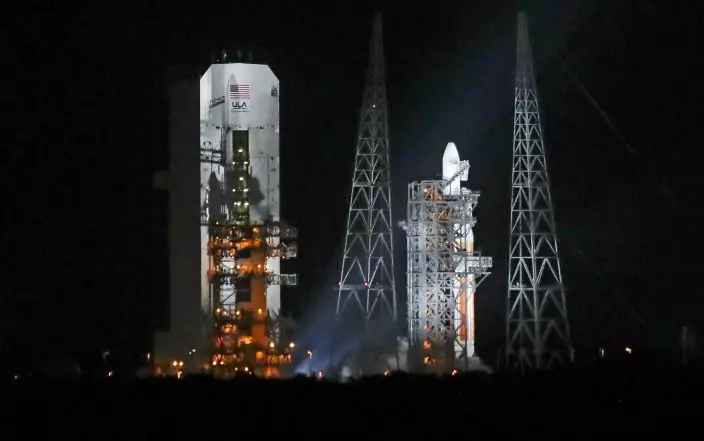
A Delta IV rocket, carrying the Parker Solar Probe, stands on launch complex 37 after the launch was scrubbed at the Kennedy Space Center, Saturday, Aug. 11, 2018, in Cape Canaveral, Fla. The Parker Solar launch has been rescheduled for early Sunday morning. (AP PhotoJohn Raoux)
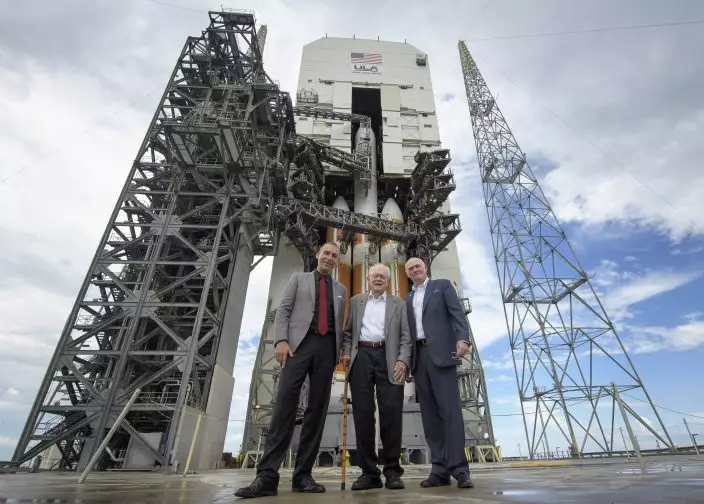
CORRECTS SPELLING TO TORY, NOT TONY - In this photo provided by NASA, astrophysicist Eugene Parker, center, stands with NASA Associate Administrator for the Science Mission Directorate Thomas Zurbuchen, left, and United Launch Alliance President and Chief Executive Officer Tory Bruno in front of the ULA Delta IV Heavy rocket with NASA's Parker Solar Probe onboard, Friday, Aug. 10, 2018 at Cape Canaveral Air Force Station, Fla. Humanity's first-ever mission into a part of the Sun's atmosphere called the corona, is scheduled to launch early Saturday. (Bill IngallsNASA via AP)
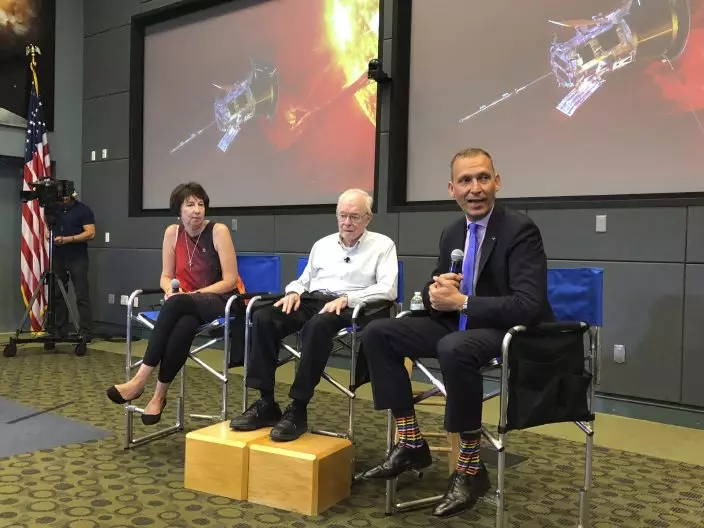
In this Thursday, Aug. 9, 2018 photo, astrophysicist Eugene Parker sits between Johns Hopkins University project scientist Nicola Fox, left, and NASA’s science mission chief Thomas Zurbuchen, during a news conference about the Parker Solar Probe at the Kennedy Space Center in Florida. It's the first time NASA has named a spacecraft after someone who's still alive. (AP PhotoMarcia Dunn)
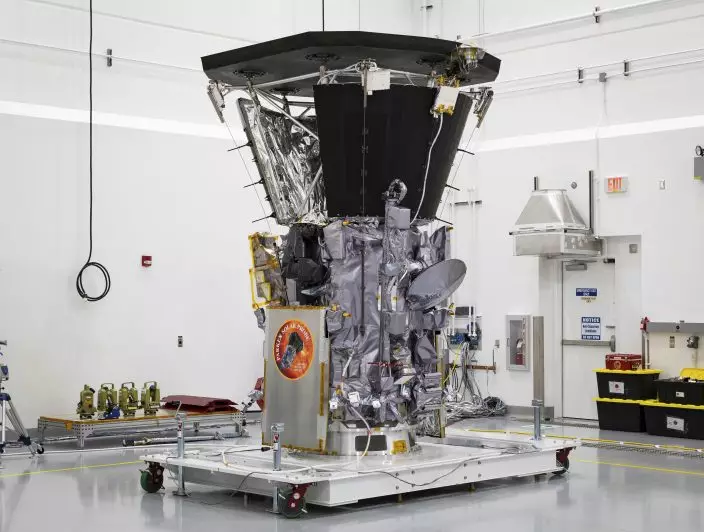
This July 6, 2018 photo made available by NASA shows the Parker Solar Probe in a clean room at Astrotech Space Operations in Titusville, Fla., after the installation of its heat shield. NASA's Parker Solar Probe will be the first spacecraft to "touch" the sun, hurtling through the sizzling solar atmosphere and coming within just 3.8 million miles (6 million kilometers) of the surface. (Ed WhitmanJohns Hopkins APLNASA via AP)
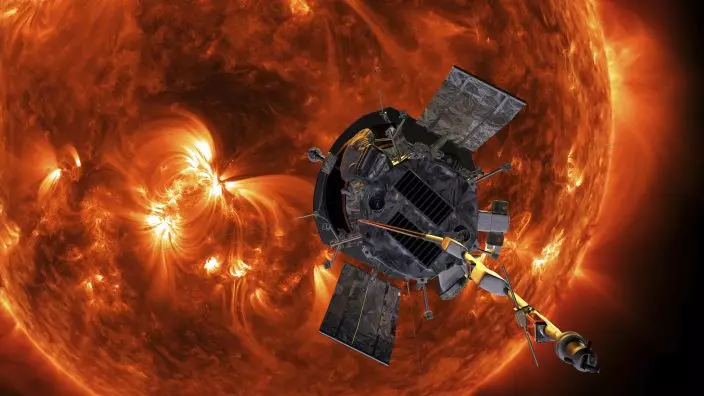
This image made available by NASA shows an artist's rendering of the Parker Solar Probe approaching the Sun. It's designed to take solar punishment like never before, thanks to its revolutionary heat shield that’s capable of withstanding 2,500 degrees Fahrenheit (1,370 degrees Celsius). (Steve GribbenJohns Hopkins APLNASA via AP)
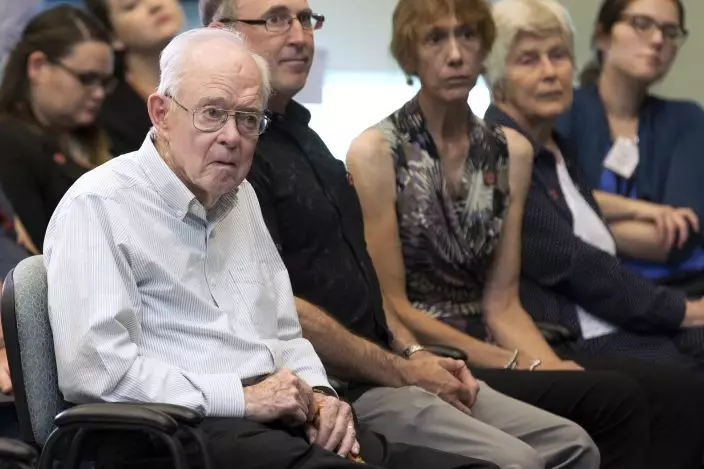
In this Thursday, Aug. 9, 2018, astrophysicist Eugene Parker attends a news conference about the Parker Solar Probe named after him, at the Kennedy Space Center in Florida. Sixty years ago, the young astrophysicist proposed the existence of solar wind. Many were skeptical and told him to read up on it first “so you don't make these killer mistakes," he recalls. (Kim ShiflettNASA via AP)
No wonder scientists consider it the coolest, hottest mission under the sun, and what better day to launch to the sun than Sunday as NASA noted.
A Delta IV rocket, carrying the Parker Solar Probe, stands on launch complex 37 after the launch was scrubbed at the Kennedy Space Center, Saturday, Aug. 11, 2018, in Cape Canaveral, Fla. The Parker Solar launch has been rescheduled for early Sunday morning. (AP PhotoJohn Raoux)
"Fly baby girl, fly!!" project scientist Nicola Fox of Johns Hopkins University tweeted just before liftoff. She urged it to "go touch the sun!"
Protected by a revolutionary new carbon heat shield and other high-tech wonders, the spacecraft will zip past Venus in October. That will set up the first solar encounter in November. Altogether, the Parker probe will make 24 close approaches to the sun on the seven-year, $1.5 billion undertaking.
For the second straight day, thousands of spectators jammed the launch site in the middle of the night as well as surrounding towns, including 91-year-old astrophysicist Eugene Parker for whom the spacecraft is named. He proposed the existence of solar wind — a steady, supersonic stream of particles blasting off the sun — 60 years ago.
CORRECTS SPELLING TO TORY, NOT TONY - In this photo provided by NASA, astrophysicist Eugene Parker, center, stands with NASA Associate Administrator for the Science Mission Directorate Thomas Zurbuchen, left, and United Launch Alliance President and Chief Executive Officer Tory Bruno in front of the ULA Delta IV Heavy rocket with NASA's Parker Solar Probe onboard, Friday, Aug. 10, 2018 at Cape Canaveral Air Force Station, Fla. Humanity's first-ever mission into a part of the Sun's atmosphere called the corona, is scheduled to launch early Saturday. (Bill IngallsNASA via AP)
It was the first time NASA named a spacecraft after someone still alive, and Parker wasn't about to let it take off without him. Saturday morning's launch attempt was foiled by last-minute technical trouble.
"I'm just so glad to be here with him," said NASA's science mission chief, Thomas Zurbuchen. "Frankly, there's no other name that belongs on this mission."
The Delta IV Heavy rocket thundered into the pre-dawn darkness, thrilling onlookers for miles around. NASA needed the mighty 23-story rocket, plus a third stage, to get the diminutive Parker probe — the size of a small car and well under a ton — racing toward the sun.
In this Thursday, Aug. 9, 2018 photo, astrophysicist Eugene Parker sits between Johns Hopkins University project scientist Nicola Fox, left, and NASA’s science mission chief Thomas Zurbuchen, during a news conference about the Parker Solar Probe at the Kennedy Space Center in Florida. It's the first time NASA has named a spacecraft after someone who's still alive. (AP PhotoMarcia Dunn)
From Earth, it is 93 million miles to the sun (150 million kilometers), and the Parker probe will be within 4 percent of that distance. That will be seven times closer than previous spacecraft.
Parker will start shattering records this fall. On its very first brush with the sun, it will come within 15.5 million miles (25 million kilometers), easily beating the current record set by NASA's Helios 2 spacecraft in 1976. By the time Parker gets to its 22nd orbit of the sun, it will be even deeper into the corona and traveling at a record-breaking 430,000 mph (690,000 kilometers per hour).
Nothing from Planet Earth has ever hit that kind of speed.
This July 6, 2018 photo made available by NASA shows the Parker Solar Probe in a clean room at Astrotech Space Operations in Titusville, Fla., after the installation of its heat shield. NASA's Parker Solar Probe will be the first spacecraft to "touch" the sun, hurtling through the sizzling solar atmosphere and coming within just 3.8 million miles (6 million kilometers) of the surface. (Ed WhitmanJohns Hopkins APLNASA via AP)
Even Fox has difficulty comprehending the mission's derring-do.
"To me, it's still mind-blowing," she said. "Even I still go, really? We're doing that?"
Zurbuchen considers the sun the most important star in our universe — it's ours, after all — and so this is one of NASA's big-time strategic missions. By better understanding the sun's life-giving and sometimes violent nature, Earthlings can better protect satellites and astronauts in orbit, and power grids on the ground, he noted. In today's tech-dependent society, everyone stands to benefit.
This image made available by NASA shows an artist's rendering of the Parker Solar Probe approaching the Sun. It's designed to take solar punishment like never before, thanks to its revolutionary heat shield that’s capable of withstanding 2,500 degrees Fahrenheit (1,370 degrees Celsius). (Steve GribbenJohns Hopkins APLNASA via AP)
With this mission, scientists hope to unlock the many mysteries of the sun, a commonplace yellow dwarf star around 4.5 billion years old. Among the puzzlers: Why is the corona hundreds of times hotter than the surface of the sun and why is the sun's atmosphere continually expanding and accelerating, as the University of Chicago's Parker accurately predicted in 1958?
"The only way we can do that is to finally go up and touch the sun," Fox said. "We've looked at it. We've studied it from missions that are close in, even as close as the planet Mercury. But we have to go there."
The spacecraft's heat shield will serve as an umbrella, shading the science instruments during the close, critical solar junctures. Sensors on the spacecraft will make certain the heat shield faces the sun at the right times. If there's any tilting, the spacecraft will correct itself so nothing gets fried. With a communication lag time of 16 minutes each way, the spacecraft must fend for itself at the sun. The Johns Hopkins flight controllers in Laurel, Maryland, will be too far away to help.
In this Thursday, Aug. 9, 2018, astrophysicist Eugene Parker attends a news conference about the Parker Solar Probe named after him, at the Kennedy Space Center in Florida. Sixty years ago, the young astrophysicist proposed the existence of solar wind. Many were skeptical and told him to read up on it first “so you don't make these killer mistakes," he recalls. (Kim ShiflettNASA via AP)
A mission to get close up and personal with our star has been on NASA's books since 1958. The trick was making the spacecraft small, compact and light enough to travel at incredible speeds, while surviving the sun's punishing environment and the extreme change in temperature when the spacecraft is out near Venus.
"We've had to wait so long for our technology to catch up with our dreams," Fox said. "It's incredible to be standing here today."
More than 1 million names are aboard the spacecraft, submitted last spring by space enthusiasts, as well as photos of Parker, the man, and a copy of his 1958 landmark paper on solar wind.
"I'll be you 10 bucks it works," Parker said.
The Associated Press Health & Science Department receives support from the Howard Hughes Medical Institute's Department of Science Education. The AP is solely responsible for all content.