An insurgent underdog no more, Vermont Sen. Bernie Sanders is laying the groundwork to launch a bigger presidential campaign than his first, as advisers predict he would open the 2020 Democratic presidential primary season as a political powerhouse.
A final decision has not been made, but those closest to the 77-year-old self-described democratic socialist suggest that neither age nor interest from a glut of progressive presidential prospects would dissuade him from undertaking a second shot at the presidency. And as Sanders' brain trust gathered for a retreat in Vermont over the weekend, some spoke openly about a 2020 White House bid as if it was almost a foregone conclusion.
"This time, he starts off as a front-runner, or one of the front-runners," Sanders' 2016 campaign manager Jeff Weaver told The Associated Press, highlighting the senator's proven ability to generate massive fundraising through small-dollar donations and his ready-made network of staff and volunteers.
Weaver added: "It'll be a much bigger campaign if he runs again, in terms of the size of the operation."
Amid the enthusiasm — and there was plenty in Burlington as the Sanders Institute convened his celebrity supporters, former campaign staff and progressive policy leaders — there were also signs of cracks in Sanders' political base. His loyalists are sizing up a prospective 2020 Democratic field likely to feature a collection of ambitious liberal leaders — and not the establishment-minded Hillary Clinton.
Instead, a new generation of outspoken Democrats such as Massachusetts Sen. Elizabeth Warren, New Jersey Sen. Cory Booker and California Sen. Kamala Harris are expected to seek the Democratic nomination. All three have embraced Sanders' call for "Medicare for All" and a $15 minimum wage, among other policy priorities he helped bring into the Democratic mainstream in the Trump era.
Acknowledging the stark differences between the 2016 and 2020 fields, Hollywood star Danny Glover, who campaigned alongside Sanders in 2016, would not commit to a second Sanders' candidacy when asked this weekend.
"I don't know what 2020 looks like right now," Glover said before taking a front-row seat for Sanders' opening remarks. "I'm going to support who I feel to be the most progressive choice."
One of Sanders' chief supporters from neighboring New Hampshire, former state senate majority leader Burt Cohen, acknowledged that some people worry Sanders is too old for a second run, although that's not a major concern of his. Like Glover, he's not sure if he'll join Sanders a second time.
"There are other people picking up the flag and holding it high, and you know, it could be Bernie, but I think there are other people as well," said Cohen, who did not attend the Vermont summit. "It's not 'Bernie or bust.' That's certainly not the case."
Another high-profile Sanders supporter who was in attendance, Cornel West, described the Vermont senator as "the most consistently progressive one out there," suggesting that some would-be 2020 candidates have adopted Sanders' words, but maintained ties to Wall Street and "militarism."
Still, West conceded that none of likely 2020 candidates "have as much baggage" as Clinton did.
Perhaps the most important member of Sanders' network, wife Jane O'Meara Sanders, said Democrats may be embracing Sanders' "bold progressive ideas" on health care and the economy in some cases, but there's need to go further on issues like climate change, affordable housing and student debt.
Whether her husband will lead the debate as a presidential candidate in 2020, she said, remains unclear. O'Meara Sanders noted that one question above all others would guide their decision: "Who can beat Donald Trump?"
"That has to be the primary goal. To win. We think you win by a very strong progressive commitment," she told AP. When asked if Sanders could win in 2020, she said "every single poll" showed that Sanders would have beaten Republican nominee Donald Trump two years ago.
O'Meara Sanders also downplayed the grueling personal demands of a presidential campaign, something that historically has led some other spouses to pressure their husbands to avoid the white-hot presidential spotlight more than once.
"It was extremely inspiring meeting all the people all over the country," she said of the 2016 campaign. "And what might be difficult for me is not as important as what might be difficult for them and whether or not we can help them with those difficulties."
"It's not about us," O'Meara Sanders added. "It's about what's right for the country."
Despite signs pointing to a 2020 run, Sanders has given himself a clear escape hatch.
Weaver, like Sanders himself in a recent interview, suggested that the senator would step aside if he believes another candidate has a better shot at denying Trump a second term. There are no clear indications from Sanders or those closest to him, however, that he currently has that belief.
"I know they haven't announced, but it sort of seems like that's what's happening," said John Cusack, another actor invited to the weekend summit. Asked about his preference for 2020, he called Sanders "the only real progressive candidate out there."
"All of the sudden, what was once fringe politics is now mainstream. Don't get me wrong, it's great that (Texas congressman) Beto O'Rourke and all these young candidates are running on the People's Summit and progressive movement platform, but let's not forget who broke us through."
"If he runs again, I'll be on board," Cusack said.
This story has been updated to correct the first name of Jeff Weaver, former Sanders campaign manager.
MIAMI (AP) — Venezuela’s government said Saturday it deported a close ally of Nicolás Maduro facing several criminal investigations in the U.S. less than three years after the businessman was pardoned by President Joe Biden as part of a prisoner swap.
The decision marks a stark reversal for Alex Saab, who Maduro fought tooth and nail to bring home after his previous international arrest in 2020. Now, the Colombian-born insider, long described by U.S. officials as Maduro’s “bag man,” may be asked to testify against his former protector, who is awaiting trial on drug charges in Manhattan after being captured in a shock raid by the U.S. military in January.
The Venezuelan immigration authority in a short statement Saturday did not explicitly say where it had sent Saab but said the decision was made based on several ongoing criminal investigations in the U.S. The statement's reference to Saab only as a “Colombian citizen” appeared to be a nod to Venezuelan law, which prohibits the extradition of its nationals. Following his last arrest, Venezuela's government submitted a copy of what it said was Saab's Venezuelan passport to a U.S. court, with then Vice President Delcy Rodríguez — now acting President — claiming he was an “innocent Venezuelan diplomat” who had been illegally “kidnapped" while on a humanitarian mission to Iran to circumvent the “immoral, imperial blockade" imposed by the United States.
Saab, 54, amassed a fortune through Venezuelan government contracts. But he fell out of favor with the country’s new leadership that took power following Maduro’s ouster. Since taking over from Maduro on Jan. 3, Rodríguez demoted Saab, firing him from her Cabinet and stripping him of his role as the main conduit for foreign companies looking to invest in Venezuela. For months conflicting news accounts have circulated that he was imprisoned or under house arrest.
His removal to the United States is likely to deepen divisions inside Rodríguez's fragile ruling coalition of Chavistas, named for the movement started by the late Hugo Chávez.
Rodríguez has generated enormous goodwill in Washington and successfully stalled any talk of new elections as she bends to the Trump administration’s demands to open up its oil and mining industries to American investment.
But those concessions to what Chavistas have long decried as the U.S. “Empire” have angered many of her more radical, ideologically driven allies, some of whom, like Interior Minister Diosdado Cabello, wield great influence inside the Venezuelan security forces and face criminal charges themselves in the U.S.
The Associated Press reported in February that federal prosecutors have been digging for months into Saab’s role in an alleged bribery conspiracy involving Venezuelan government contracts to import food.
The investigation stems from a 2021 case the Justice Department brought against Saab’s longtime partner, Alvaro Pulido, a former law enforcement official said. That prosecution, out of Miami, centers around the so-called CLAP program set up by Maduro to provide staples — rice, corn flour, cooking oil — to poor Venezuelans struggling to feed themselves at a time of rampant hyperinflation and a crumbling currency.
Saab is identified in the indictment as “Co-Conspirator 1" and allegedly helped set up a web of companies used to bribe a pro-Maduro governor who awarded the business partners a contract to import food boxes from Mexico at an inflated price.
Saab was first arrested in 2020 after his private jet made a refueling stop in Cape Verde en route to Iran on what the Venezuelan government described as a humanitarian mission to circumvent U.S. sanctions.
Rodríguez celebrated Saab’s return in 2023 as a “resounding victory" for Venezuela over what she called a U.S.-led campaign of lies and threats. But several Republicans criticized the deal, including Sen. Chuck Grassley, of Iowa, who wrote a letter to then-Attorney General Merrick Garland saying history “should remember (Saab) as a predator of vulnerable people."
Over the objections of law enforcement, Biden in 2023 agreed to free Saab in exchange for the release of several imprisoned Americans and Venezuela’s return of a fugitive foreign defense contractor known as “Fat Leonard.” The deal came as part of an effort by the Biden White House to roll back sanctions and lure Maduro into holding a free and fair presidential election.
Biden's pardon of Saab was narrowly tailored to a 2019 indictment — the case number is cited in the pardon itself — related to a contract he and Pulido allegedly won through bribes to build low-income housing units in Venezuela that were never built.
Should Saab be returned to U.S. custody, he could become a valuable witness against Maduro.
The businessman secretly met with the Drug Enforcement Administration before his first arrest and, in a closed-door court hearing in 2022, his lawyers revealed that the businessman, for years, helped the DEA untangle corruption in Maduro’s inner circle. As part of that cooperation, he forfeited more than $12 million in illegal proceeds from dirty business dealings.
Saab's Miami-based attorney, Neil Schuster, declined to comment. The Justice Department did not immediately respond to a request for comment.
Associated Press writer Eric Tucker contributed to this report from Washington.
This story is part of an investigation that includes the FRONTLINE documentary “Crisis in Venezuela,” which aired Feb. 10, 2026, on PBS. Watch the documentary at pbs.org/frontline, in the PBS App and on FRONTLINE’s YouTube channel.
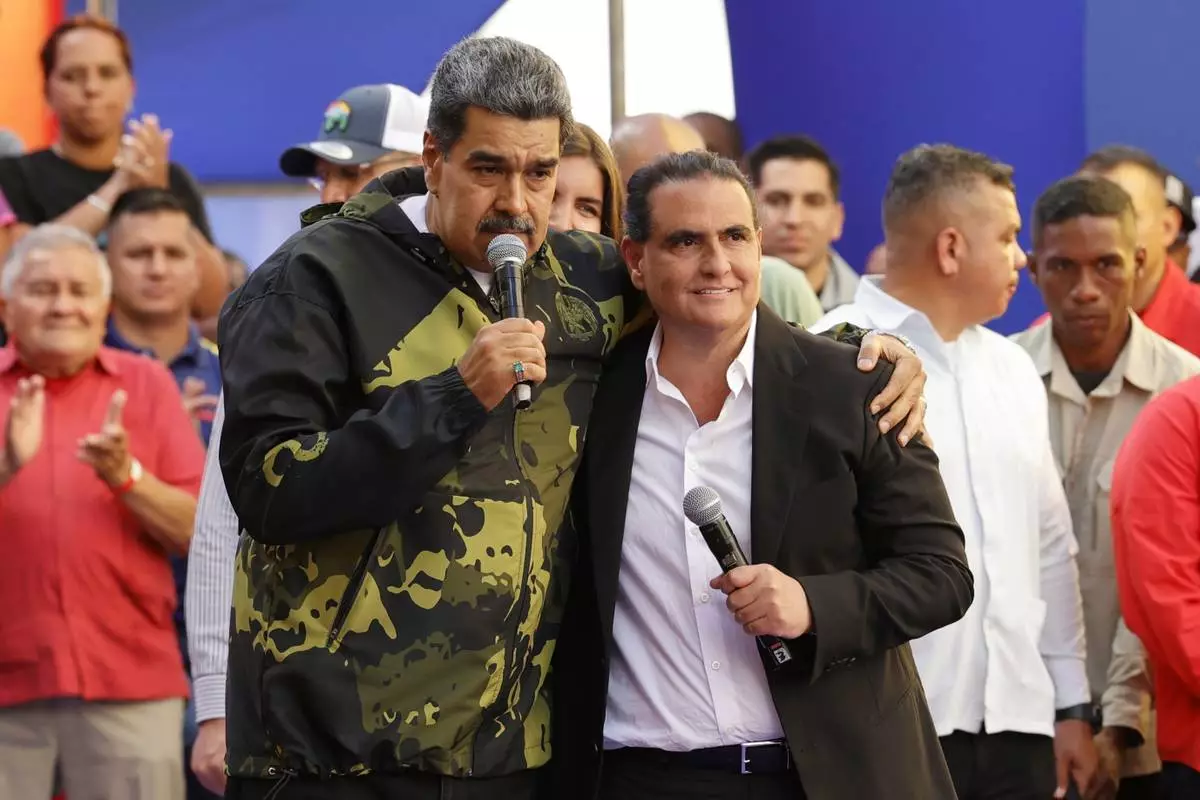
FILE - Venezuela's President Nicolas Maduro, left, and Alex Saab stand together during an event marking the anniversary of the 1958 coup that overthrew dictator Marcos Perez Jimenez, in Caracas, Venezuela, Jan. 23, 2024. (AP Photo/Jesus Vargas, File)