Skip to Content Facebook Feature Image

AP Explains: Iran's FM quits as atomic deal unravels

News

AP Explains: Iran's FM quits as atomic deal unravels
News

News

AP Explains: Iran's FM quits as atomic deal unravels

2019-02-26 18:15 Last Updated At:18:20

The nuclear deal with world powers once buoyed the political fortunes of Iran's President Hassan Rouhani and his trusted Foreign Minister Mohammad Javad Zarif. Now it threatens to sink them.

Facing growing political and economic pressure after President Donald Trump's decision to withdraw America from the atomic accord, Zarif resigned suddenly Monday night and Rouhani now faces renewed calls from hard-liners to do the same.

While Rouhani has yet to accept Zarif's resignation, the relatively moderate cleric has hardened his tone toward the West. The fallout has also exposed inner tensions within Iran's theocracy, where both elected officials and paramilitary forces answer to Supreme Leader Ayatollah Ali Khamenei.
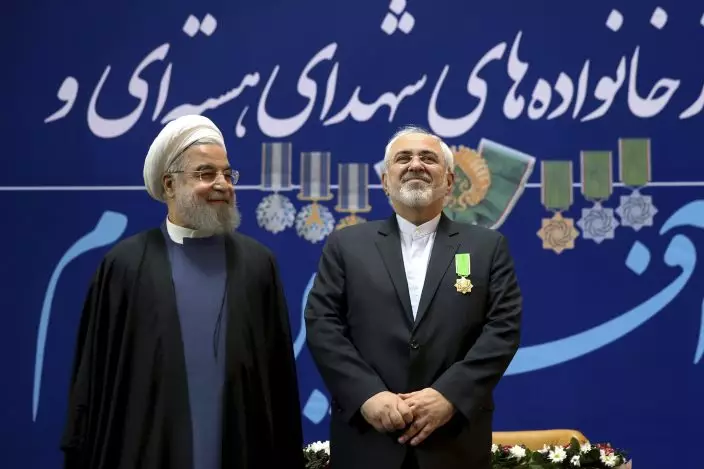
FILE - In this Feb. 8, 2016 file photo, Iranian President Hassan Rouhani, left, and his Foreign Minister Mohammad Javad Zarif pose for a photograph after Zarif was awarded a "Medal of Merit" in a ceremony in Tehran, Iran. The nuclear deal with world powers once buoyed the political fortunes of Rouhani and Zarif. Now it threatens to sink them. (AP PhotoEbrahim Noroozi, File)

FILE - In this Feb. 8, 2016 file photo, Iranian President Hassan Rouhani, left, and his Foreign Minister Mohammad Javad Zarif pose for a photograph after Zarif was awarded a "Medal of Merit" in a ceremony in Tehran, Iran. The nuclear deal with world powers once buoyed the political fortunes of Rouhani and Zarif. Now it threatens to sink them. (AP PhotoEbrahim Noroozi, File)

WHAT HAPPENED?

Late Monday, Zarif posted a picture on Instagram honoring Fatima, the daughter of the Prophet Muhammad, as Iranians commemorate her birth Tuesday. He wrote in the caption: "I sincerely apologize for inability to continue service and for all the shortcomings during my service." Minutes later, Iran's state-run IRNA news agency confirmed through a spokesman that Zarif, 59, had resigned.

WHY NOW?

FILE - In this July 14, 2015 file photo, Iranians celebrate following a landmark nuclear deal in Tehran, Iran. The nuclear deal with world powers once buoyed the political fortunes of Iran's President Hassan Rouhani and his trusted Foreign Minister Mohammad Javad Zarif. Now it threatens to sink them. (AP PhotoEbrahim Noroozi, File)

FILE - In this July 14, 2015 file photo, Iranians celebrate following a landmark nuclear deal in Tehran, Iran. The nuclear deal with world powers once buoyed the political fortunes of Iran's President Hassan Rouhani and his trusted Foreign Minister Mohammad Javad Zarif. Now it threatens to sink them. (AP PhotoEbrahim Noroozi, File)

That remains unclear. Zarif on Tuesday morning reportedly told diplomats his resignation would further empower the Foreign Ministry against those who encroach on it. The remarks came after Syrian President Bashar Assad was received by Khamenei and Gen. Qassem Soleimani, the head of an elite force within the Revolutionary Guard. Photographs of the meetings released by state media showed no sign that Zarif attended.

WHY IS THIS IMPORTANT?

Zarif was the main negotiator of the 2015 nuclear deal, which he hammered out during several rounds of talks with then-Secretary of State John Kerry. He was also seen as the face of Iran's growing outreach to the West, frequently tweeting in English.
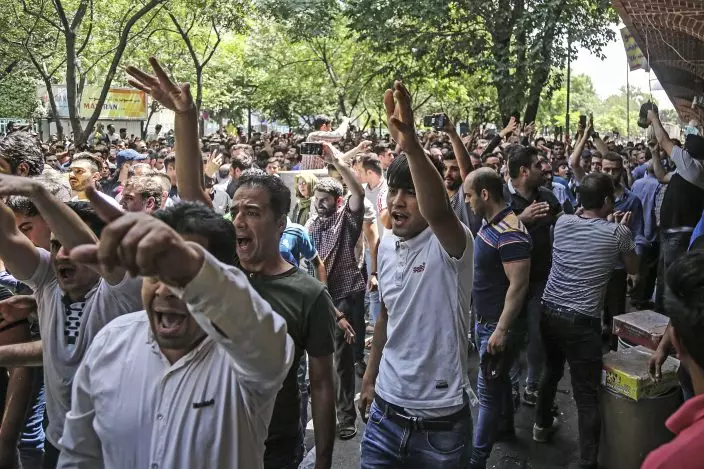
FILE - In this June 25, 2018 file photo, a group of protesters chant slogans at the old grand bazaar in Tehran, Iran, as they demonstrate against economic issues. The nuclear deal with world powers once buoyed the political fortunes of Iran's President Hassan Rouhani and his trusted Foreign Minister Mohammad Javad Zarif. Now it threatens to sink them. (Iranian Labor News Agency via AP, File)

FILE - In this June 25, 2018 file photo, a group of protesters chant slogans at the old grand bazaar in Tehran, Iran, as they demonstrate against economic issues. The nuclear deal with world powers once buoyed the political fortunes of Iran's President Hassan Rouhani and his trusted Foreign Minister Mohammad Javad Zarif. Now it threatens to sink them. (Iranian Labor News Agency via AP, File)

His resignation comes amid growing criticism of that approach. Iranians celebrated the signing of the nuclear deal, which promised to lift crippling sanctions in exchange for Tehran curbing its uranium enrichment. But the agreement was cast into doubt with Trump's election, and he withdrew from it and restored sanctions last year.

As a result, most Iranians saw no benefit from the deal, or from Rouhani and Zarif's outreach. Iran's currency has tanked over the past year, wiping out people's life savings and sending prices soaring. Sporadic protests have broken out, and Rouhani has recently adopted a stronger tone toward the West.

WHO IS IN CHARGE?

The supreme leader has final say on all state matters and serves as the country's commander in chief. Iranian presidents serve four-year terms and are subordinate to the supreme leader but still wield considerable influence over both domestic policy and foreign affairs. Iran also has an elected parliament.

Within its elected government, politicians are roughly divided into reformists who seek to change Iran's political system from within; hard-liners, who believe the supreme leader is God's chosen representative and want a more confrontational approach to the West; and moderates, who chart a middle path.

But there's also the Revolutionary Guard, which answers directly to the supreme leader. The Guard's political and economic influence has ballooned in recent years, and Soleimani has emerged as a national hero over his role in leading its military interventions around the region. Many Iranians say they trust the Guard more than the civilian government, suggesting it should take on an even greater role.

WHAT HAPPENS NEXT?

Rouhani must now decide whether to accept or reject Zarif's resignation. Analysts and others say this is Zarif's third resignation in the last year, but the first to become public. It's also likely Zarif spoke first with the supreme leader to get his permission, which would further pressure Rouhani to accept it.

If Rouhani accepts his resignation, the choice of Zarif's successor will signal the president's future approach to the West. U.N. inspectors say Iran is still complying with the nuclear deal. But as it continues to unravel, Iran may decide it has more to gain by withdrawing from the agreement, or threatening to do so.

Either way, Rouhani could be the next to go, as hard-liners increasingly speak about impeaching him.

Follow Jon Gambrell on Twitter at www.twitter.com/jongambrellap .
NEW YORK (AP) — More drops for superstars caught up in Wall Street’s artificial-intelligence frenzy knocked the U.S. stock market off its record highs. The S&P 500 fell 1.1% Friday from its all-time high and had its worst day in three weeks. The weakness for tech stocks yanked the Nasdaq composite down a market-leading 1.7%, and the Dow Jones Industrial Average fell 0.5% from its own record set the day before. Broadcom dragged the market lower even though the chip company reported a stronger profit for the latest quarter than analysts expected. Treasury yields rose to crank up the pressure on stocks.

THIS IS A BREAKING NEWS UPDATE. AP’s earlier story follows below.

NEW YORK (AP) — More drops for superstars caught up in Wall Street's artificial-intelligence frenzy are knocking the U.S. stock market off its record highs on Friday.

The S&P 500 fell 1% from its all-time high set the day before and was heading toward its worst day in three weeks. The weakness for tech stocks yanked the Nasdaq composite down by a market-leading 1.5%, as of 3:11 p.m. Eastern time, and the Dow Jones Industrial Average gave back 190 points, or 0.4%, after setting its own record the day before.

Broadcom dragged the market lower and tumbled 12% even though the chip company reported a stronger profit for the latest quarter than analysts expected. Analysts called the performance solid, and CEO Hock Tan said strong 74% growth in AI semiconductor revenue helped lead the way.

But investors may have been concerned with some of Broadcom’s financial forecasts, including how much profit it can squeeze out of each $1 of revenue. The AI heavyweight may also have simply run out of momentum after its stock came into the day with a surge of 75.3% for the year so far, more than quadruple the S&P 500’s gain.

Broadcom’s stumble came a day after Oracle plunged nearly 11% despite likewise reporting a bigger profit for the latest quarter than analysts expected.

Doubts remain about whether all the spending that Oracle is doing on AI technology will end up being worth it, along with how it will pay for it. Such questions are dogging the AI industry broadly, even as many billions of dollars continue to flow in.

Broadcom was the heaviest weight on the S&P 500 Friday, followed by Nvidia. The chip company that's become the poster child of the AI boom fell 2.5%. Oracle fell another 4.4%.

The stock market also felt some pressure from the bond market, where the yield on the 10-year Treasury climbed to 4.19% from 4.14% late Thursday. Higher yields can discourage investors from paying high prices for stocks and other investments, particularly when critics say they already look too expensive.

Friday's drops for AI superstars continue a jagged return toward Earth after they earlier had been the main engine propelling Wall Street higher. Other stocks that used to struggle with uncertainty about the U.S. economy’s strength and what the Federal Reserve will do with interest rates, meanwhile, have been doing better.

The stocks in the Dow Jones Industrial Average, which has much less of an emphasis on tech, are still up 1.2% for the week so far. That's much better than the Nasdaq composite's drop of 1.5%.

Even with Friday's rise in yields, investors are feeling more optimistic about interest rates. The Fed earlier this week cut its main interest rate for the third time this year and indicated another cut may be ahead in 2026. Wall Street loves lower rates because they can boost the economy and send prices for investments higher, even if they potentially make inflation worse.

The Fed’s chair, Jerome Powell, did hint on Wednesday that interest rates may be on hold for a while. But he helped soothe nerves when his comments appeared less harsh than some investors expected in shutting off the possibility of more cuts in 2026.

Stocks of travel-related companies were relatively strong on Friday, and 41% of the stocks within the S&P 500 rose. Oil prices have eased this week, which should help trim their bills, and hopes are rising that easier interest rates will support the economy and encourage more people to take trips.

Southwest Airlines climbed 1.6%, while Norwegian Cruise Line rose 1.6%.

The biggest gain in the S&P 500 came from Lululemon Athletica, which jumped 12.2% after reporting better profit and revenue for the three months through Nov. 2 than analysts expected. It also said its CEO, Calvin McDonald, plans to step down at the end of January following pressure to boost revenue.

In stock markets abroad, indexes fell in Europe following a stronger finish in Asia.

Stocks jumped 1.7% in Hong Kong and rose 1.4% in Tokyo for two of the world’s bigger gains.

AP Writers Teresa Cerojano and Matt Ott contributed.

Trader William Lawrence works on the floor of the New York Stock Exchange, Thursday, Dec. 11, 2025. (AP Photo/Richard Drew)

Trader William Lawrence works on the floor of the New York Stock Exchange, Thursday, Dec. 11, 2025. (AP Photo/Richard Drew)

Trader Jonathan Mueller works on the floor of the New York Stock Exchange, Thursday, Dec. 11, 2025. (AP Photo/Richard Drew)

Trader Jonathan Mueller works on the floor of the New York Stock Exchange, Thursday, Dec. 11, 2025. (AP Photo/Richard Drew)

Currency traders work near a screen showing the Korea Composite Stock Price Index (KOSPI) at the foreign exchange dealing room of the Hana Bank headquarters in Seoul, South Korea, Friday, Dec. 12, 2025. (AP Photo/Ahn Young-joon)

Currency traders work near a screen showing the Korea Composite Stock Price Index (KOSPI) at the foreign exchange dealing room of the Hana Bank headquarters in Seoul, South Korea, Friday, Dec. 12, 2025. (AP Photo/Ahn Young-joon)

Currency traders work near a screen showing the Korea Composite Stock Price Index (KOSPI), left, and the foreign exchange rate between U.S. dollar and South Korean won at the foreign exchange dealing room of the Hana Bank headquarters in Seoul, South Korea, Friday, Dec. 12, 2025. (AP Photo/Ahn Young-joon)

Currency traders work near a screen showing the Korea Composite Stock Price Index (KOSPI), left, and the foreign exchange rate between U.S. dollar and South Korean won at the foreign exchange dealing room of the Hana Bank headquarters in Seoul, South Korea, Friday, Dec. 12, 2025. (AP Photo/Ahn Young-joon)

A board above the trading floor of the New York Stock Exchange displays the closing number for the Dow Jones industrial average, Thursday, Dec. 11, 2025. (AP Photo/Richard Drew)

A board above the trading floor of the New York Stock Exchange displays the closing number for the Dow Jones industrial average, Thursday, Dec. 11, 2025. (AP Photo/Richard Drew)

Currency traders watch monitors near a screen showing the Korea Composite Stock Price Index (KOSPI) at the foreign exchange dealing room of the Hana Bank headquarters in Seoul, South Korea, Friday, Dec. 12, 2025. (AP Photo/Ahn Young-joon)

Currency traders watch monitors near a screen showing the Korea Composite Stock Price Index (KOSPI) at the foreign exchange dealing room of the Hana Bank headquarters in Seoul, South Korea, Friday, Dec. 12, 2025. (AP Photo/Ahn Young-joon)

Recommended Articles