
Skip to Content Facebook Feature Image

Cohen returns to Capitol Hill for 4th day of testimony

News

Cohen returns to Capitol Hill for 4th day of testimony
News

News

Cohen returns to Capitol Hill for 4th day of testimony

2019-03-06 13:18 Last Updated At:13:20

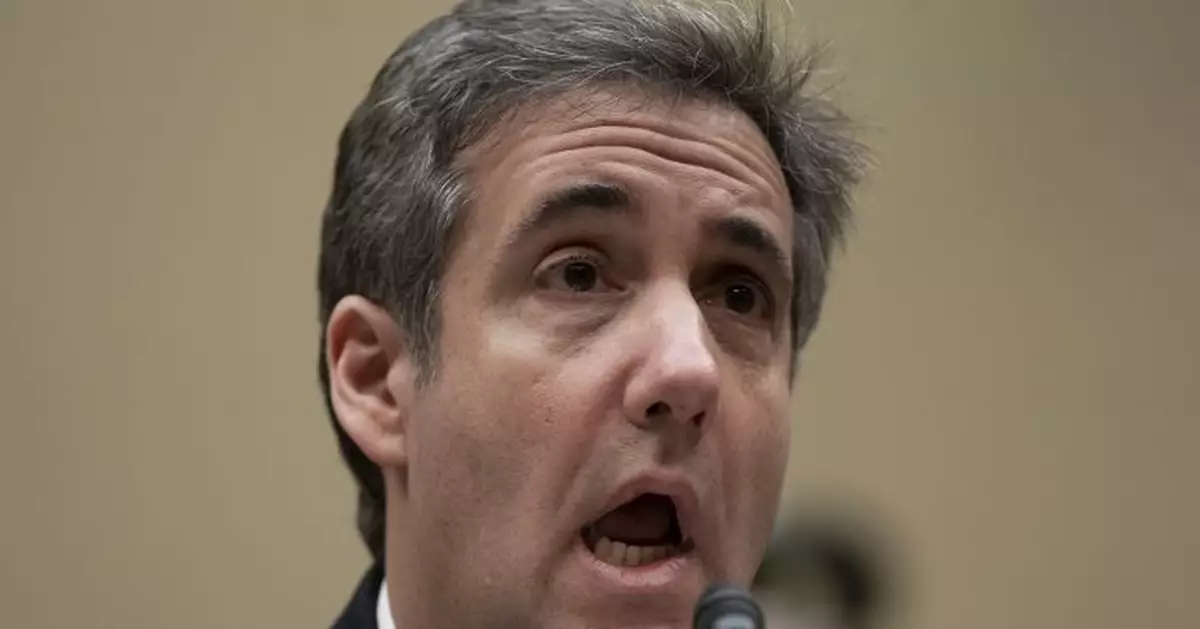
President Donald Trump's former lawyer is returning to Capitol Hill for a fourth day of testimony as Democrats pursue a flurry of investigations into Trump's White House, businesses and presidential campaign.

Michael Cohen became a key figure in those investigations after turning on his former boss and cooperating with special counsel Robert Mueller's probe. He was interviewed behind closed doors by both the Senate and House intelligence committees last week and is due for another private, daylong meeting with the House intelligence panel on Wednesday.

Cohen also testified publicly before the House Oversight and Reform Committee, where he called Trump a con man, a cheat and a racist. He pleaded guilty last year to lying to Congress, campaign finance violations and other charges and is set to begin a three-year prison sentence in May.

Among the issues discussed in Cohen's closed-door interviews with both the House and Senate was the issue of pardons, according to people familiar with those interviews. They requested anonymity to speak about the confidential discussion.

The issue is expected to come up again during Cohen's return visit. Though Cohen told Congress last week that he had never asked for nor would accept a pardon from Trump, a lawyer for Cohen expressed interest to the Trump legal team in a possible pardon for his client in the aftermath of a raid last April on Cohen's hotel room, home and office, according to people familiar with the encounter who weren't authorized to discuss it by name and spoke on the condition of anonymity.

The president's attorneys were noncommittal during the conversation with Cohen's lawyer, Stephen Ryan, the people said. Cohen did not participate in the conversation.

No pardon was given, and Cohen ultimately wound up pleading guilty and cooperating against the president in separate investigations by the special counsel and by federal prosecutors in New York. Another of Cohen's lawyers, Lanny Davis, said on MSNBC Tuesday evening that Cohen was referring to the time after he turned on Trump when he testified that he wouldn't accept a pardon.

There is nothing inherently improper about a subject in a criminal investigation seeking a pardon from a president given the president's wide latitude in granting them. But lawmakers have requested information about talks on possible pardons for Cohen and other defendants close to the president who have become entangled in Mueller's investigation.

House Intelligence Committee Chairman Adam Schiff, D-Calif., said after last week's private meeting with Cohen that the committee had "additional document requests" that they were discussing with him. Schiff would not comment on the substance of the interview, but said it helped "to shed light on a lot of issues that are very core to our investigation."

The intelligence panel is investigating Russian interference in the 2016 election and whether Trump's campaign coordinated with the Russians in any way. They are also looking into Trump's foreign financial dealings and whether there was obstruction of justice. It is one of several probes Democrats have launched in recent weeks as they delve deeper into Trump's political and personal dealings.

On Monday, House Judiciary Committee Chairman Jerrold Nadler, D-N.Y., sent 81 letters to Trump's family and associates seeking documents and information. Nadler said he would investigate possible obstruction of justice, corruption and abuse of power.

Cohen pleaded guilty to lying to Congress about the duration of negotiations over a Trump real estate project in Moscow. In addition, he pleaded guilty to campaign finance violations for his involvement in payments to two women who allege they had affairs with Trump, affairs that Trump denies.

Federal prosecutors in New York have said Trump directed Cohen to arrange the payments to buy the silence of porn actress Stormy Daniels and former Playboy model Karen McDougal in the run-up to the 2016 campaign. Cohen told a judge that he agreed to cover up Trump's "dirty deeds" out of "blind loyalty."

Cohen said in the Oversight testimony that Trump directed him to arrange the hush money payment to Daniels. He said the president arranged to reimburse Cohen, and Cohen brought to the hearing a check that he said was proof of the transaction.

Follow all of AP's Trump Investigations coverage at https://apnews.com/TrumpInvestigations

JOHANNESBURG (AP) — South African immigration authorities raided a United States refugee processing center in Johannesburg and seven Kenyans working there illegally were arrested and given deportation orders, South Africa's Home Affairs Ministry said Wednesday, as the U.S. called the action “unacceptable.”

Tuesday's raid occurred at a center that processes applications by white South Africans who have been given priority for refugee status in the U.S. by the Trump administration. It was bound to increase tensions between the countries, whose relations have cooled dramatically since President Donald Trump returned to office.

The Trump administration's claim that members of South Africa's Afrikaner white minority group are being persecuted by the Black-led government has been widely rejected, but it has been central to the deterioration of ties between the U.S. and Africa's most advanced economy.

The Home Affairs Ministry said the Kenyans were in the country on tourist visas which did not allow them to work, adding that U.S. officials' work with them at the refugee processing center “raises serious questions about intent and diplomatic protocol.”

It was not immediately clear whether the U.S. had known about the Kenyans’ status.

The ministry said no U.S. officials were arrested in the raid and that the site was not a diplomatic one. It said South Africa's Foreign Ministry has started “formal diplomatic engagements with both the United States and Kenya to resolve this matter.”

U.S. State Department spokesperson Tommy Pigott said “interfering in our refugee operations is unacceptable,” adding that they were seeking “immediate clarification from the South African government and expect full cooperation and accountability.”

The U.S. Embassy in a statement last month said the U.S. government had contracted a Kenya-based company, RSC Africa, to process refugee applications by white South Africans. RSC Africa is operated by Church World Service, a U.S.-based nongovernmental organization that offers refugee assistance and works with the U.S. Refugee Admissions Program.

The Home Affairs Ministry said the Kenyans were working at the U.S. refugee processing site “despite the fact that earlier visa applications for Kenyan nationals to perform this work had been lawfully declined.” The seven Kenyans were given deportation orders and banned from entering South Africa for a five-year period.

Trump has singled out South Africa for criticism on a range of issues, claiming without evidence that Afrikaners are being killed and having their land seized and that South Africa is pursuing an anti-U.S. foreign policy through its diplomatic relations with Palestinian authorities and Iran.

The U.S. boycotted last month's Group of 20 world leaders summit in South Africa, and Trump said it will exclude South Africa from the group when it hosts the annual summit next year. Trump also issued an executive order in February that said the U.S. would stop aid and assistance to South Africa over what it called its “egregious actions.”

South Africa's government has said the U.S. claims over the persecution of Afrikaners are based on misinformation and that white South Africans don't meet the criteria for refugee status because there is no persecution, although it said it wouldn't stop anyone applying. Afrikaners are white South Africans descended from mainly Dutch and French colonial settlers who first came to the country in the 17th century.

The Trump administration announced in October it was dramatically cutting the annual quota for refugees allowed in the U.S. to 7,500 from a previous limit of 125,000 and white South Africans would be given most of the places. A first group of white South African refugees had already arrived in the U.S. under the new program for them in May. It's not clear how many have been relocated since then.

Imray reported from Cape Town, South Africa. Associated Press writer Matthew Lee in Washington contributed to this report.

AP Africa news: https://apnews.com/hub/africa

FILE - Refugees from South Africa arrive, Monday, May 12, 2025, at Dulles International Airport in Dulles, Va. (AP Photo/Julia Demaree Nikhinson, File)

FILE - Refugees from South Africa arrive, Monday, May 12, 2025, at Dulles International Airport in Dulles, Va. (AP Photo/Julia Demaree Nikhinson, File)

FILE - Refugees from South Africa, arrive Monday, May 12, 2025, at Dulles International Airport in Dulles, Va. (AP Photo/Julia Demaree Nikhinson, File)

FILE - Refugees from South Africa, arrive Monday, May 12, 2025, at Dulles International Airport in Dulles, Va. (AP Photo/Julia Demaree Nikhinson, File)

Recommended Articles