From Ben Affleck and Susan Sarandon to Anna Wintour and Willie Nelson, celebrities lined up to give money — and a dash of star power — to their favorite Democratic presidential candidates ahead of this week's first quarter fundraising deadline.
For months, candidates in the crowded field of more than a dozen contenders have aggressively courted key figures in music, television, publishing and film, who are one of the party's most reliable sources of campaign cash. Although many donors remain on the sidelines, contributing to lackluster fundraising hauls, an early snapshot included in the campaign finance reports submitted to the Federal Election Commission this week offers a glimpse of who is drawing attention from entertainment industry in the early stages of the race.
"When you talk about Hollywood, yes, we are talking about movie stars and writers and directors, but we are also talking about people with decades of experience with presidential campaigns," said Yusef Robb, a longtime California political strategist. "Earning support from somebody with a lot of connections in the political world couples with their star power, which people in the chattering classes notice."
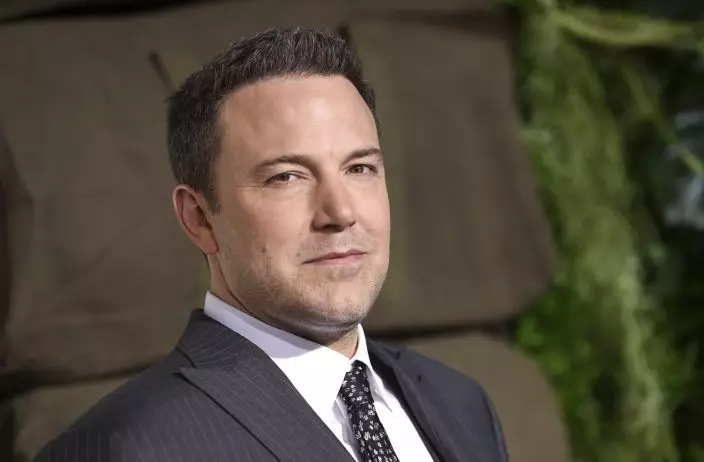
FILE - In this March 3, 2019, file photo, actor Ben Affleck attends the world premiere of "Triple Frontier" at Jazz at Lincoln Center in New York. From Ben Affleck and Susan Sarandon to Anna Wintour and Willie Nelson, celebrities lined up to give money to their favorite Democratic presidential candidates. (Photo by Evan AgostiniInvisionAP, File)
California Sen. Kamala Harris has long-standing relationships with major entertainment industry figures in her home state. But former Texas Rep. Beto O'Rourke, Vermont Sen. Bernie Sanders and South Bend, Indiana, Mayor Pete Buttigieg are also among the candidates who count celebrities as donors.
So far, few donors are bundling large sums of money for candidates by asking their friends, family and colleagues to give, too. But many have given individually, which is limited under campaign finance law to a $2,800 contribution during the primary election, followed by another $2,800 earmarked for the general election campaign.
Last month, Harris was feted at the Pacific Palisades home of director J.J. Abrams and his wife, Katie McGrath, in a gathering attended by Hollywood powerbrokers, including TV hitmaker Shonda Rhimes. Harris also has received money from Ben Affleck, who gave $2,800; actress Eva Longoria, who gave $5,400; composer Quincy Jones, who gave $2,800; and former "Mad Men" star Jon Hamm, who gave $1,000.
O'Rourke, a former punk rocker, received $2,800 from a fellow Texan, county music icon Willie Nelson, as well as $1,850 from Grateful Dead bassist Phil Lesh and $2,800 from Dave Matthews Band violinist Boyd Tinsley. He also took in $5,600 from Vogue editor-in-chief Anna Wintour, $1,500 from comedian and "Breaking Bad" actor Bob Odenkirk, $2,500 from Texas film director Richard Linklater and $350 from "Saturday Night Live" star Cecily Strong.
Sanders received $2,700 from actor and comedian Danny DeVito, $2,800 from actress Susan Sarandon, $2,500 from piano player Norah Jones and $1,000 from Foo Fighters guitarist Christopher Shiflett. Jonathan Fishman, drummer for the jam band Phish, which was formed in Sanders' home state of Vermont, gave $1,000, while Thomas Middleditch from HBO's "Silicon Valley" gave $500, records show.
Buttigieg, whose campaign raked in $7 million after emerging as an unexpected hit, has also started to draw celebrity attention. "West Wing" star Bradley Whitford gave $2,000, actor Ryan Reynolds donated $250, NFL network broadcaster Rich Eisen gave $500 and "Game of Thrones" executive producer Carolyn Strauss chipped in $250.
Buttigieg also drew at least one contribution from an unusual source. James Murdoch, the son of conservative media mogul Rupert Murdoch, whose Fox News is closely allied with President Donald Trump, cut Buttigieg a $2,800 donation, record show.
NEW YORK (AP) — A federal judge in New York tossed out actor Blake Lively’s sexual harassment claims Thursday against actor Justin Baldoni over their roles in the movie “It Ends With Us,” but he left intact three claims, including retaliation, that will let a jury hear many of the allegations anyway.
The written ruling by Judge Lewis J. Liman in Manhattan came after Lively sued Baldoni last December, alleging sexual harassment among over a dozen claims against Baldoni and other parties.
A trial is scheduled for May 18.
Baldoni and production company Wayfarer Studios had countersued Lively and her husband, “Deadpool” actor Ryan Reynolds, accusing them of defamation and extortion. The judge dismissed Baldoni’s claims last June.
In his ruling, Liman determined that Lively was an independent contractor rather than an employee. On that basis, he said she was not entitled to bring sexual harassment claims under Title VII of the Civil Rights Act of 1964. That law prohibits employment discrimination on various grounds, including gender.
As to retaliation claims, the judge said some evidence might enable a jury to conclude that Baldoni's production company planned not only to damage Lively's reputation but to destroy her career as there was fear she would file a discrimination claim. Lively alleges that a smear campaign has been “devastating for her reputation and career,” the judge noted.
In an analysis of the sexual harassment claims, the judge said Lively's claims had to be viewed in the context of the movie they were working on.
“Lively claims that during filming, Baldoni leaned in and gestured as if he was intending to kiss her, and that he kissed her forehead, rubbed his face and mouth against her neck, put his thumb to her mouth and flicked her lower lip, caressed her, and leaned into her neck, saying ‘it smells good,’” the judge wrote.
He said there was no question that the conduct would support a hostile work environment claim if it happened on a factory floor or in an executive suite.
However, the judge noted, Baldoni was “acting in the scene.”
“Assuming he was improvising, the conduct was not so far beyond what might reasonably be expected to take place between two characters during a slow dancing scene such that an inference of hostile treatment on the basis of sex would arise. At least in isolation, the conduct was directed to Lively’s character rather than to Lively herself,” he wrote.
“Creative artists, no less than comedy room writers, must have some amount of space to experiment within the bounds of an agreed script without fear of being held liable for sexual harassment,” Liman added.
Despite those findings, the judge said some of Lively's claims about sexual harassment may be put to a jury to support two retaliation claims that survived the ruling, including one against It Ends With Us Movie LLC and Wayfarer Studios, and a third claim that was left intact alleging breach of a contract rider agreement against It Ends With Us Movie LLC.
The judge noted that Baldoni once said “pretty hot” after asking Lively to remove her jacket, exposing a lace bra underneath, and that when he was warned that it was inappropriate and distracting to make such comment, he allegedly rolled his eyes and responded: “Sorry, I missed the sexual harassment training.”
Liman also cited a scene in which Baldoni pushed for Lively to perform a birth scene naked and then the scene was filmed over several hours without the set being closed to nonessential personnel.
And in another instance, the judge said, it was alleged that Baldoni volunteered that he had previously been addicted to pornography and Lively said she had never seen pornography.
Liman said it “may be fair grounds for an author or a director to discuss personal experiences, including those related to sex, as part of the creative process,” but the judge wrote that Baldoni may have crossed the line when he later announced to others on set that Lively had never seen pornography.
In a statement, Lively attorney Sigrid McCawley wrote that Lively “looks forward to testifying at trial and continuing to shine a light on this vicious form of online retaliation so that it become easier to detect and fight.”
She added: “This case has always been and will remain focused on the devasting retaliation and the extraordinary steps the defendants took to destroy Blake Lively’s reputation because she stood up for safety on the set and that is the case that is going to trial.”
A lawyer for Baldoni and his production company did not immediately comment.
“It Ends With Us,” an adaptation of Colleen Hoover’s bestselling 2016 novel that begins as a romance but takes a dark turn into domestic violence, was released in August 2024, exceeding box office expectations with a $50 million debut. But the movie’s release was shrouded by speculation over discord between Lively and Baldoni.
Lively appeared in the 2005 film “The Sisterhood of the Traveling Pants” and the TV series “Gossip Girl” from 2007 to 2012 before starring in films including “The Town” and “The Shallows.”
Baldoni starred in the TV comedy “Jane the Virgin,” directed the 2019 film “Five Feet Apart” and wrote “Man Enough,” a book challenging traditional notions of masculinity.
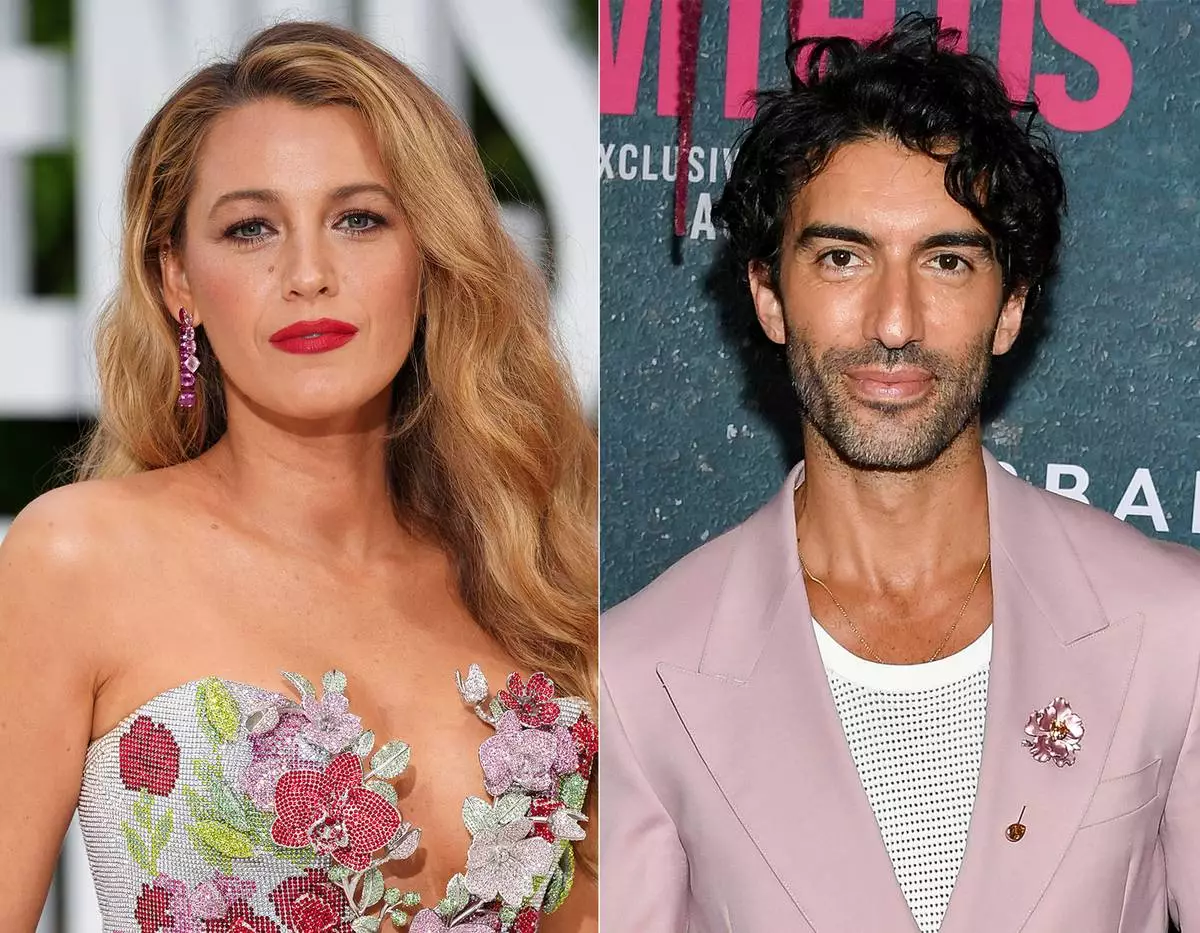
This combination of images shows Blake Lively at the London screening of the film "It 'Ends With Us" on Aug. 8, 2024, left, and Justin Baldoni at the world premiere of the film in New York on Aug. 6, 2024. (AP Photo)