
Skip to Content Facebook Feature Image

Students use augmented reality tool to help manufacture race car

TECH

Students use augmented reality tool to help manufacture race car
TECH

TECH

Students use augmented reality tool to help manufacture race car

2019-05-10 22:55 Last Updated At:22:56

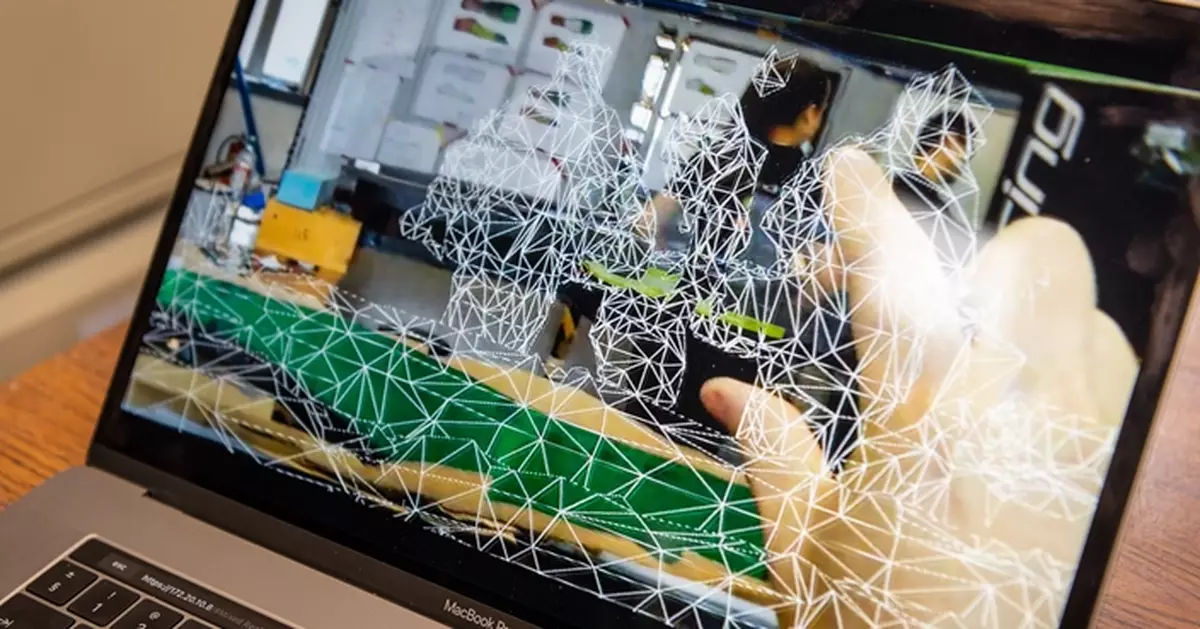
The AR tool will help with the construction of the car’s monocoque – the shell of the vehicle.

Augmented reality is being used for the first time to build a race car intended for use in competitive racing, according to a university.

Students at the University of Bath are using a new AR tool developed by technology company Rocketmakers in the project.

When complete, their vehicle will race in the 2019 Formula Student competition run by the Institution of Mechanical Engineers.

AR has previously been used in tests and demonstrations by car manufacturers but it is believed this is the first time the technology will be used to build a car intended for use in competitive racing.

The AR tool will help with the construction of the car’s shell, known as a monocoque, specifically with the application of carbon fibre laminates.

This process will be conducted over a week, with students from Team Bath Racing working in shifts to apply each pre-cut carbon fibre laminate in the correct location.

The Rocketmakers tool creates an AR version of the monocoque with the correct shape, location and orientation of each segment of laminate visible to the wearer during the application process.

It will be used through two Microsoft Hololens headsets, with computer assisted design (CAD) files that the students have developed.

Jack Harris, a student of mechanical with automotive engineering at the University of Bath, said: “After you’ve spent most of a year designing a car, the week-long process of carbon fibre layup is really nerve-racking.

“We’ve been talking to Rocketmakers for months to determine where the best use of AR technology would be for assisting car construction.

“Carbon fibre layup is definitely one of those jobs that, despite the high tech equipment we use for our design and testing, still relies mostly on hand-eye co-ordination.

“Having a tool to assist with the stressful, backbreaking process is really exciting.”

It is hoped that the tool will provide users with an improved work experience and accuracy rate than current methods.

Carbon fibre laminates are typically applied by robots in production vehicles.

Their application in small-scale production is considered one of the more physically and mentally demanding parts of building bespoke vehicles.

One misplaced carbon fibre segment can have large negative consequences for the integrity of the final result.

The Formula Student competition challenges student engineers to design, build and race a single-seat car in one year.

Richard Godfrey, chief executive of Rocketmakers, said: “It will be great knowing when we see the Team Bath Racing car zip around the track that our designers had a hand in making it one of the world’s first AR-assisted cars.”

BRUSSELS (AP) — The European Union's executive on Wednesday warned that it would take action against any “unjustified measures” after the U.S. State Department barred five Europeans it accuses of pressuring U.S. technology firms to censor or suppress American viewpoints.

The Europeans were characterized by U.S. Secretary of State Marco Rubio as “radical” activists and “weaponized” nongovernmental organizations. They include the former EU commissioner responsible for supervising social media rules, Thierry Breton.

Breton, a businessman and former French finance minister, clashed last year on social media with tech billionaire Elon Musk over broadcasting an online interview with Donald Trump in the months leading up to the U.S. election.

The European Commission, the EU’s powerful executive branch and which supervises tech regulation in Europe, said that it “strongly condemns the U.S. decision to impose travel restrictions” and that it has requested clarification about the move. French President Emmanuel Macron also condemned it.

“If needed, we will respond swiftly and decisively to defend our regulatory autonomy against unjustified measures,” the commission said in a statement, without elaborating.

Rubio wrote in an X post on Tuesday that “for far too long, ideologues in Europe have led organized efforts to coerce American platforms to punish American viewpoints they oppose.”

“The Trump Administration will no longer tolerate these egregious acts of extraterritorial censorship,” he posted.

The European Commission countered that “the EU is an open, rules-based single market, with the sovereign right to regulate economic activity in line with our democratic values and international commitments.”

“Our digital rules ensure a safe, fair, and level playing field for all companies, applied fairly and without discrimination,” it said.

Macron said that the visa restrictions “amount to intimidation and coercion aimed at undermining European digital sovereignty,” he posted on X.

Macron said that the EU’s digital rules were adopted by “a democratic and sovereign process” involving all member countries and the European Parliament. He said that the rules “ensure fair competition among platforms, without targeting any third country.”

He underlined that “the rules governing the European Union’s digital space are not meant to be determined outside Europe.”

Breton and the group of Europeans fell afoul of a new visa policy announced in May to restrict the entry of foreigners deemed responsible for censorship of protected speech in the United States.

The four others are: Imran Ahmed, chief executive of the Centre for Countering Digital Hate; Josephine Ballon and Anna-Lena von Hodenberg, leaders of HateAid, a German organization; and Clare Melford, who runs the Global Disinformation Index.

Rubio said the five had advanced foreign government censorship campaigns against Americans and U.S. companies, which he said created “potentially serious adverse foreign policy consequences” for the United States.

The action to bar them from the U.S. is part of a Trump administration campaign against foreign influence over online speech, using immigration law rather than platform regulations or penalties.

In a post on X on Tuesday, Sarah Rogers, the U.S. under secretary of state for public diplomacy, called Breton the “mastermind” behind the EU’s Digital Services Act, which imposes a set of strict requirements designed to keep internet users safe online. This includes flagging harmful or illegal content like hate speech.

Breton responded on X by noting that all 27 EU member countries voted for the Digital Services Act in 2022. “To our American friends: ‘Censorship isn’t where you think it is,’” he wrote.

Angela Charlton contributed to this report from Paris.

Secretary of State Marco Rubio speaks during a news conference at the State Department, Friday, Dec. 19, 2025, in Washington. (AP Photo/Julia Demaree Nikhinson)

Secretary of State Marco Rubio speaks during a news conference at the State Department, Friday, Dec. 19, 2025, in Washington. (AP Photo/Julia Demaree Nikhinson)

Recommended Articles