Skip to Content Facebook Feature Image

Timeline of events that led to the fall of the Berlin Wall

News

Timeline of events that led to the fall of the Berlin Wall
News

News

Timeline of events that led to the fall of the Berlin Wall

2019-11-06 16:13 Last Updated At:16:20

A glance at events leading up to the fall of the Berlin Wall in November 1989 and Germany's subsequent reunification.

Jan. 19, 1989: East German leader Erich Honecker says the Berlin Wall "will still exist in 50 and even in 100 years, if the reasons for it are not overcome."

More Images
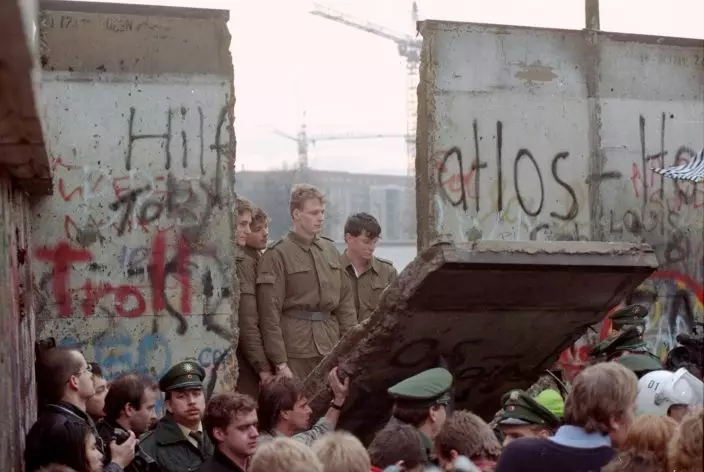
FILE - In this Nov. 11, 1989 file photo, East German border guards are seen through a gap in the Berlin wall after demonstrators pulled down a segment of the wall at Brandenburg gate, Berlin. (AP PhotoLionel Cironneau, File)
FILE - In this Nov. 11, 1989 file photo, East German border guards are seen through a gap in the Berlin wall after demonstrators pulled down a segment of the wall at Brandenburg gate, Berlin. (AP PhotoLionel Cironneau, File)

FILE - In this Saturday Nov. 11, 1989 file photo, hundreds of Berliners climb on top of the Berlin Wall at Brandenburg Gate in Berlin, demanding in a peaceful protest that the wall will be pulled down. (AP PhotoLutz Schmidt, File)
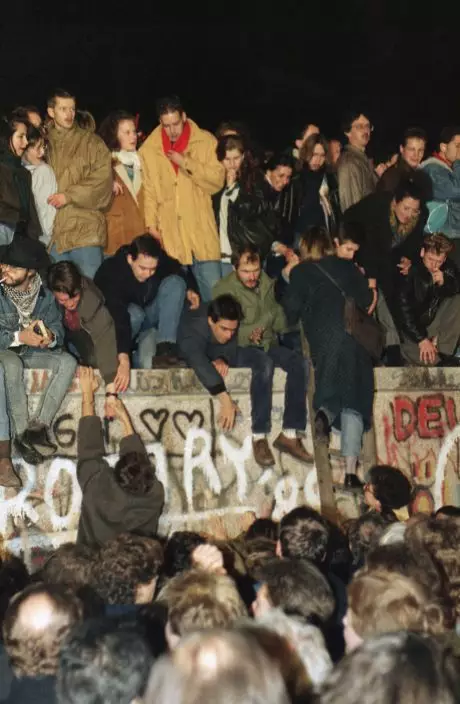
FILE - In this Saturday Nov. 11, 1989 file photo, hundreds of Berliners climb on top of the Berlin Wall at Brandenburg Gate in Berlin, demanding in a peaceful protest that the wall will be pulled down. (AP PhotoLutz Schmidt, File)

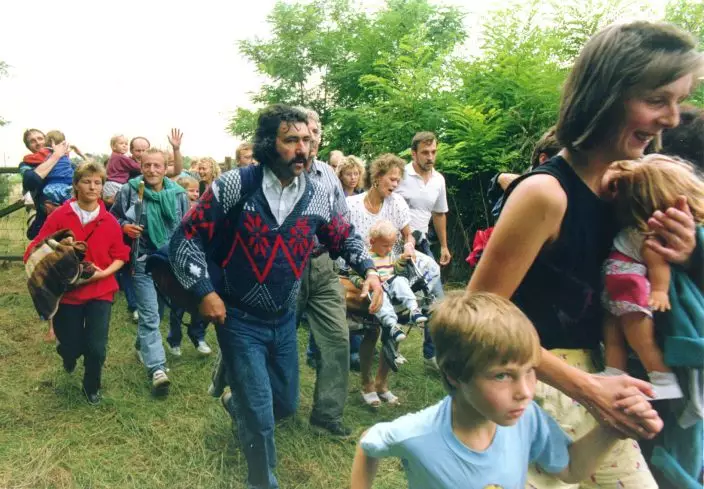
FILE—This Aug.19, 1989 file photo East Germans surprise Hungarian border guards and rush through a gate into Moerbisch, Austria. The gate was opened as part of joint Austrian-Hungarian event, marking the end of the Iron Curtain. The East Germans had heard of the event and used it for their flight to the West. (AP-Photovotava, File)
FILE—This Aug.19, 1989 file photo East Germans surprise Hungarian border guards and rush through a gate into Moerbisch, Austria. The gate was opened as part of joint Austrian-Hungarian event, marking the end of the Iron Curtain. The East Germans had heard of the event and used it for their flight to the West. (AP-Photovotava, File)

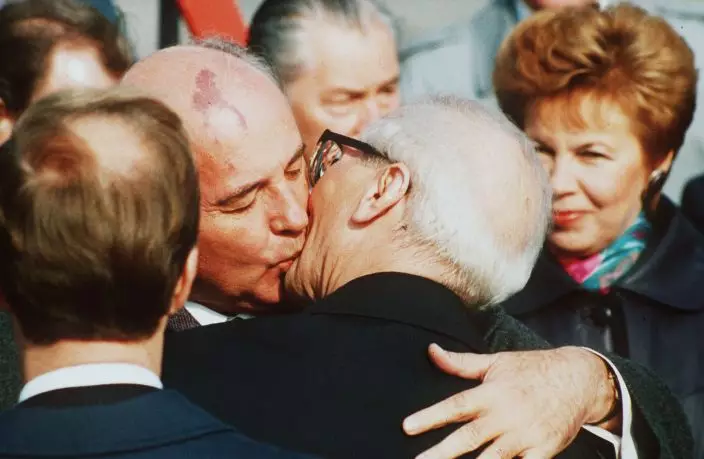
FILE -- In this Oct. 6, 1989 file photo, Soviet President Mikhail Gorbachev, left, kisses East German leader Erich Honecker after Gorbachev's arrival at East Berlin. At right is Raisa Gorbachev. (AP-PhotoBoris Yurchenko)
FILE -- In this Oct. 6, 1989 file photo, Soviet President Mikhail Gorbachev, left, kisses East German leader Erich Honecker after Gorbachev's arrival at East Berlin. At right is Raisa Gorbachev. (AP-PhotoBoris Yurchenko)

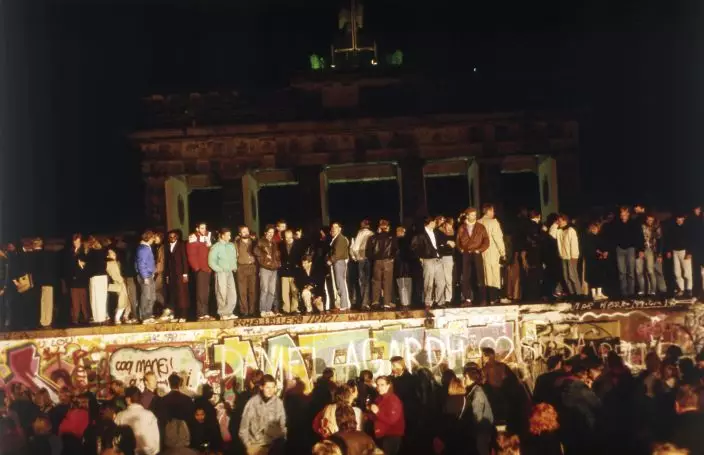
FILE - In this early morning, Nov. 10, 1989 file photo, Berliners from East and West crowd in front of the Brandenburger Tor (Brandenburg Gate), standing atop and below the Berlin Wall, which has divided the city since the end of World War II. (AP PhotoJockel Finck)
FILE - In this early morning, Nov. 10, 1989 file photo, Berliners from East and West crowd in front of the Brandenburger Tor (Brandenburg Gate), standing atop and below the Berlin Wall, which has divided the city since the end of World War II. (AP PhotoJockel Finck)

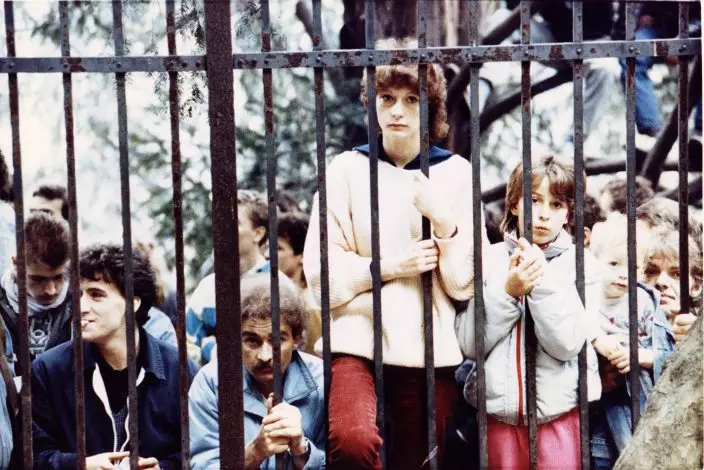
FILE - In this Sept. 30, 1989 file photo, East German refugees look through the fence of the West German embassy in Prague, Czechoslovakia. (AP PhotoDiether Endlicher, File)
FILE - In this Sept. 30, 1989 file photo, East German refugees look through the fence of the West German embassy in Prague, Czechoslovakia. (AP PhotoDiether Endlicher, File)

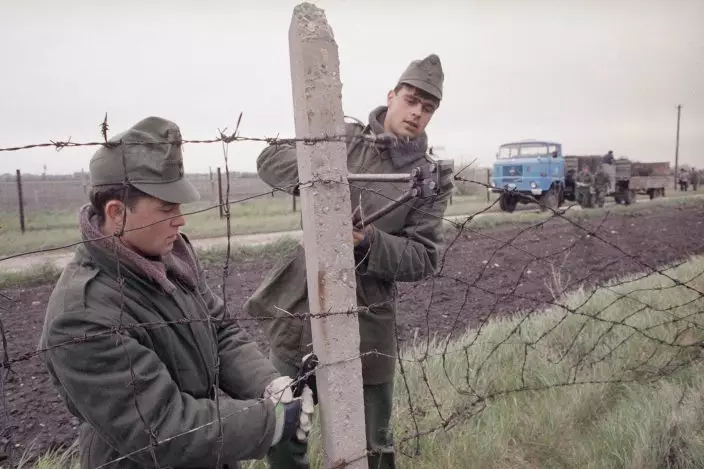
FILE - In this May 2, 1989, file photo, Hungarian border guards cut a hole into the "Iron Curtain," opening its border with Austria and the west near Hegyeshalom, some 50 kilometers east of Vienna. (AP PhotoBernhard J. Holzner, File)
FILE - In this May 2, 1989, file photo, Hungarian border guards cut a hole into the "Iron Curtain," opening its border with Austria and the west near Hegyeshalom, some 50 kilometers east of Vienna. (AP PhotoBernhard J. Holzner, File)

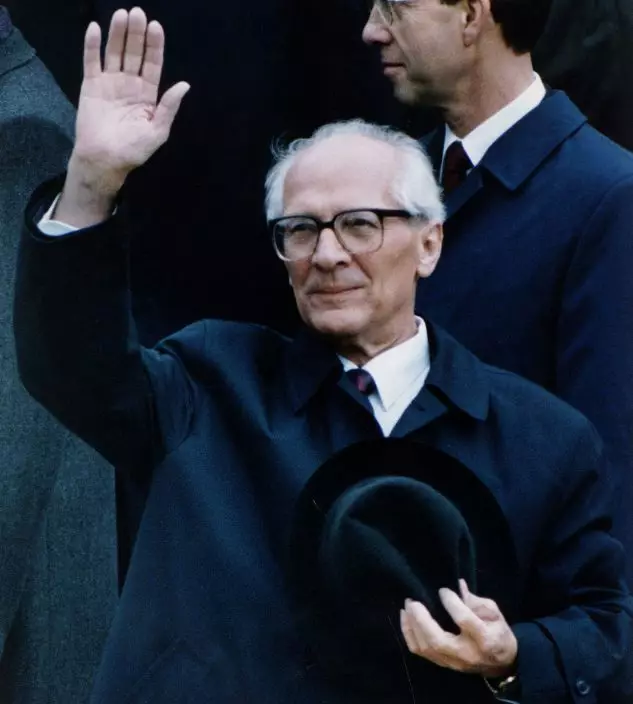
FILE - In this Oct. 7, 1989, file photo, East German State and Party Leader Erich Honecker waves during a military parade in East Berlin, on occasion of the 40th anniversary of the Communist State. (AP PhotoHeribert Proepper, file)
FILE - In this Oct. 7, 1989, file photo, East German State and Party Leader Erich Honecker waves during a military parade in East Berlin, on occasion of the 40th anniversary of the Communist State. (AP PhotoHeribert Proepper, file)

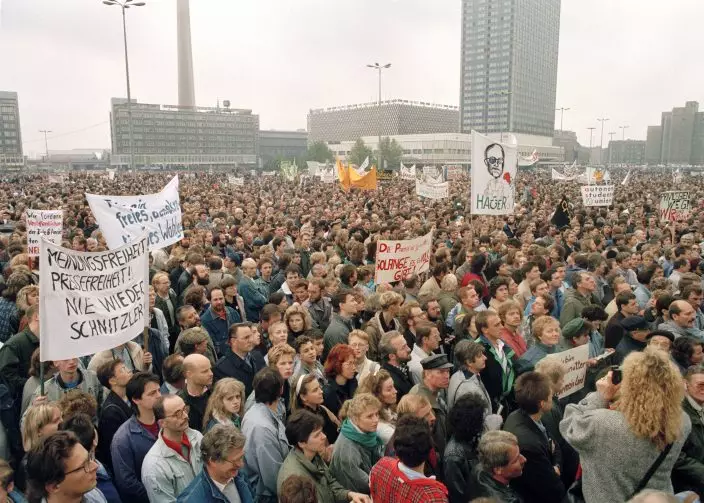
FILE - In this Saturday, Nov. 4, 1989 file photo, about one million demonstrators crowd the Alexanderpletz in East Berlin during Germany in a protest rally against censorship and repression. On banners they demanded new leaders and free elections. (AP PhotoElke Bruhn-Hoffman, File)
FILE - In this Saturday, Nov. 4, 1989 file photo, about one million demonstrators crowd the Alexanderpletz in East Berlin during Germany in a protest rally against censorship and repression. On banners they demanded new leaders and free elections. (AP PhotoElke Bruhn-Hoffman, File)
Feb. 5: 20-year-old Chris Gueffroy is fatally shot while trying to cross the border in Berlin. He is the last person to be killed at the Wall.

FILE - In this Nov. 11, 1989 file photo, East German border guards are seen through a gap in the Berlin wall after demonstrators pulled down a segment of the wall at Brandenburg gate, Berlin. (AP PhotoLionel Cironneau, File)

FILE - In this Nov. 11, 1989 file photo, East German border guards are seen through a gap in the Berlin wall after demonstrators pulled down a segment of the wall at Brandenburg gate, Berlin. (AP PhotoLionel Cironneau, File)

May 2: Hungarian border guards begin removing border fortifications and barbed wire at the country's frontier with Austria, the first chink in the Iron Curtain that separated Europe's east and west.

May 7: Local elections are held in East Germany. Opposition representatives report that the number of "no" votes to the country's communist rulers isn't reflected by official results.

Aug. 19: Hundreds of East Germans take advantage of a "Pan-European Picnic" organized by Hungarian opposition members near the Austrian border to escape to the West.

FILE - In this Saturday Nov. 11, 1989 file photo, hundreds of Berliners climb on top of the Berlin Wall at Brandenburg Gate in Berlin, demanding in a peaceful protest that the wall will be pulled down. (AP PhotoLutz Schmidt, File)

FILE - In this Saturday Nov. 11, 1989 file photo, hundreds of Berliners climb on top of the Berlin Wall at Brandenburg Gate in Berlin, demanding in a peaceful protest that the wall will be pulled down. (AP PhotoLutz Schmidt, File)

Sept. 4: The first of what become weekly Monday demonstrations for freedom of assembly and travel is held in Leipzig.

Sept. 11: Hungary allows East Germans to cross its border to Austria, opening the way to the West for tens of thousands.

Sept. 12: Tadeusz Mazowiecki becomes Poland's first non-communist prime minister since World War II.

FILE—This Aug.19, 1989 file photo East Germans surprise Hungarian border guards and rush through a gate into Moerbisch, Austria. The gate was opened as part of joint Austrian-Hungarian event, marking the end of the Iron Curtain. The East Germans had heard of the event and used it for their flight to the West. (AP-Photovotava, File)

FILE—This Aug.19, 1989 file photo East Germans surprise Hungarian border guards and rush through a gate into Moerbisch, Austria. The gate was opened as part of joint Austrian-Hungarian event, marking the end of the Iron Curtain. The East Germans had heard of the event and used it for their flight to the West. (AP-Photovotava, File)

Sept. 30: Nearly 6,000 East Germans holed up at the West German embassy in Prague are allowed to leave for the West.

Oct. 3: East Germany halts visa-free travel to Czechoslovakia to stem an exodus of its citizens.

Oct. 7: East Germany celebrates its 40th birthday and visiting Soviet leader Mikhail Gorbachev urges its leadership to reform. Authorities clamp down on protesters.

FILE -- In this Oct. 6, 1989 file photo, Soviet President Mikhail Gorbachev, left, kisses East German leader Erich Honecker after Gorbachev's arrival at East Berlin. At right is Raisa Gorbachev. (AP-PhotoBoris Yurchenko)

FILE -- In this Oct. 6, 1989 file photo, Soviet President Mikhail Gorbachev, left, kisses East German leader Erich Honecker after Gorbachev's arrival at East Berlin. At right is Raisa Gorbachev. (AP-PhotoBoris Yurchenko)

Oct. 18: Honecker is removed as East German leader after 18 years in power, replaced by Egon Krenz.

Nov. 4: Some 500,000 people gather in East Berlin's central Alexanderplatz for the country's biggest pro-democracy protest.

Nov. 9: East Germany opens its heavily fortified border after 28 years. Over the subsequent weeks and months, people chip away at the barrier.

FILE - In this early morning, Nov. 10, 1989 file photo, Berliners from East and West crowd in front of the Brandenburger Tor (Brandenburg Gate), standing atop and below the Berlin Wall, which has divided the city since the end of World War II. (AP PhotoJockel Finck)

FILE - In this early morning, Nov. 10, 1989 file photo, Berliners from East and West crowd in front of the Brandenburger Tor (Brandenburg Gate), standing atop and below the Berlin Wall, which has divided the city since the end of World War II. (AP PhotoJockel Finck)

Dec. 3: Krenz and the East German politburo resign. Krenz resigns as the country's leader three days later, leaving moderate communist Hans Modrow in charge of East Germany.

Dec. 22: A new border crossing opens at the Brandenburg Gate, the symbol of Germany's Cold War division.

March 18, 1990: East Germany's first democratic election. Center-right candidate Lothar de Maiziere becomes prime minister.

FILE - In this Sept. 30, 1989 file photo, East German refugees look through the fence of the West German embassy in Prague, Czechoslovakia. (AP PhotoDiether Endlicher, File)

FILE - In this Sept. 30, 1989 file photo, East German refugees look through the fence of the West German embassy in Prague, Czechoslovakia. (AP PhotoDiether Endlicher, File)

Oct. 3: Germany is reunited after four decades of Cold War division.

Follow AP's full coverage of the 30th anniversary of the fall of the Berlin Wall at https://www.apnews.com/FalloftheBerlinWall

FILE - In this May 2, 1989, file photo, Hungarian border guards cut a hole into the "Iron Curtain," opening its border with Austria and the west near Hegyeshalom, some 50 kilometers east of Vienna. (AP PhotoBernhard J. Holzner, File)

FILE - In this May 2, 1989, file photo, Hungarian border guards cut a hole into the "Iron Curtain," opening its border with Austria and the west near Hegyeshalom, some 50 kilometers east of Vienna. (AP PhotoBernhard J. Holzner, File)

FILE - In this Oct. 7, 1989, file photo, East German State and Party Leader Erich Honecker waves during a military parade in East Berlin, on occasion of the 40th anniversary of the Communist State. (AP PhotoHeribert Proepper, file)

FILE - In this Oct. 7, 1989, file photo, East German State and Party Leader Erich Honecker waves during a military parade in East Berlin, on occasion of the 40th anniversary of the Communist State. (AP PhotoHeribert Proepper, file)

FILE - In this Saturday, Nov. 4, 1989 file photo, about one million demonstrators crowd the Alexanderpletz in East Berlin during Germany in a protest rally against censorship and repression. On banners they demanded new leaders and free elections. (AP PhotoElke Bruhn-Hoffman, File)
FILE - In this Saturday, Nov. 4, 1989 file photo, about one million demonstrators crowd the Alexanderpletz in East Berlin during Germany in a protest rally against censorship and repression. On banners they demanded new leaders and free elections. (AP PhotoElke Bruhn-Hoffman, File)
WASHINGTON (AP) — The Justice Department has launched a months-long effort to prosecute people accused of assaulting or hindering federal officers while protesting President Donald Trump’s immigration crackdown and military deployments. Attorney General Pam Bondi has vowed such offenders will face “severe consequences.”

In a review of scores of criminal prosecutions brought by federal prosecutors, The Associated Press found that the Justice Department has struggled to deliver on Bondi's pledge.

An analysis of 166 federal criminal cases brought since May against people in four Democratic-led cities at the epicenter of demonstrations found that aggressive charging decisions and rhetoric painting defendants as domestic terrorists have frequently failed to hold up in court.

“It’s clear from this data that the government is being extremely aggressive and charging for things that ordinarily wouldn’t be charged at all,” said Mary McCord, a former federal prosecutor who is the director of Georgetown University Law Center’s Institute for Constitutional Advocacy. “They appear to want to chill people from protesting against the administration’s mass deportation plans.”

Here are some key findings from the AP's analysis:

Of 100 people initially charged with felony assaults on federal agents, 55 saw their charges reduced to misdemeanors, or dismissed.

Sometimes prosecutors failed to win grand jury indictments required to prosecute someone on a felony, the AP found. Videos and testimony called into question some of the initial allegations, resulting in prosecutors downgrading offenses.

In dozens of cases, officers suffered minor or no injuries, undercutting a key component of the felony assault charge that requires the potential for serious bodily harm.

One of the cases was against Dana Briggs, a 70-year-old Air Force veteran charged in September with assault after a protest in Chicago. After video footage emerged of federal agents knocking Briggs to the ground, prosecutors dropped a case they had already reduced to a misdemeanor.

Another case dropped by prosecutors was against 28-year-old Lucy Shepherd, who was charged with felony assault after she batted away the arm of a federal officer who was attempting to clear a crowd outside Portland’s Immigration and Customs Enforcement facility. Her lawyers argued a video of her arrest showed she brushed aside an officer with “too little force to have been intended to inflict any kind of injury.”

A Justice Department spokesperson said it will continue to seek the most serious available charges against those alleged to have put federal agents in harm’s way.

“We will not tolerate any violence directed toward our brave law enforcement officials who are working tirelessly to keep Americans safe,” said Natalie Baldassarre, a DOJ spokesperson.

The administration has deployed — or sought to deploy — troops to the four cities where AP examined the criminal cases: Washington, D.C, Los Angeles, Portland and Chicago. Trump and his administration have sought to justify the military deployments, in part, by painting immigration protesters as “antifa,” which the president has sought to designate as a “domestic terrorist organization.”

Short for “anti-fascists,” antifa is an umbrella term for far-left-leaning protesters who confront or resist white supremacists, sometimes clashing with law enforcement.

The AP’s review found a handful of references to “antifa” in court records in the cases it reviewed. The review found no case in which federal authorities officially accused a protester of being a “domestic terrorist” or part of an organized effort to attack federal agents.

Experts said they were surprised the Justice Department took five misdemeanor cases to trial, given that such trials eat up resources. They were further shocked that DOJ lost all those trials.

“When the DOJ tries to take a swing at someone, they should hit 99.9% of the time. And that’s not happening,” said Ronald Chapman II, a defense attorney who practices extensively in federal court.

The highest-profile loss involved Sean Charles Dunn, a Washington, D.C., man who tossed a Subway-style sandwich at a Border Patrol agent he had berated as a “fascist.” Dunn was acquitted Nov. 6 after a two-day trial.

In Los Angeles, 32-year-old Katherine Carreño was acquitted on a misdemeanor assault charge stemming from an August protest outside a federal building.

Prosecutors had alleged she ignored an officer’s commands to move out of the way of a government vehicle and “raised her hand and brought it down in a slapping/chopping motion” onto the officer’s arm.

Social media video shown to jurors raised doubts about that narrative, showing an officer striding toward Carreño and pushing her back.

Prosecutors have secured felony indictments against 58 people, some of whom were initially charged with misdemeanors. They are accused of assaulting federal officers in several ways, including by hurling rocks and projectiles, punching or kicking them and shooting them with paintballs. None have yet to go to trial.

From the start of Trump’s second term through Nov. 24, the Department of Homeland Security says there have been 238 assaults on ICE personnel nationwide. The agency declined to provide its list or details about how it defines assaults.

“Rioters and other violent criminals have threatened our law enforcement officers, thrown rocks, bottles, and fireworks at them, slashed the tires of their vehicles, rammed them, ambushed them, and even shot at them,” said Department of Homeland Security Assistant Secretary Tricia McLaughlin.

Ding reported from Los Angeles, Fernando from Chicago, Rush from Portland, Oregon, and Foley from Iowa City, Iowa.

Contact the AP’s global investigative team at Investigative@ap.org or https://www.ap.org/tips/

FILE - California National Guard are positioned at the Federal Building on Tuesday, June 10, 2025, in downtown Los Angeles. (AP Photo/Eric Thayer, File)

FILE - California National Guard are positioned at the Federal Building on Tuesday, June 10, 2025, in downtown Los Angeles. (AP Photo/Eric Thayer, File)

FILE - Police and federal officers deploy gas canisters to disperse protesters near a U.S. Immigration and Customs Enforcement facility in Portland, Ore. on Oct. 5, 2025. (AP Photo/Ethan Swope, File)

FILE - Police and federal officers deploy gas canisters to disperse protesters near a U.S. Immigration and Customs Enforcement facility in Portland, Ore. on Oct. 5, 2025. (AP Photo/Ethan Swope, File)

Katherine Carreño stands for a portrait Saturday, Dec. 6, 2025, in Los Angeles. (AP Photo/Allison Dinner)

Katherine Carreño stands for a portrait Saturday, Dec. 6, 2025, in Los Angeles. (AP Photo/Allison Dinner)

FILE - A protester is detained outside the U.S. Immigration and Customs Enforcement facility on Sunday, Oct. 12, 2025, in Portland, Ore. (AP Photo/Jenny Kane, File)

FILE - A protester is detained outside the U.S. Immigration and Customs Enforcement facility on Sunday, Oct. 12, 2025, in Portland, Ore. (AP Photo/Jenny Kane, File)

Katherine Carreño stands for a portrait Saturday, Dec. 6, 2025, in Los Angeles. (AP Photo/Allison Dinner)

Katherine Carreño stands for a portrait Saturday, Dec. 6, 2025, in Los Angeles. (AP Photo/Allison Dinner)

Recommended Articles