A Chinese Catholic priest whose demotion was key to a now-stalled effort at reconciliation between China and the Vatican is being pressured to join the official Communist Party-controlled church organization, a fellow priest and Catholic news source said.
Monsignor Vincenzo Guo Xijin was one of two legitimate bishops who remain loyal to the pope who were asked last year by the Vatican to step aside. That was part of a controversial agreement that also called for the Holy See to recognize seven bishops who had been appointed by Beijing without papal consent.
Local government and religious affairs department officials, along with representatives from the ruling Communist Party’s United Front Work Department, are visiting Guo regularly in an effort to persuade him to join the Chinese Catholic Patriotic Association, the Rev. Peng Zhekang, a priest in Guo’s diocese in the eastern province of Fujian, said by phone.
“They are not coming to look for trouble,” Peng said of the visitors.
However, the Vatican-affiliated news agency AsiaNews said Guo was being “hounded by public security agents” to agree to join the patriotic association in return for government recognition of his religious status. It said Guo is under the constant supervision of two guards, and officials and agents arrive throughout the day seeking to change his mind.
“For months, the Fujian authorities have been exerting pressure, blackmailing and threatening priests to push them to sign this accession in exchange for government recognition without which their ministry is forbidden,” AsiaNews said.
The agreement to give China some say over bishop appointments prompted accusations that the church was caving in to the Communist Party just as China’s leaders are waging a sweeping crackdown on religion. It has also been denounced as a betrayal of underground clergy and their congregants who are often persecuted for their defiance of the state.
Others called it an imperfect but much-needed step toward uniting Catholics in the world's most populous country.
Various popes have long cherished the hope of bringing together China's 12 million Catholics who are divided between those worshipping in state-sanctioned churches and the underground priests and parishioners loyal to the pope, who are frequently detained and harassed.
China demanded Chinese Catholics cut ties with the Vatican shortly after the Communist seizure of power in 1949.
Pope Francis will pass through Chinese airspace Saturday as he travels from Bangkok to Tokyo, and plans to send a telegram to President and party leader Xi Jinping. That is the first opportunity to address the relationship between the sides following last year’s agreement.
Peng, of Guo’s parish in the city of Mindong, said the local church was in the process of merging its official and underground sides, but only about two-thirds of clergy were on board with the move.
“Those still resisting the merger believe the government’s demand for a church independent from the Vatican has an impact on their beliefs,” Peng said.
Due to that, Guo “feels he has the responsibility to stay behind to take care of them,” Peng said.
Calls to Guo’s cellphone were answered by a message saying it was invalid, while calls to the local police and religious affairs department rang unanswered.
Since the agreement was reached, China has given no public indication that it would offer greater freedoms for Catholics or yield more influence to the Vatican.
Meanwhile, the Communist Party has been tightening controls on all religions, especially Christianity and Islam, which are viewed as foreign imports and potential challengers to Communist authority.
Authorities have removed or demolished crosses from even officially sanctioned churches, shuttered churches, and in at least one township, replaced posters of Jesus Christ with portraits of President Xi in what is being called the harshest anti-religion campaign since the 1966-76 Cultural Revolution.
BANGKOK (AP) — Asian shares slipped further on Thursday after declines for AI stocks dragged the U.S. market to its worst day in nearly a month.
Traders are waiting for an update on U.S. inflation, and on a decision Friday by Japan’s central bank on interest rates. The Bank of Japan is expected to raise its key rate by 0.25 percentage point to tamp down price pressures, despite a contraction in the July-September quarter.
Tokyo's Nikkei 225 lost 1.2% to 48,929.95, with technology shares leading the decline.
Computer chip maker Tokyo Electron lost 3.5% while chip testing equipment maker Advantest dropped 4.1%.
Honda Motor Corp. fell 2.9% after reports said it was suspending production at some plants in Japan and China due to shortages of computer chips.
South Korea’s Kospi sank 1.8% to 3,989.06, also pulled lower by selling of shares in electronics companies and automakers. LG Electronics declined 4.3%, while Samsung Electronics lost 1.6%.
Chinese markets were mixed as Hong Kong's Hang Seng fell 0.4% to 25,357.64, while the Shanghai Composite index edged 0.2% higher, to 3,876.40.
In Australia, the S&P/ASX 200 edged 0.1% lower to 8,575.50.
Later Thursday, the U.S. government will report on inflation last month. Economists expect that report to show prices for U.S. consumers continue to rise faster than anyone would like.
On Wednesday, the S&P 500 fell 1.2% to 6,721.43 and the Dow Jones Industrial Average dipped 0.5% to 47,885.97. The Nasdaq composite dropped 1.8% to 22,693.32.
Slightly more stocks rose within the S&P 500 than fell, but they got drowned out by the drops for companies in the artificial-intelligence industry.
The sector is being pressured by questions over whether Big Tech companies' share prices have shot too high, whether all the investment in AI will be profitable and productive enough to justify the costs, and by worries over stratospheric levels of debt some companies are taking on to pay for it all.
Broadcom dropped 4.5%, Oracle fell 5.4% and CoreWeave sank 7.1%. Nvidia, the chip company that’s become Wall Street’s most influential stock because of its tremendous size, fell 3.8% and was the day's heaviest weight on the S&P 500.
Power companies that jumped earlier in the year on expectations for stronger demand from electricity-sucking data centers also lost some of their shine. Constellation Energy fell 6.7%.
On the winning side of Wall Street were oil companies, after President Donald Trump ordered a blockade of all “sanctioned oil tankers” into Venezuela.
That sent the price of a barrel of benchmark U.S. crude higher by 1.2% to $55.94. just a day after it sank to its lowest level since 2021.
Early Thursday, U.S. crude was up 43 cents at $56.24 per barrel. Brent crude, the international standard, gained 40 cents to $60.08 per barrel. It had climbed 1.3% on Wednesday.
That in turn helped ConocoPhillips rise 4.6%. Devon Energy rallied 5.3%, and Exxon Mobil climbed 2.4%.
Oil prices have been falling for most of this year on expectations that companies are pumping more than enough crude to meet the world’s demand.
Netflix added 0.2% after Warner Bros. Discovery’s board said it still recommends shareholders approve a buyout offer from the streaming giant for its Warner Bros. business, rather than a competing hostile bid from Paramount Skydance for the entire company.
Warner Bros. Discovery fell 2.4%, while Paramount Skydance dropped 5.4%.
In other dealings early Thursday, the U.S. dollar rose to 155.75 Japanese yen from 155.70 yen. The euro slipped to $1.1740 from $1.1743.
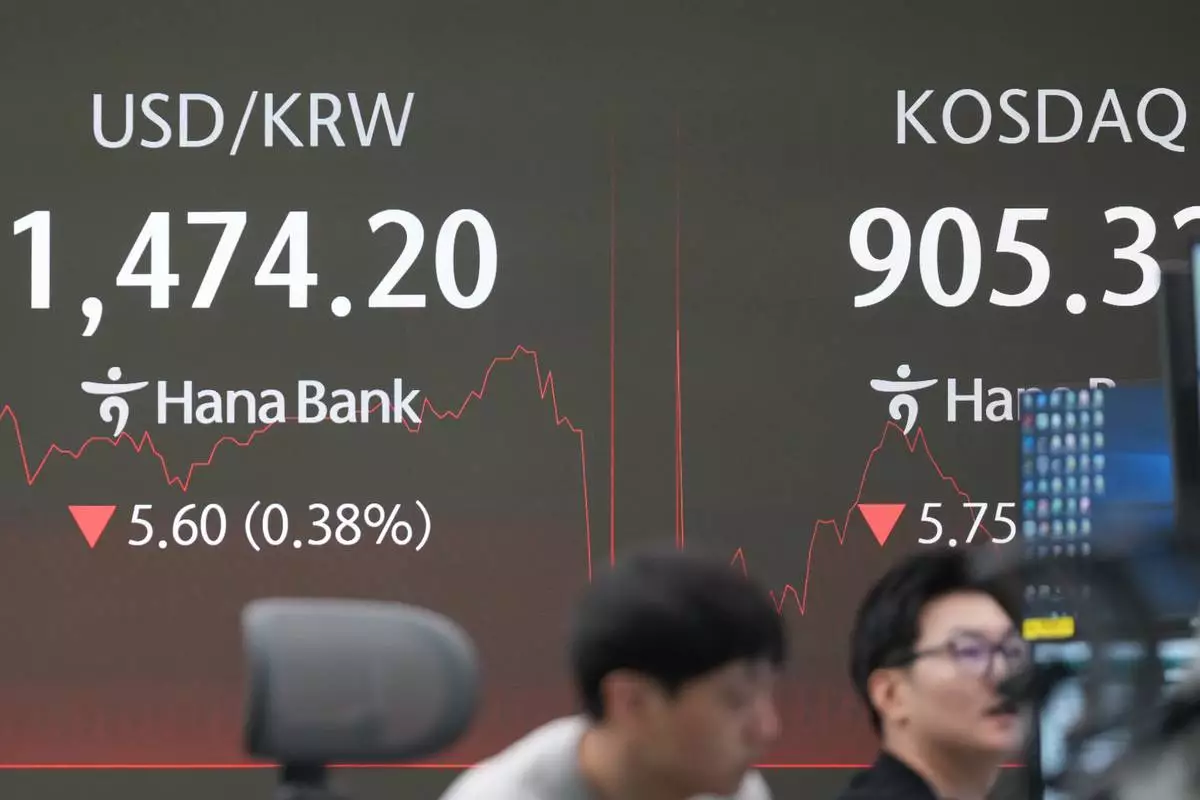
Dealers work near the screens showing the foreign exchange rate between U.S. dollar and South Korean won, left, and the Korean Securities Dealers Automated Quotations (KOSDAQ) at a dealing room of Hana Bank in Seoul, South Korea, Thursday, Dec. 18, 2025. (AP Photo/Lee Jin-man)

Jim Boyle, CEO of Medline Industries, poses for a picture outside the Nasdaq MarketSite, Wednesday, Dec. 17, 2025, in New York. (AP Photo/Yuki Iwamura)
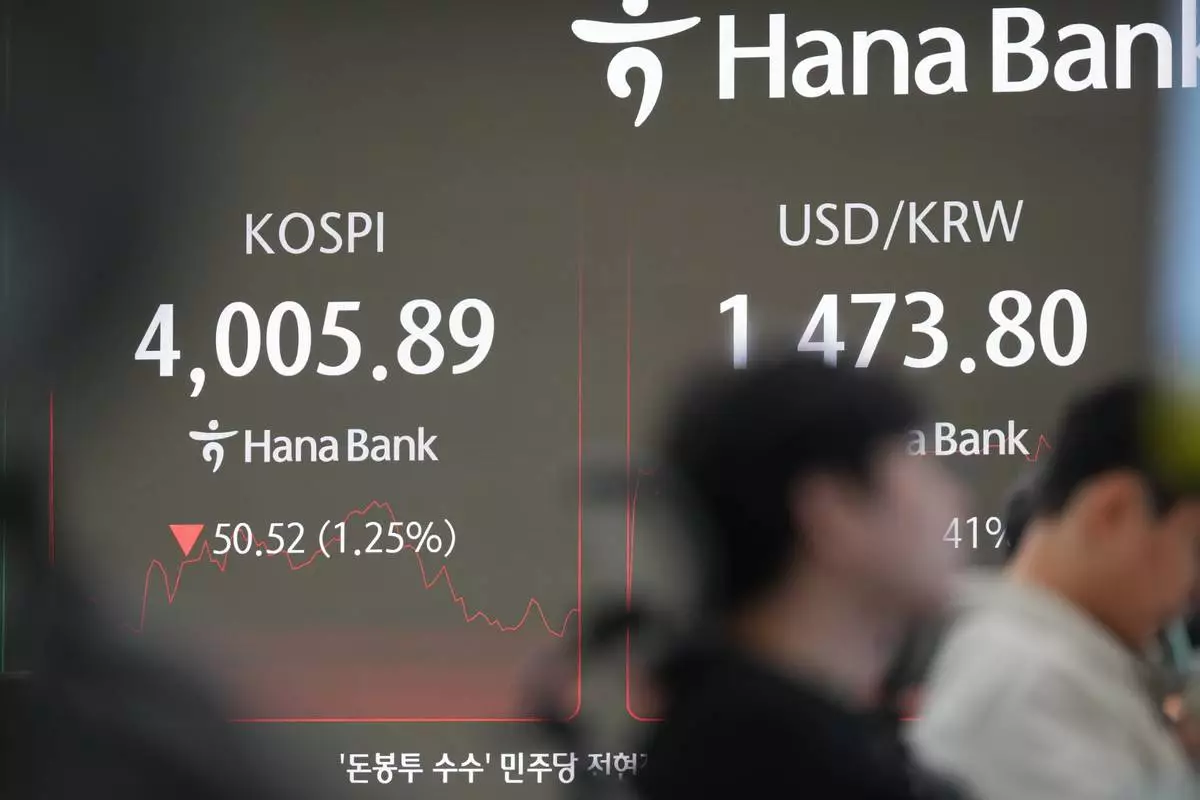
Dealers work near the screens showing the Korea Composite Stock Price Index (KOSPI), left, and the foreign exchange rate between U.S. dollar and South Korean won at a dealing room of Hana Bank in Seoul, South Korea, Thursday, Dec. 18, 2025. (AP Photo/Lee Jin-man)
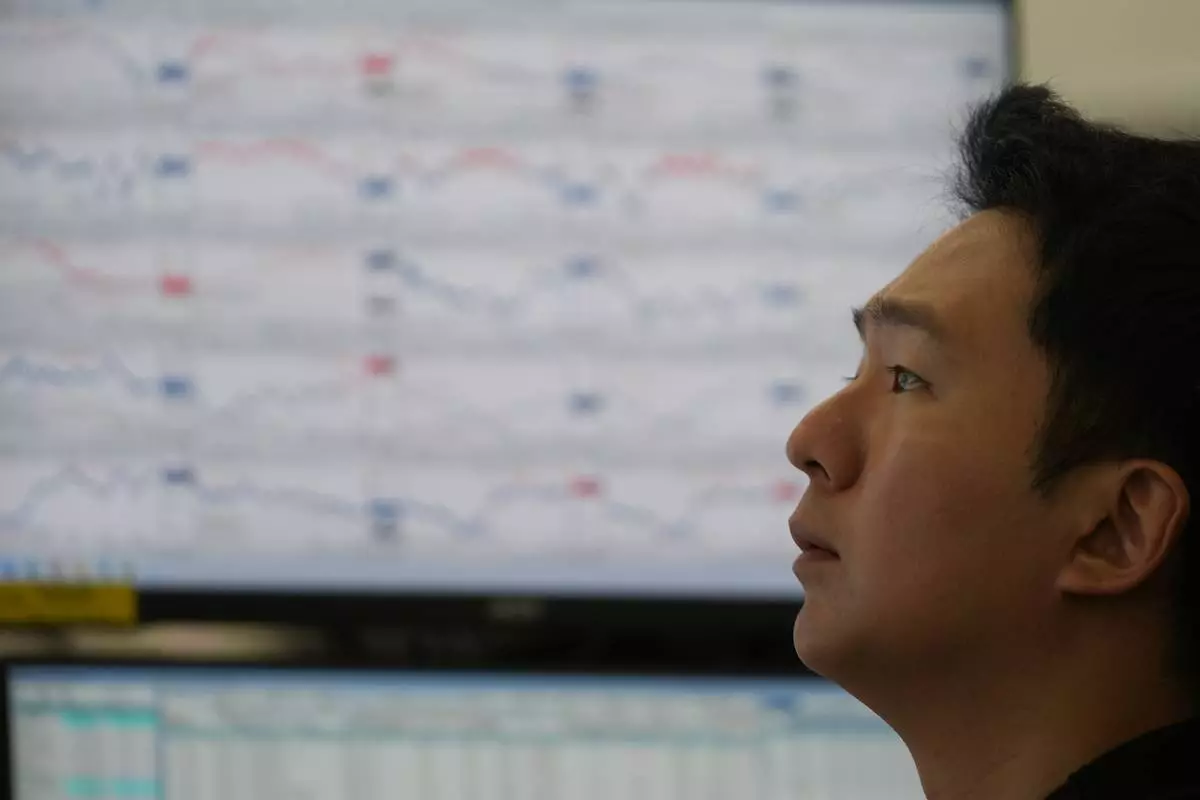
A dealer watches computer monitors at a dealing room of Hana Bank in Seoul, South Korea, Thursday, Dec. 18, 2025. (AP Photo/Lee Jin-man)