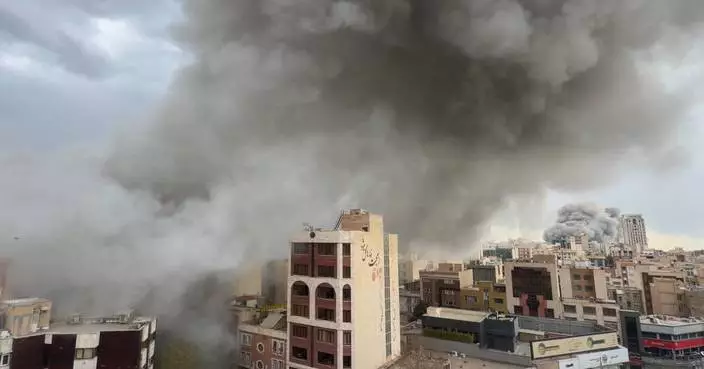
The death toll in India’s capital from riots last week between Hindus and Muslims rose to 46, officials said Monday, a day after false rumors of new violence led to panicked calls to police in many parts of the city.
The riots in New Delhi began over a disputed new citizenship law, which led to clashes in which hundreds were injured and houses, shops, mosques, schools and vehicles were set on fire.
Click to Gallery
Opposition Congress party lawmakers shout slogans demanding resignation of Indian Home Minister Amit Shah during a protest in the Parliament premises against last week's deadly communal riots in New Delhi, India, Monday, March 2, 2020. (AP Photo)
Congress party workers shout slogans and burn an effigy of Indian Home Minister Amit Shah as they protest against last week's deadly communal riots in New Delhi, India, Monday, March 2, 2020. (AP PhotoManish Swarup)
Police detain Congress party workers during a protest against last week's deadly communal riots in New Delhi, India, Monday, March 2, 2020. (AP PhotoManish Swarup)
Police detain Congress party workers during a protest against last week's deadly communal riots in New Delhi, India, Monday, March 2, 2020. (AP PhotoManish Swarup)
Tensions between Hindu hard-liners and Muslims protesting the Hindu-first policies of Prime Minister Narendra Modi’s government had been building for months when the violence exploded a week ago Sunday, the eve of U.S. President Donald Trump’s state visit to India.

Opposition Congress party lawmakers shout slogans demanding resignation of Indian Home Minister Amit Shah during a protest in the Parliament premises against last week's deadly communal riots in New Delhi, India, Monday, March 2, 2020. (AP Photo)
Apart from a single tweet after the riots had almost ended, Modi has been publicly silent on the violence.
His powerful home minister, Amit Shah, has accused opposition parties of inciting the riots by spreading misinformation about the citizenship law, which fast-tracks naturalization for religious minorities from several neighboring countries but not Muslims.
The rumors spreading on Sunday included reports of armed groups marching in neighborhoods while chanting slogans, and houses being set on fire.
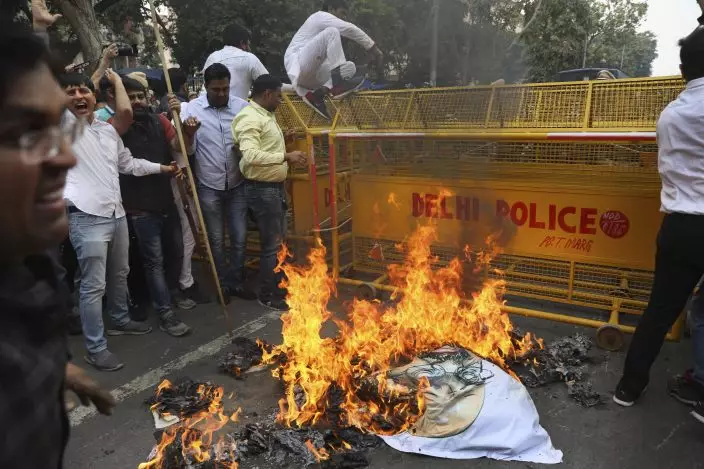
Congress party workers shout slogans and burn an effigy of Indian Home Minister Amit Shah as they protest against last week's deadly communal riots in New Delhi, India, Monday, March 2, 2020. (AP PhotoManish Swarup)
The panic subsided when police reached out to both Hindu and Muslim religious leaders and asked them to help maintain calm in their neighborhoods. Police also issued statements and some lawmakers took to the streets to reassure people that the situation was normal.
On Monday, India’s top court agreed to hear cases filed by riot victims accusing leaders of Modi’s Bharatiya Janata Party of hate speech. Some of the victims accuse Kapil Mishra, a local leader of Modi’s party who lost his Delhi state assembly seat in recent elections, of stoking the violence.
Mishra had demanded at a rally that police shut down a Muslim-led protest in the city or else he and his followers would do it themselves.
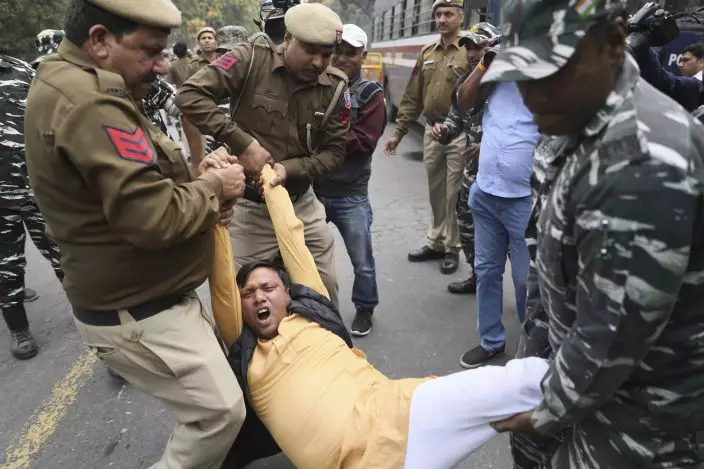
Police detain Congress party workers during a protest against last week's deadly communal riots in New Delhi, India, Monday, March 2, 2020. (AP PhotoManish Swarup)
Hours later, Hindus and Muslims fought each other with guns and swords, metal rods and axes, leaving the streets where the rioting occurred resembling a war zone.
The violence had largely subsided by Wednesday, but the Indian capital has remained on edge.
Most of the dead and injured were Muslims, with thousands fleeing their homes in fear.
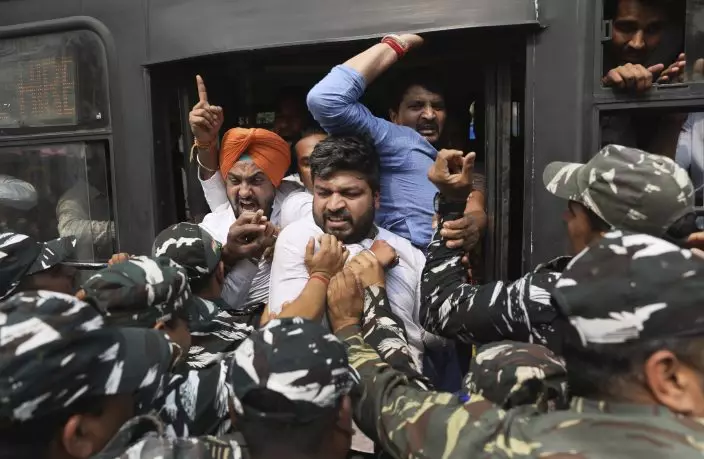
Police detain Congress party workers during a protest against last week's deadly communal riots in New Delhi, India, Monday, March 2, 2020. (AP PhotoManish Swarup)
Authorities are yet to provide an official account of what sparked the violence. Police spokesman Manjeet Singh Randhawa did not respond to repeated questions about how many of the hundreds of people detained in the riots had been charged.
The violence is the latest in a long line of communal clashes that date to the British partition of the Indian subcontinent in 1947, when the country was split into secular, Hindu-majority India and the Islamic state of Pakistan.
DUBAI, United Arab Emirates (AP) — Explosions sounded in Iran's capital city Wednesday as its war with the U.S. and Israel entered a fifth day following earlier strikes on an Iranian nuclear site and retaliatory strikes by the Islamic Republic across the Gulf region.
The explosions around Tehran came as dawn broke, according to Iran state television, while Israel's military said its air defenses had been activated to intercept Iranian missiles and explosions were heard around Jerusalem.
Air sirens sounded in the morning across the island kingdom of Bahrain, home to the U.S. Navy’s 5th Fleet, and Qatar’s Ministry of Defense said Iran launched two ballistic missiles against it and one hit Al-Udeid Qatari Base, but didn’t cause casualties.
Five days into a war that U.S. President Donald Trump suggested could last a month or longer, nearly 800 people have been killed in Iran, including some Trump said he had considered as possible future leaders of the country.
Explosions also hit Lebanon, where Israel said it is retaliating against Hezbollah militants. Lebanon's state-run media reported that at least four people were killed in an Israeli strike that hit a residential complex in the city of Baalbeck. More than 50 people have been killed in Lebanon and more than 300 wounded, according to the Health Ministry.
A day earlier, Israel launched airstrikes against Iranian missile launchers and a nuclear research site, and Iran struck back against Israel and others, targeting U.S. embassies and disrupting energy supplies and travel.
The American embassy in Saudi Arabia and the U.S. consulate in the United Arab Emirates came under drone attacks, and the U.S. State Department said Wednesday that it had authorized non-emergency government personnel to evacuate Saudi Arabia. The UAE said it had been attacked by more than 1,000 Iranian missiles and drones since the conflict began but had intercepted most of them.
Iran has fired regular salvoes of missiles and drones missiles at Israel, though most of the incoming fire has been intercepted. Eleven people in Israel have been killed since the conflict began.
The spiraling nature of the war raised questions about when and how it would end.
Trump's administration has offered various objectives, including destroying Iran’s missile capabilities, wiping out its navy, preventing it from obtaining a nuclear weapon and ensuring it cannot continue to support allied armed groups.
While the initial U.S.-Israeli strikes killed Iranian Supreme Leader Ayatollah Ali Khamenei and Trump urged Iranians to overthrow their government, senior administration officials have since said regime change was not the goal.
Trump on Tuesday seemed to downplay the chances of the war ending Iran's theocratic rule, saying that “someone from within” the Iranian regime might be the best choice to take power once the U.S.-Israel campaign is finished.
Speaking Tuesday from the Oval Office, Trump said Reza Pahlavi, the exiled son of Iran’s toppled shah, is not someone that his administration has considered in depth to take over.
As far as possible leaders inside Iran, “the people we had in mind are dead,” Trump said.
“I guess the worst case would be do this, and then somebody takes over who’s as bad as the previous person, right? That could happen," Trump said. "We don’t want that to happen.”
Iran’s leaders are scrambling to replace Khamenei, who ruled the country for 37 years. It’s only the second time since the 1979 Islamic Revolution that a new supreme leader is being chosen. Potential candidates range from hard-liners committed to confrontation with the West to reformists who seek diplomatic engagement.
Adm. Brad Cooper, the top U.S. military commander in the Middle East, said American forces have struck nearly 2,000 targets in Iran since the war began. In a video posted Tuesday on X, Cooper said the U.S. has “severely degraded Iran’s air defenses” and taken out hundreds of ballistic missiles, launchers and drones.
“We’ve just begun,” Cooper said.
Satellite images published Tuesday by Colorado-based company Vantor showed the domed roof of Iran’s presidential complex in Tehran had been destroyed, supporting Israel’s claim of an overnight strike. Iran did not acknowledge the damage or report any casualties.
Israeli military spokesman Brig. Gen. Effie Defrin said the Israeli military struck a building in the Iranian city of Qom where clerics were expected to meet to discuss selecting a new supreme leader. He said the army was still assessing whether anyone was hit.
The Israeli military said it also conducted airstrikes on Iranian sites that produce and store ballistic missiles, and that it destroyed what it called Iran’s secret, underground nuclear headquarters. Without providing evidence, it said the site was used for research “to develop a key component for nuclear weapons.”
There was no immediate public comment from the U.S. or Iran about the site Israel named.
Iran has said it has not enriched uranium since June, though it has maintained its right to do so and says its nuclear program is peaceful.
The U.S.-Israeli strikes have killed at least 787 people in Iran, according to the Red Crescent Society.
Kuwait, which had previously reported a single death, said Wednesday that an 11-year-old girl was killed by falling shrapnel as Kuwaiti forces were intercepting “hostile aerial targets.” In addition, three people were killed in the United Arab Emirates and one in Bahrain.
Six U.S. Army Reserve soldiers were killed by a drone strike Sunday on a command center in Port Shuaiba, Kuwait.
Rising reported from Bangkok, and Magdy from Cairo. Elena Becatoros in Athens, Greece, Melanie Lidman in Tel Aviv, Israel, and Giovanna Dell'Orto in Miami contributed to this report.

Andrew Coady and his daughter Keira, right, talk about his son, Sgt. Declan Coady, 20, of West Des Moines, Iowa, outside their home, Tuesday, March 3, 2026, in West Des Moines, Iowa. (AP Photo/Charlie Neibergall)
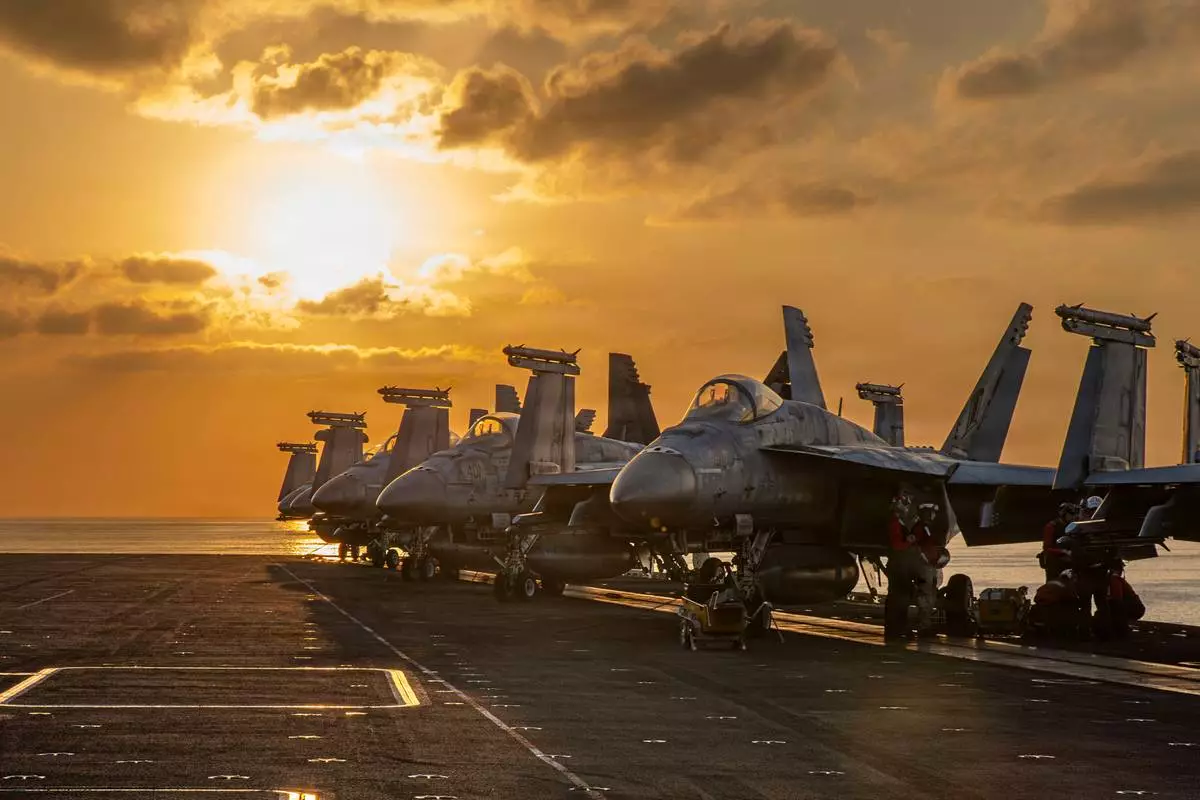
This image provided by U.S. Central Command shows aircraft on the flight deck of the USS Abraham Lincoln (CVN 72) that are operating in support of the war in Iran, on Tuesday, March 3, 2026. (U.S. Navy via AP)
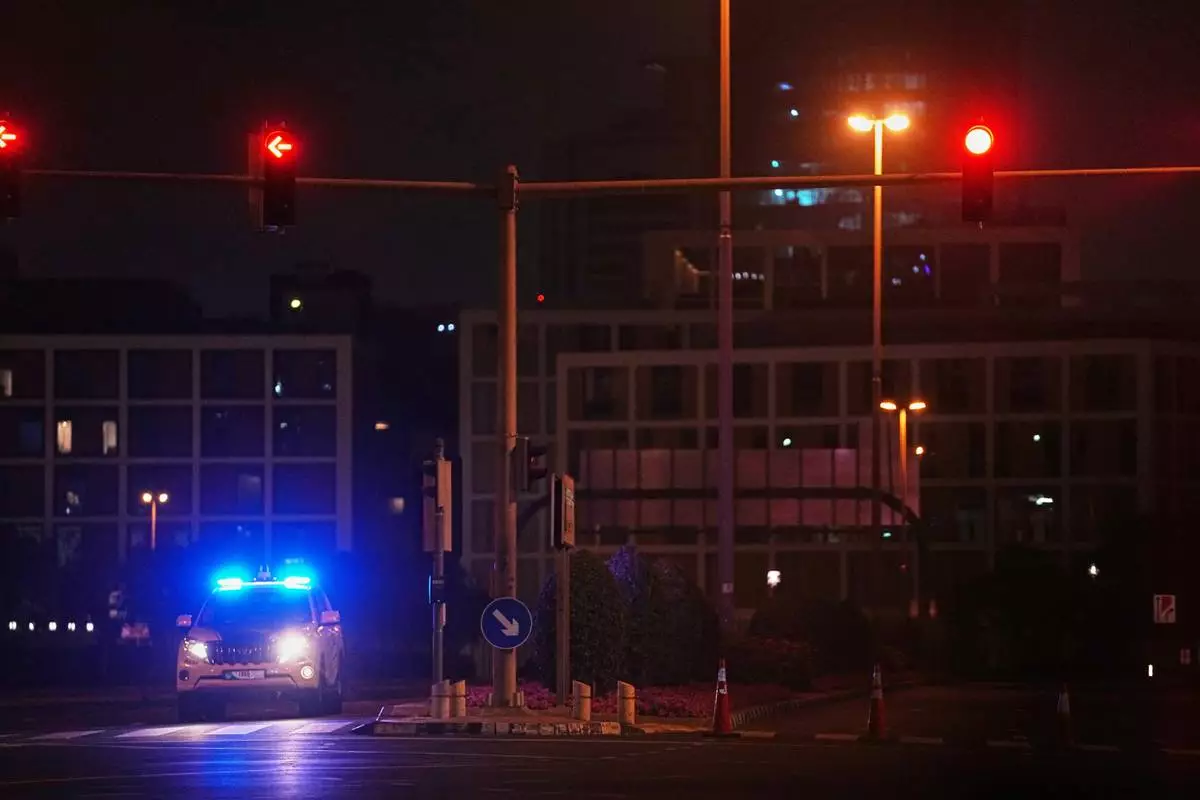
A police car blocks a street leading to the U.S. consulate after an Iranian drone struck a parking lot outside the compound, sparking a small fire in Dubai, United Arab Emirates, early Wednesday, March 4, 2026. (AP Photo/Fatima Shbair)