Skip to Content Facebook Feature Image

2 nuke plants, 1 bribery scandal, no answers: Towns on edge

News

2 nuke plants, 1 bribery scandal, no answers: Towns on edge
News

News

2 nuke plants, 1 bribery scandal, no answers: Towns on edge

2021-01-15 22:24 Last Updated At:22:30

For much of the past four years, the residents of a pair of villages along Lake Erie have been on edge over the fate of their nuclear plants, which generate enough tax money to pay for nicer schools than their neighbors.

Like many U.S. nuclear plants struggling to compete with with natural gas and renewable energy, the owners of the Ohio plants turned to the government for help, persuading the state's lawmakers to give them a $1 billion bailout.

But relief for the villages of Perry and Oak Harbor was short-lived after the financial rescue became entangled in a political bribery scandal that has brought calls to jettison the bailout.
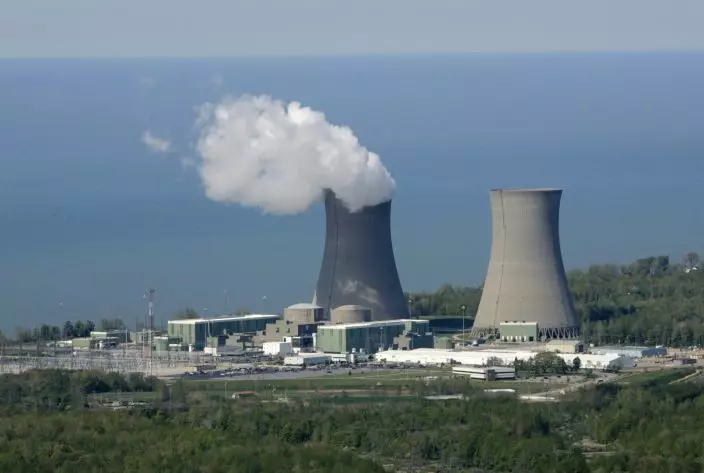
FILE-This May 20, 2005 file photo shows the Perry Nuclear Power Plant on the shores of Lake Erie in North Perry, Ohio. Across the nation, a handful of nuclear plants unable to compete with natural gas and renewable energy have shut down within the last two years, taking away steady and lucrative sources of tax money for schools, roads and libraries. The uncertainty surrounding the future of both Ohio plants, Davis-Besse near Toledo and Perry near Cleveland, has created plenty of nervousness in their hometowns that have found themselves caught in the middle of the scandal-tainted bailout. (AP PhotoMark Duncan, File)

FILE-This May 20, 2005 file photo shows the Perry Nuclear Power Plant on the shores of Lake Erie in North Perry, Ohio. Across the nation, a handful of nuclear plants unable to compete with natural gas and renewable energy have shut down within the last two years, taking away steady and lucrative sources of tax money for schools, roads and libraries. The uncertainty surrounding the future of both Ohio plants, Davis-Besse near Toledo and Perry near Cleveland, has created plenty of nervousness in their hometowns that have found themselves caught in the middle of the scandal-tainted bailout. (AP PhotoMark Duncan, File)

The uncertainty surrounding the future of both Ohio plants — Davis-Besse near Toledo and Perry near Cleveland — has created a new wave of anxiety that is stretching into another year after state lawmakers, at the end of December, put off deciding whether to repeal the bailout or come up with a new financial lifeline that would keep the plants open.

It’s just the latest twist for the rural towns, which found themselves caught in the middle of the scandal-tainted bailout this summer when federal investigators said the plants’ former owner secretly funneled millions to secure the payout.

“It’s like a big slap in the face,” said Perry Fire Chief James McDonald, whose department gets nearly half of its budget from taxes paid by the nuclear plant east of Cleveland.

The nuclear plants are anchors for Perry and Oak Harbor, two working-class bedroom communities that are rooted in agriculture and have little other industry. The two plants employ about 1,400 workers and generate roughly $30 million in tax revenue for their home communities, with the biggest chunk going to schools — which are the communities' biggest draw.

Closing the Davis-Besse plant would be “catastrophic,” said Guy Parmigian, superintendent of a school district that would lose millions from a closure. “It's not just us. It's our library, our county, the township.”

Because his school gets about 40% of its revenue from the plant, the district would face deep budget cuts without it. “We don’t want to think about the possibilities, but they’re certainly there on the table,” Parmigian said.

It's a familiar conundrum for towns anchored by nuclear plants.

They often become too reliant on their tax revenue, as it’s hard to attract other businesses because of the fears associated with the industry. Plus, almost all nuclear plants — including the ones in Ohio — are in out-of-the-way places, and many closed sites can’t be redeveloped for new uses because they store radioactive waste.

Losing the stream of revenue from the Perry plant could turn the area into a “ghost town” because taxes would likely soar to make up the difference, said Jack Thompson, superintendent of Perry Local schools, which has a pool and community fitness center, thanks to the plant, which opened in the late 1980s.

Towns in Vermont, Illinois and Florida and other states where nuclear plants have closed over the years already have seen that kind of economic impact firsthand and now struggle with higher property taxes, cuts in services and less school funding.

While nuclear power plants aren't designed to last forever, the closures in the U.S. are happening earlier than expected because plants are struggling to compete with cheaper natural gas-fired plants and renewable energy sources. Four plants have shut down since the beginning of 2018, and more are on the chopping block.

A few states, including New York, Illinois and New Jersey, have saved their plants by approving bailouts funded by new charges on electricity customers.

That's what Ohio did a year ago after FirstEnergy Solutions announced it planned to close its two nuclear operations by 2021.

But now the FBI and others are investigating FirstEnergy Corp.'s role in the alleged bribery scheme to secure the bailout.

State lawmakers haven't been able to agree for months whether to repeal the bailout, change it or keep it. Now they've postponed any decisions until later this year.

The Ohio Supreme Court and a county judge issued decisions last month that temporarily block the state from collecting fees from electricity users that were added to pay for the bailout of the plants, which are now owned by Energy Harbor, a former subsidiary of FirstEnergy.

What remains unknown is what lawmakers will do next and whether the two plants would close without the bailout or find another way to keep operating.

Their new owners haven't said whether they must have the money to keep going. It all means that the future of the plants, their workers and their hometowns is unsettled.

“These poor people,” said Jerry Cirino, who was elected to the state Senate in November to represent Lake County where the Perry plant operates. “They're telling me they can't take this anxiety much longer.”


SYDNEY (AP) — An accused gunman in Sydney’s Bondi Beach massacre was charged with 59 offenses including 15 charges of murder on Wednesday, as hundreds of mourners gathered in Sydney to begin funerals for the victims.

Two shooters slaughtered 15 people on Sunday in an antisemitic mass shooting targeting Jews celebrating Hanukkah at Bondi Beach, and more than 20 other people are still being treated in hospitals. All of those killed by the gunmen who have been identified so far were Jewish.

As investigations unfold, Australia faces a social and political reckoning about antisemitism, gun control and whether police protections for Jews at events such as Sunday’s were sufficient for the threats they faced.

Naveed Akram, the 24-year-old alleged shooter, was charged on Wednesday after waking from a coma in a Sydney hospital, where he has been since police shot him and his father at Bondi. His father Sajid Akram, 50, died at the scene.

The charges include one count of murder for each fatality and one count of committing a terrorist act, police said.

Akram was also charged with 40 counts of causing harm with intent to murder in relation to the wounded and with placing an explosive near a building with intent to cause harm.

Police said the Akrams' car, which was found at the crime scene, contained improvised explosive devices.

Akram's lawyer did not enter pleas and did not request his client's release on bail during a video court appearance from his hospital bed, a court statement said.

Akram is being represented by Legal Aid NSW, which has a policy of refusing media comment on behalf of clients. He is expected to remain under police guard in hospital until he is well enough to be transferred to a prison.

Families from Sydney's close-knit Jewish community gathered, one after another, to begin to bury their dead. The victims of the attack ranged in age from a 10-year-old girl to an 87-year-old Holocaust survivor.

Jews are usually buried within 24 hours from their deaths, but funerals have been delayed by coroner’s investigations.

The first farewelled was Eli Schlanger, 41, a husband and father of five who served as the assistant rabbi at Chabad-Lubavitch of Bondi and organized Sunday's Chanukah by the Sea event where the attack unfolded. The London-born Schlanger also served as chaplain in prisons across New South Wales state and in a Sydney hospital.

“After what happened, my biggest regret was — apart from, obviously, the obvious – I could have done more to tell Eli more often how much we love him, how much I love him, how much we appreciate everything that he does and how proud we are of him,” said Schlanger's father-in-law, Rabbi Yehoram Ulman, who sometimes spoke through tears.

“I hope he knew that. I’m sure he knew it,” Ulman said. "But I think it should've been said more often.”

One mourner, Dmitry Chlafma, said as he left the service that Schlanger was his longtime rabbi.

“You can tell by the amount of people that are here how much he meant to the community,” Chlafma said. “He was warm, happy, generous, one of a kind.”

Outside the funeral, not far from the site of the attack, the mood was hushed and grim, with a heavy police presence.

Authorities believe that the shooting was “a terrorist attack inspired by Islamic State,” Australia's federal police commissioner Krissy Barrett said Wednesday.

The Islamic State group is a scattered and considerably weaker group since a 2019 U.S.-led military intervention drove it out of territory it had seized in Iraq and Syria, but its cells remain active and it has inspired a number of independent attacks including in western countries.

Authorties are also examining a trip the suspects made to the Philippines in November.

Groups of Muslim separatist militants, including Abu Sayyaf in the southern Philippines, once expressed support for IS and have hosted small numbers of foreign militants from Asia, the Middle East and Europe in the past. Philippine military and police officials say there has been no recent indication of any foreign militants in the country’s south.

The news that the suspects were apparently inspired by the Islamic State group provoked more questions about whether Australia's government had done enough to stem hate-fueled crimes, especially directed at Jews. In Sydney and Melbourne, where 85% of Australia's Jewish population lives, a wave of antisemitic attacks has been recorded in the past year.

After Jewish leaders and survivors of Sunday's attack lambasted the government for not heeding their warnings of violence, Prime Minister Anthony Albanese vowed Wednesday to take whatever government action was needed to stamp out antisemitism.

Albanese and the leaders of some Australian states have pledged to tighten the country’s already strict gun laws in what would be the most sweeping reforms since a shooter killed 35 people in Port Arthur, Tasmania, in 1996. Mass shootings in Australia have since been rare.

Albanese has announced plans to further restrict access to guns, in part because it emerged the older suspect had amassed six weapons legally. Proposed measures include restricting gun ownership to Australian citizens and limiting the number of weapons a person can hold.

Meanwhile, Australians seeking ways to make sense of the horror settled on practical acts. Hours-long lines were reported at blood donation sites and at dawn on Wednesday, hundreds of swimmers formed a circle on the sand, where they held a minute's silence. Then they ran into the sea.

Not far away, part of the beach remained behind police tape as the investigation into the massacre continued, shoes and towels abandoned as people fled still strewn across the sand.

One event that would return to Bondi was the Hanukkah celebration the gunmen targeted, which has run for 31 years, Ulman said. It would be in defiance of the attackers' wish to make people feel like it was dangerous to live as Jews, he added.

“Eli lived and breathed this idea that we can never ever allow them not only to succeed, but anytime that they try something we become greater and stronger,” he said.

“We’re going to show the world that the Jewish people are unbeatable."

Graham-McLay reported from Wellington and McGuirk from Melbourne.

Family react at the coffin of Rabbi Eli Schlanger, a victim in the Bondi Beach mass shooting, during his funeral at a synagogue in Bondi on Wednesday, Dec. 17, 2025, in Sydney, Australia. (AP Photo/Mark Baker, Pool)

Family react at the coffin of Rabbi Eli Schlanger, a victim in the Bondi Beach mass shooting, during his funeral at a synagogue in Bondi on Wednesday, Dec. 17, 2025, in Sydney, Australia. (AP Photo/Mark Baker, Pool)

Rabbi Yehoram Ulman, father-in-law of Rabbi Eli Schlanger, a victim in the Bondi Beach mass shooting, speaks at his funeral at a synagogue in Bondi on Wednesday, Dec. 17, 2025, in Sydney, Australia. (AP Photo/Mark Baker, Pool)

Rabbi Yehoram Ulman, father-in-law of Rabbi Eli Schlanger, a victim in the Bondi Beach mass shooting, speaks at his funeral at a synagogue in Bondi on Wednesday, Dec. 17, 2025, in Sydney, Australia. (AP Photo/Mark Baker, Pool)

Rabbi Yossi Friedman speaks to people gathering at a flower memorial by the Bondi Pavilion at Bondi Beach on Tuesday, Dec. 16, 2025, following Sunday's shooting in Sydney, Australia. (AP Photo/Mark Baker)

Rabbi Yossi Friedman speaks to people gathering at a flower memorial by the Bondi Pavilion at Bondi Beach on Tuesday, Dec. 16, 2025, following Sunday's shooting in Sydney, Australia. (AP Photo/Mark Baker)

Family react at the coffin of Rabbi Eli Schlanger, a victim in the Bondi Beach mass shooting, during his funeral at a synagogue in Bondi on Wednesday, Dec. 17, 2025, in Sydney, Australia. (AP Photo/Mark Baker, Pool)

Family react at the coffin of Rabbi Eli Schlanger, a victim in the Bondi Beach mass shooting, during his funeral at a synagogue in Bondi on Wednesday, Dec. 17, 2025, in Sydney, Australia. (AP Photo/Mark Baker, Pool)

Recommended Articles