Cheered on by President Joe Biden, House Democrats are hustling to pass the most ambitious effort in decades to overhaul policing nationwide, confident they can avoid clashing with moderates in their own party who are wary of reigniting a debate they say hurt them during last fall's election.
The George Floyd Justice in Policing Act was set for a House vote late Wednesday.
The sweeping legislation, which was approved last summer but stalled in the Senate, was named in honor of Floyd, whose killing by police in Minnesota last Memorial Day sparked protests nationwide. The bill would ban chokeholds and “qualified immunity” for law enforcement and create national standards for policing in a bid to bolster accountability.
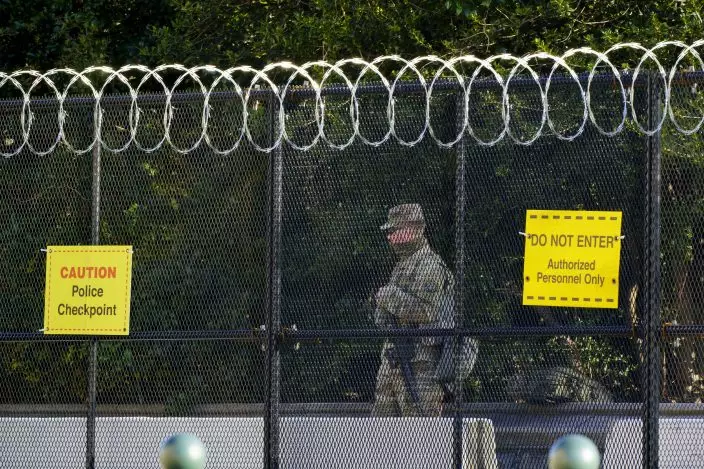
A National Guard member keeps watch along Constitution Avenue at the Capitol where heightened security remains since the Jan. 6 attacks by a mob of supporters of then-President Donald Trump, in Washington, Wednesday, March 3, 2021. The U.S. Capitol Police say they have intelligence showing there is a "possible plot" by a militia group to breach the U.S. Capitol on Thursday. (AP PhotoJ. Scott Applewhite)
Democrats say they are determined to pass the bill a second time, to combat police brutality and institutional racism after the deaths of Floyd, Breonna Taylor and other Black Americans following interactions with law enforcement — images of which were sometimes jarringly captured on video. Those killings drew a national and international outcry.
But the debate over legislation has turned into a political liability for Democrats as Republicans seized on calls by some activists and progressives to “defund the police” to argue that Democrats were intent on slashing police force budgets. This bill doesn't do that.
Former Democratic National Committee Chairman Tom Perez said it was a reason the party, after talking confidently of growing its majority in November, instead saw it shrink to just 10 seats, 221-211.
“We played too much defense on ‘defund the police,’” Perez said.
Moderate Democrats said the charge helped to drive Democratic defeats in swing districts around the country.
“No one ran on ‘defund the police,’ but all you have to do is make that a political weapon,” said Rep. Henry Cuellar, a moderate Texas Democrat who has pushed for more police funding in places like his city of Laredo, where law enforcement presence is especially concentrated given the close proximity to the Mexican border.
While Democrats used their then-larger majority to pass the police reform measure in the House last summer, it stalled in the then-Republican-controlled Senate, where GOP senators pushed an alternate plan that Democrats blocked from consideration, calling it inadequate. Democrats now control both chambers of Congress, but it seems unlikely the bill could pass the Senate without substantial changes to win GOP support.
The bill had been set for a vote Thursday, but House leaders abruptly changed the schedule after U.S. Capitol Police warned of threats of violence by a militia group seeking to storm the Capitol two months after the Jan. 6 siege.
Democratic control in the House is now so narrow that the loss of even a handful of moderate votes can sink legislation. But senior Democratic congressional aides said Wednesday they were confident the policing bill would clear the House and were eager to get it to the Senate, where negotiations will take longer.
Despite the political attacks by Republicans, even the House's more centrist lawmakers, some representing more conservative districts, appear ready to back the bill. Aides pointed to the moderate New Democrat Coalition saying this week that its members would support it.
“Black Americans have endured generations of systemic racism and discrimination for too long, and this has been painfully evident in their treatment by law enforcement," said Rep. Suzan DelBene, D-Wash, who chairs the coalition.
That endorsement came despite the bill's prohibitions on so-called qualified immunity, which shields law enforcement from certain lawsuits and is one of the main provisions that will likely need to be negotiated in any compromise with the Senate.
Police unions and other law enforcement groups have argued that, without such legal protections, fears of lawsuits will stop people from becoming police officers — even though the measure permits such suits only against law enforcement agencies, rather than all public employees.
California Rep. Karen Bass, who authored the bill, understands the challenge some House members face in supporting it.,
“My colleagues, several of them, I do not make light of the difficulty they had getting reelected because of the lie around defunding the police,” Bass said.
She called provisions limiting qualified immunity and easing standards for prosecution “the only measures that hold police accountable — that will actually decrease the number of times we have to see people killed on videotape.”
Bass said she was not planning to make concessions before the bill clears the House. Changes would only serve to weaken it while failing to shield Democrats from the false “defund the police” narrative surrounding it, she said.
“Even if they were to vote against the bill, even if they were to have a press conference denouncing the bill, they are still going to be hit with the same lie,” Bass said of Democrats.
She also acknowledged the challenges Democrats faced last November — and may likely see again — when former President Donald Trump's reelection campaign and other leading Republicans crowded the airwaves with images of cities around the country burning. But Bass said those attacks, like much of the opposition to the bill, are built on racism, promoting fears about how, “The scary Black people are going to attack you if you try to rein in the police.”
“That's as old as apple pie in our history,” she said. “So do you not act because of that?”
Still, she conceded that changes are likely to come if the measure is to win the minimum 60 votes it will need to advance in the Senate, which is now split 50-50s. Bass said she'd been in contact with South Carolina Sen. Tim Scott, the only Black Republican in the chamber, and was confident he would help deliver some GOP support.
Scott said this week that the legislation's sticking points were qualified immunity and prosecutorial standards and that in both areas, “We have to protect individual officers.”
“That's a red line for me,” Scott said, adding “hopefully we'll come up with something that actually works.”
That could prove a tall order, despite the White House's vocal support for police reform. Biden has promised to combat systemic racism and signed executive orders he says will begin doing that, though advocates are expecting the new administration to go further.
Biden has tweeted that he hopes "to be able to sign into law a landmark police reform bill.”
LUANDA, Angola (AP) — Pope Leo XIV called Sunday for Angolans to fight the “scourge of corruption” with a culture of justice as he opened a poignant day in his African odyssey that will take the American pope to an epicenter of the African slave trade.
Leo celebrated Mass before an estimated 100,000 people outside the capital and again sought to encourage Angolans. He denounced the exploitation of their mineral-rich land and people, who still bear the scars of a brutal, post-independence civil war.
“We wish to build a country where old divisions are overcome once and for all, where hatred and violence disappear, and where the scourge of corruption is healed by a new culture of justice and sharing,” Leo said in his homily in Kilamba, a Chinese-built development about 25 kilometers (15 miles) outside the capital.
Later Sunday, Leo will celebrate the Rosary prayer at the Sanctuary of Mama Muxima, an important Catholic shrine on the edge of the Kwanza River about 110 kilometers (70 miles) south of Luanda.
The Church of Our Lady of Muxima, built by Portuguese colonizers at the end of the 16th century as part of a fortress complex, became a hub in the slave trade. It was where enslaved Africans were gathered to be baptized by Portuguese priests before being forced to walk to the port of Luanda to be put on ships to the Americas.
While it's a popular Catholic shrine today, its history is emblematic of the Catholic Church’s role in the slave trade hundreds of years ago, the forced baptisms of enslaved people and what some scholars say is the Holy See’s continued refusal to fully acknowledge it and atone for it.
The visit is particularly significant because the Creole ancestors of the first U.S.-born pope include enslaved people and slave owners, according to genealogical research.
“For Black Catholics, Pope Leo’s visit to the Muxima shrine is an important moment of healing,” said Anthea Butler, senior fellow at the Koch Center, Oxford University.
She noted that many Black Catholics are Catholic because of slavery and the “Code Noir,” which she said required slaves purchased by Catholic owners to be baptized in the church.
“Others were already Catholic when they were trafficked from Angola to slave holding colonies,” said Butler, a Black Catholic scholar whose maternal family hails from Louisiana, where the pope’s ancestors also had their roots.
Angola’s Portuguese colonizers were emboldened by 15th-century directives from the Vatican that authorized them to enslave non-Christians.
In 1452, for example, Pope Nicholas V issued the papal bull Dum Diversas, which gave the Portuguese king and his successors the right “to invade, conquer, fight and subjugate” and take all possessions — including land — of “Saracens, and pagans, and other infidels, and enemies of the name of Christ” anywhere, said the Rev. Christopher J. Kellerman, a Jesuit priest and author of “All Oppression Shall Cease: A History of Slavery, Abolitionism, and the Catholic Church.”
The bull also gave the Portuguese permission “to reduce their persons to perpetual slavery.”
That bull and another issued three years later, Romanus Pontifex, formed the basis of the Doctrine of Discovery, the theory that legitimized the colonial-era seizure of land in Africa and the Americas, and justified slavery.
The Vatican in 2023 formally repudiated the Doctrine of Discovery, but it never formally rescinded, abrogated or rejected the bulls themselves. The Vatican insists that a later bull, Sublimis Deus in 1537, reaffirmed that Indigenous peoples shouldn’t be deprived of their liberty or the possession of their property, and were not to be enslaved.
Kellerman recalled that most of the 12.5 million Africans who were direct victims of the trans-Atlantic slave trade were sold into slavery by other Africans and were not captured by Europeans.
“That being said, at the time of the building of Muxima, the Portuguese were doing both — buying enslaved people and colonizing/slave raiding. So they were fully using their papal permissions during this time,” he said in emailed comments to The Associated Press.
He said the first pope to condemn slavery itself was Pope Leo XIII, the current pope’s namesake and inspiration, in two encyclicals in 1888 and 1890. But Kellerman said that pope and others since have continued to perpetuate the “false narrative” that the Holy See was always against slavery, when the historical record says otherwise.
While Leo's visit to Muxima was in honor of its role as a shrine, Kellerman said he hoped that the visit would also give Leo a chance to learn more about the history of the slave trade.
“The popes repeatedly authorized Portugal’s colonization efforts in Africa and Portuguese participation in the slave trade, but the Vatican has never fully admitted this,” he said. “It would be so powerful if at some point Pope Leo were to apologize for the popes’ role in the trade.”
During a 1985 visit to Cameroon, St. John Paul II asked forgiveness of Africans for the slave trade. In 1992 visit to Goree Island, Senegal, the largest slave-trading center in West Africa, he denounced the injustice of slavery and called it a “tragedy of a civilization that called itself Christian.”
According to genealogical research published by Henry Louis Gates Jr., 17 of Leo's American ancestors were Black, listed in census records as mulatto, black, Creole or a free person of color. His family tree includes slaveholders and enslaved people, Gates reported in an essay in the New York Times.
Gates, a Harvard University professor who hosts the popular PBS documentary series “Finding Your Roots,” presented his research to Leo during a July 5 audience at the Vatican. According to a report of their meeting in The Harvard Gazette, “The pope asked about ancestors, both Black and white, who were enslavers.”
Leo has not spoken publicly about his family heritage or the Gates research, and some Black Catholic scholars are hesitant to impose on him a narrative about his identity that he himself has not yet addressed publicly.
“It’s important that we tell our own stories,” said Tia Noelle Pratt, a sociologist of religion and professor at Villanova University, the pope’s alma mater.
“We haven’t heard anything from him about what he thinks about it, and so to impose anything on him, I think would be completely inappropriate,” said Pratt, author of “Faithful and Devoted: Racism and Identity in the African-American Catholic Experience.”
Cardinal Wilton Gregory, the retired archbishop of Washington and the first African American cardinal, said he was “delighted” to have facilitated the encounter.
“It’s one of the things that I think for many African Americans and people of color, they identify with great pride the pope has roots in our own heritage,” Gregory said. “And I think he’s happy about that too, because it’s another link to the people that he tries to serve and is called to serve.”
Associated Press religion coverage receives support through the AP’s collaboration with The Conversation US, with funding from Lilly Endowment Inc. The AP is solely responsible for this content.
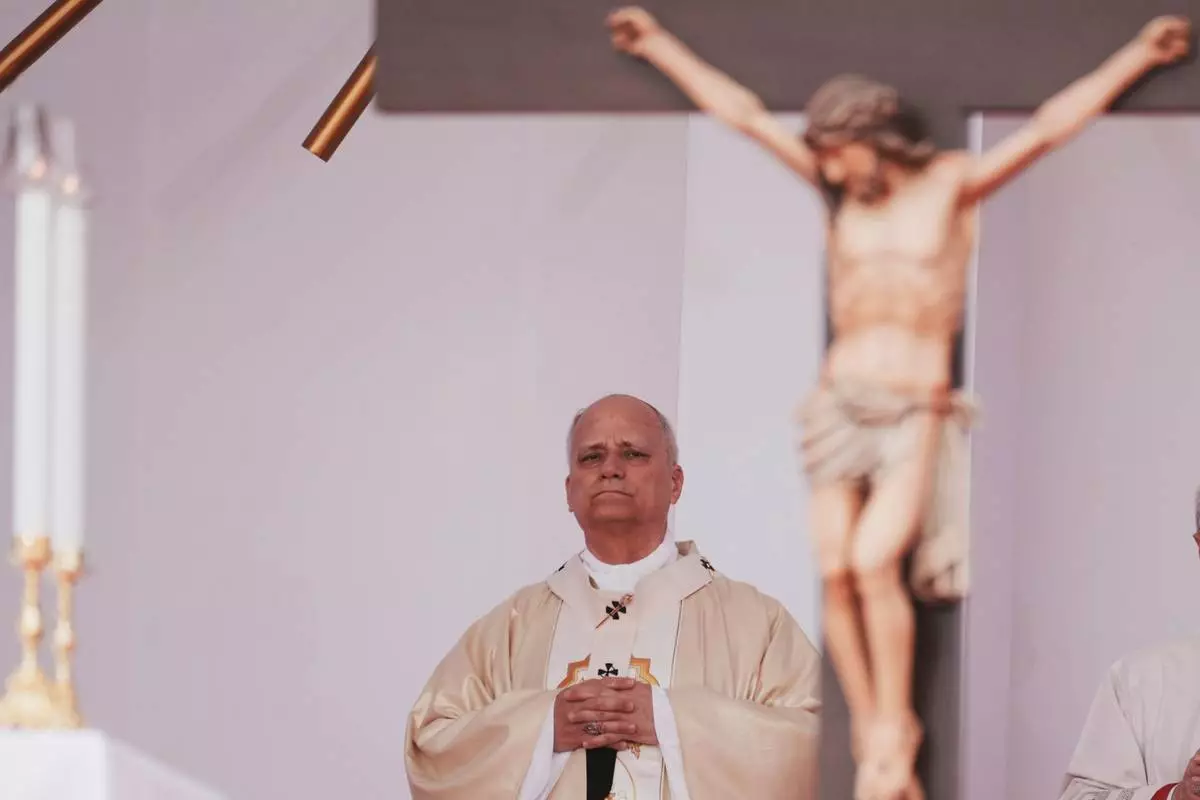
Pope Leo XIV presides over Sunday Mass, Sunday, April 19, 2026, in Kilamba, some 30 kilometers south of Luanda, Angola, on the seventh day of an 11-day apostolic journey to Africa. (AP Photo/Andrew Medichini)
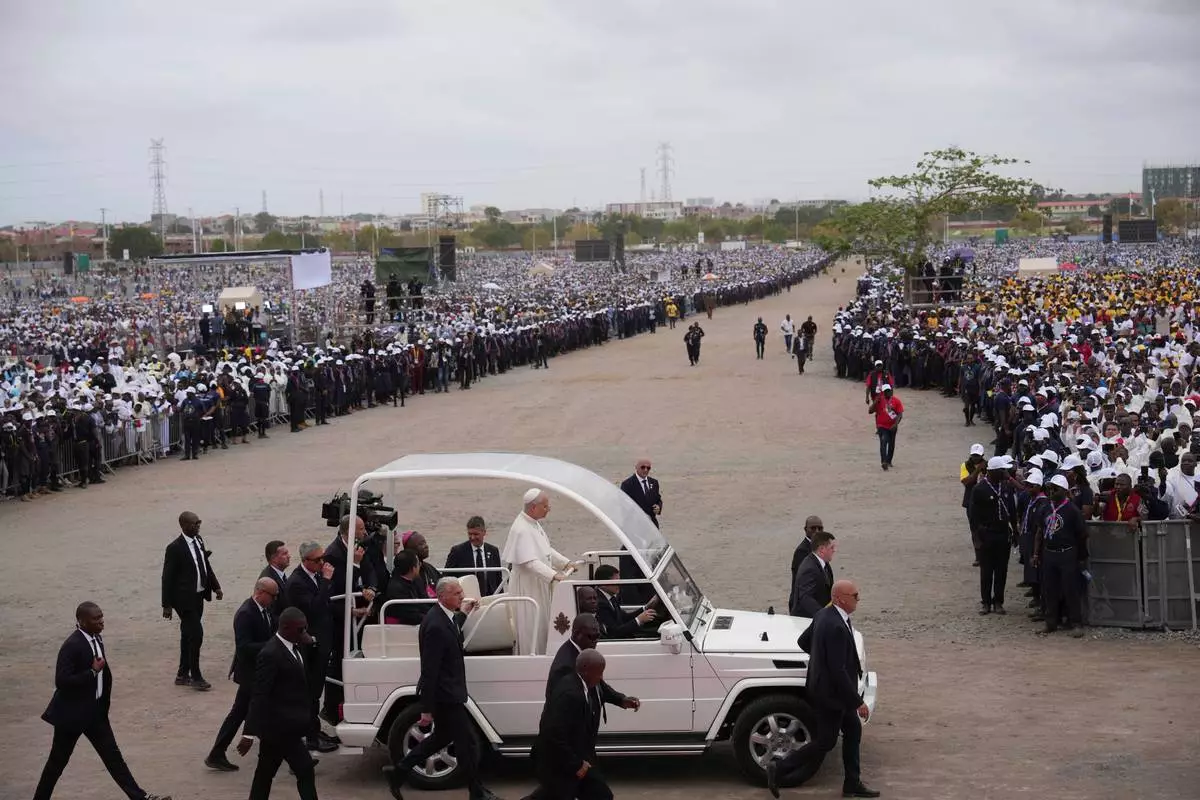
Pope Leo XIV arrives in Kilamba, some 30 kilometers south of Luanda, Angola, to preside over Sunday Mass, Sunday, April 19, 2026, on the seventh day of an 11-day apostolic journey to Africa. (AP Photo/Andrew Medichini)
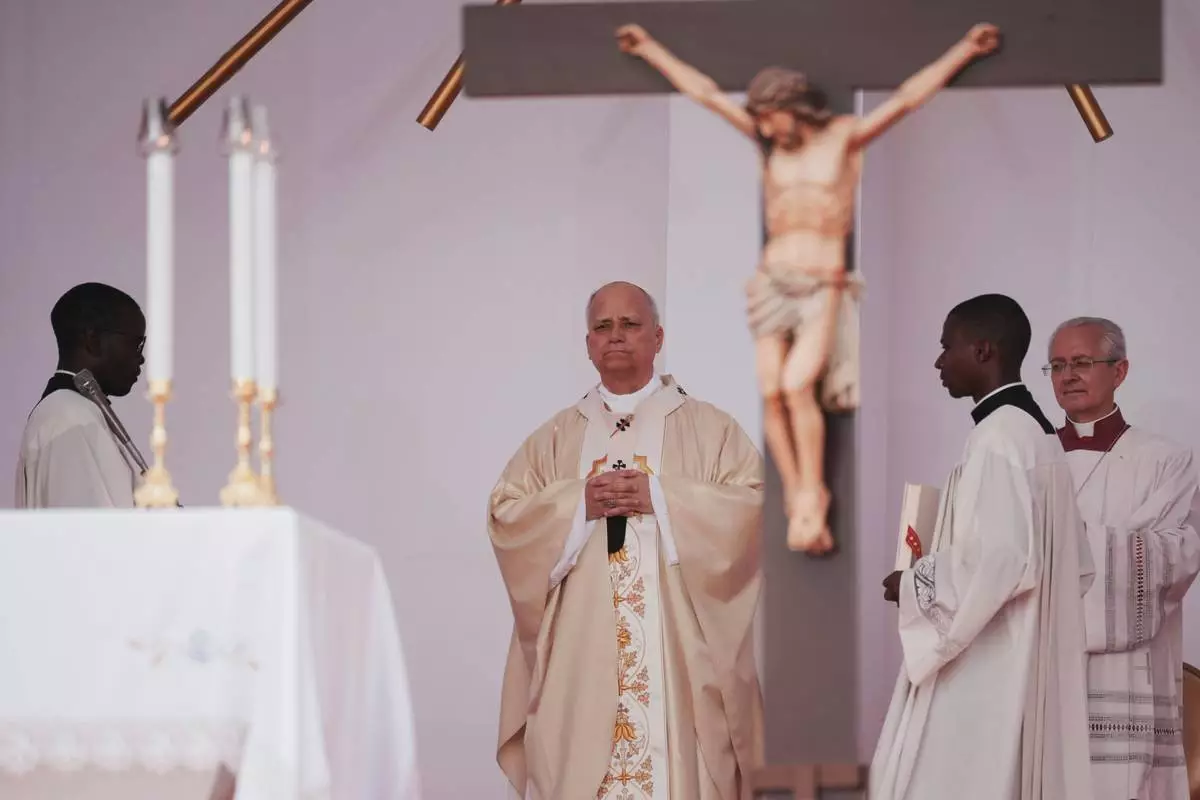
Pope Leo XIV presides over Sunday Mass, Sunday, April 19, 2026, in Kilamba, some 30 kilometers south of Luanda, Angola, on the seventh day of an 11-day apostolic journey to Africa. (AP Photo/Andrew Medichini)