PALO ALTO, Calif.--(BUSINESS WIRE)--Apr 22, 2024--
Streetbeat, a leader in AI-powered financial advising with robust investment options in stocks and crypto, is thrilled to announce the launch of its Tuition Rewards Program. This pioneering initiative offers families the unique opportunity to significantly reduce college tuition costs through smart investing via Streetbeat.
Click to Gallery
(Graphiic: Business Wire)
(Graphiic: Business Wire)
Damian Scavo, Streetbeat CEO (Photo: Business Wire)
(Graphiic: Business Wire)
This press release features multimedia. View the full release here: https://www.businesswire.com/news/home/20240422093834/en/
With the cost of college continuing to rise—77% of families consider college too expensive—the average undergraduate tuition and fees at private nonprofit colleges reached approximately $41,540 for the 2023-2024 academic year. The total yearly costs at these institutions often exceed $60,000, including room and board costs.
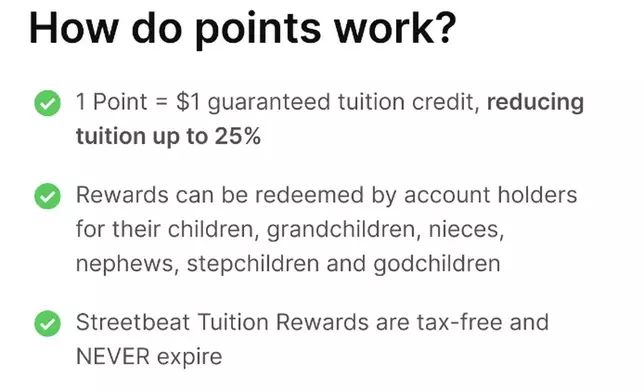
The Streetbeat Tuition Rewards Program transforms how families approach financing higher education. By investing through Streetbeat, subscribers can earn Points that convert directly into tuition savings—up to 25% off—at over 450 prestigious private colleges and universities nationwide.
For an annual subscription of $159, Streetbeat offers $5,000 in reward points. Additionally, subscribers receive a 10% annual bonus on their assets under management as points. For instance, a family could save up to $55,690 on tuition fees per member at San Diego University.
Damian Scavo, Streetbeat CEO, comments: "My parents couldn’t afford to pay for college for me or my brother. We both had to work through our college years. When my father passed away during my second year of university, I had to drop out to support my family. A program like Streetbeat's Tuition Rewards Program would have been life-changing. I'm truly happy that I can now help millions of others change theirs."
Discover the future of finance and education with Streetbeat's Tuition Rewards Program. Visit https://get.streetbeat.com/tuitionrewards to unlock 25% college tuition savings.
Some of the participating colleges include:
The full list of participating colleges can be accessed on the Streetbeat website and directly via https://streetbeat.com/en/tuition-rewards/universities. To explore more about how Streetbeat’s Tuition Rewards Program can make college more affordable for your family, please visit https://get.streetbeat.com/tuitionrewards.
Damian Scavo, the CEO of Streetbeat, will be hosting a live event on our social medias on Friday, April 26th, during which he will award $65,000 in points to one fortunate individual, covering up to one year of college tuition. The challenge? Locate him to win.
For further details on this event, please visit: https://get.streetbeat.com/tuitionrewards
About Streetbeat: Streetbeat is a leading provider of AI-powered investment solutions, offering smart portfolio management and financial planning tools to empower individuals to achieve their financial goals. With a commitment to innovation and excellence, Streetbeat is revolutionizing the world of finance, one investment at a time.

(Graphiic: Business Wire)

(Graphiic: Business Wire)

Damian Scavo, Streetbeat CEO (Photo: Business Wire)

(Graphiic: Business Wire)
LAS VEGAS (AP) — Jim Kelly set the standard for every Bills quarterback, but even the Hall of Famer likely wouldn't have made the type of play Josh Allen pulled off Sunday.
Allen passed for 255 yards and two touchdowns, using his improvisational brilliance to tie Kelly's franchise record for TD passes, and Buffalo held off the Las Vegas Raiders 33-30 on Sunday.
The Raiders (3-3), who have lost three in a row, rallied late to tie it at 23-all. James Cook rushed for a 3-yard touchdown with 4:43 left to put the Bills (5-1) ahead for good. Tyler Bass added a 38-yard field goal with 1:56 remaining for what turned out to be a crucial two-possession lead.
Allen equaled Kelly's franchise record of 258 TD passes in the third quarter, escaping almost a sure sack by shot-putting a 12-yard pass to Keon Coleman. Bills fans, who accounted for well more than half the crowd at Allegiant Stadium, chanted “M-V-P!”
“The last two weeks, the amount of fans we've had in both stadiums is pretty remarkable,” Allen said, referencing the friendly crowd at SoFi Stadium in a win over the Rams. “It feeds us, and we play better when we feel that energy and feel that juice.”
As for the toss to Coleman, Allen said he was “just doing what I got to do to help this team win a football game.”
Bills coach Joe Brady joked that “it was a great play call.”
“That's who he is,” Brady said. “I thought he was outstanding today.”
Allen's five-game streak of games with a rushing touchdown ended, one short of the Super Bowl-era record set four years ago by Chicago's Justin Fields.
Cook, making extra certain to secure the ball after fumbling twice Monday night against the Rams and losing one in overtime, was mistake-free in rushing for 95 yards. He also caught three passes for 58 yards, including a 26-yarder against a Raiders defense that went the other way, leaving him alone to set up his go-ahead score.
“They asked me in the (CBS) production (meeting) last night, ‘What are you going to do with James Cook?’ I was like, ‘Hand him the football,’” Brady said. “I didn't get to stand right here without James, and it's the confidence I have in him in not making it anything bigger than what it needs to be. I trust that he's going to correct it and clean it up, and he was outstanding today.”
The Bills had their first game without a turnover after committing nine over the previous three weeks.
Kirk Cousins threw for 313 yards and two touchdowns to Tre Tucker for the Raiders. The latter was a gorgeous 44-yarder with 1:32 left that brought Las Vegas within three points. Tucker finished with five catches for 97 yards.
Michael Mayer caught seven passes for a career-high 95 yards for Las Vegas, and fellow tight end Brock Bowers hauled in four receptions for 70 yards.
The Raiders had opportunities to put even more pressure on one of the league's best teams, but they scored touchdowns on two of five trips to the red zone.
“That’s unacceptable,” coach Klint Kubiak said. “And that starts with me.”
A critical missed chance for Las Vegas came early in the fourth quarter, when it had second-and-goal at the Bills 1-yard line while trailing by 10 points.
Ashton Jeanty was stuffed for a 3-yard loss when defensive lineman Greg Gaines blasted through the line of scrimmage. Then, Bills cornerback Davison Igbinosun broke up Cousins' third-down pass in the end zone to force a field goal.
“We got to come away with those four-point plays and get the touchdown,” Cousins said.
The Bills appeared to be in firm control when they took a 23-13 lead on Allen's sensational pass to Coleman, but the Raiders tied it on Cousins' 11-yard pass to Tucker with 8:07 left.
Bills safety C.J. Gardner-Johnson, who is playing for his sixth team in six seasons, was ejected late in the first half after spitting at a Raiders player.
Las Vegas had just picked up a first down on a defensive holding call, and the unsportsmanlike-conduct penalty on Gardner-Johnson advanced the ball to Buffalo's 14-yard line. That helped set up Matt Gay's 27-yard field goal as time expired to make it 13-13.
Bills: WR DJ Moore (shoulder) and DL Ed Oliver (knee) did not play for the second week in a row. OLB Bradley Chubb (ribs) went out briefly in the second quarter before returning. TE Dalton Kincaid (ribs), playing in his hometown on his 27th birthday, was injured in the third quarter but returned.
Bills: After a bye, host Baltimore on Nov. 1.
Raiders: Host the Los Angeles Rams next Sunday.
See AP’s full NFL coverage here
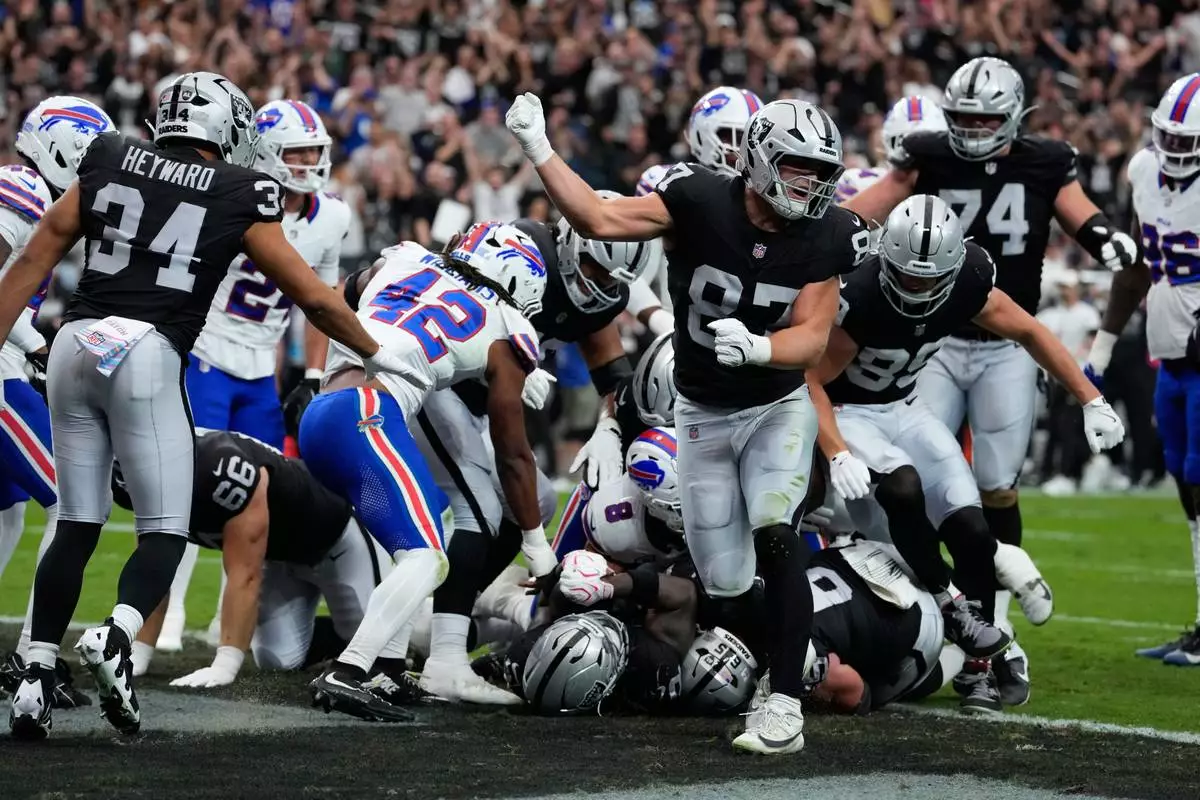
Las Vegas Raiders tight end Michael Mayer (87) celebrates a touchdown against the Buffalo Bills during an NFL football game in Las Vegas, Sunday, Oct. 18, 2026. (AP Photo/John Locher)
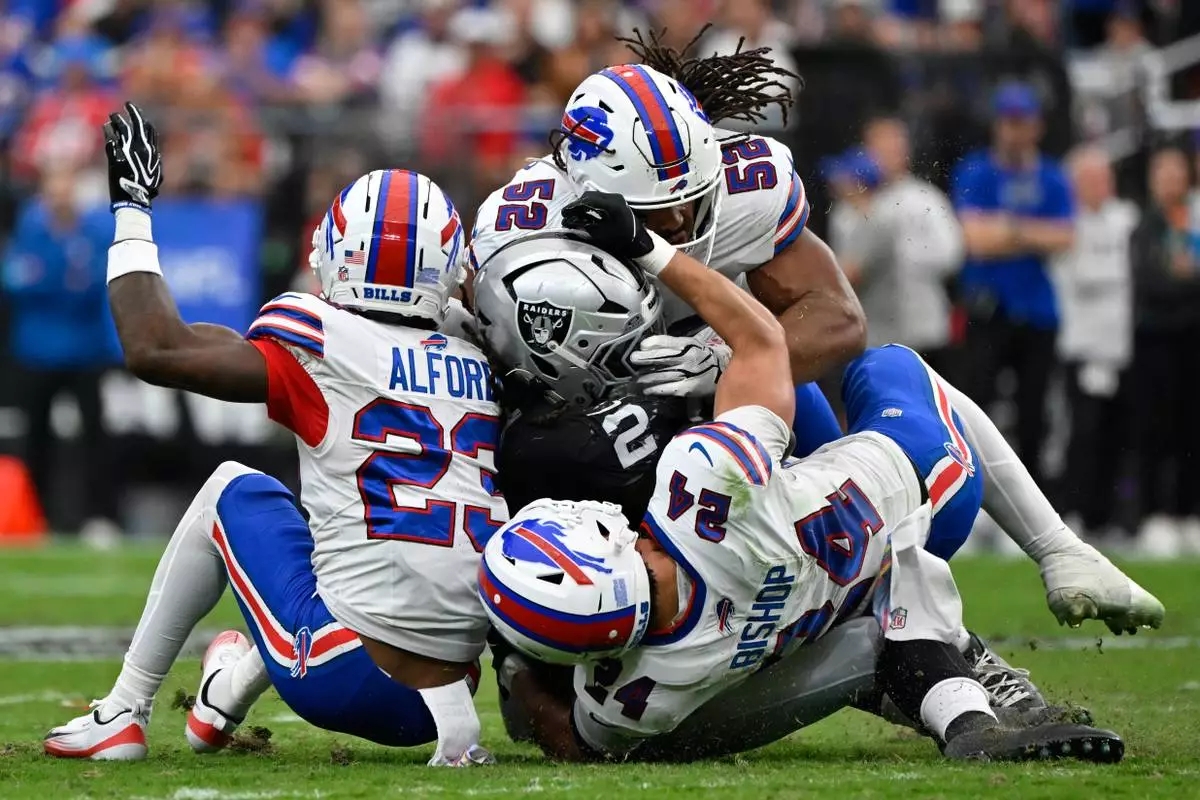
Las Vegas Raiders running back Ashton Jeanty (2) is stopped by Buffalo Bills linebacker Kaleb Elarms-Orr (52), cornerback Dee Alford (23) and safety Cole Bishop (24) during an NFL football game in Las Vegas, Sunday, Oct. 18, 2026. (AP Photo/David Becker)
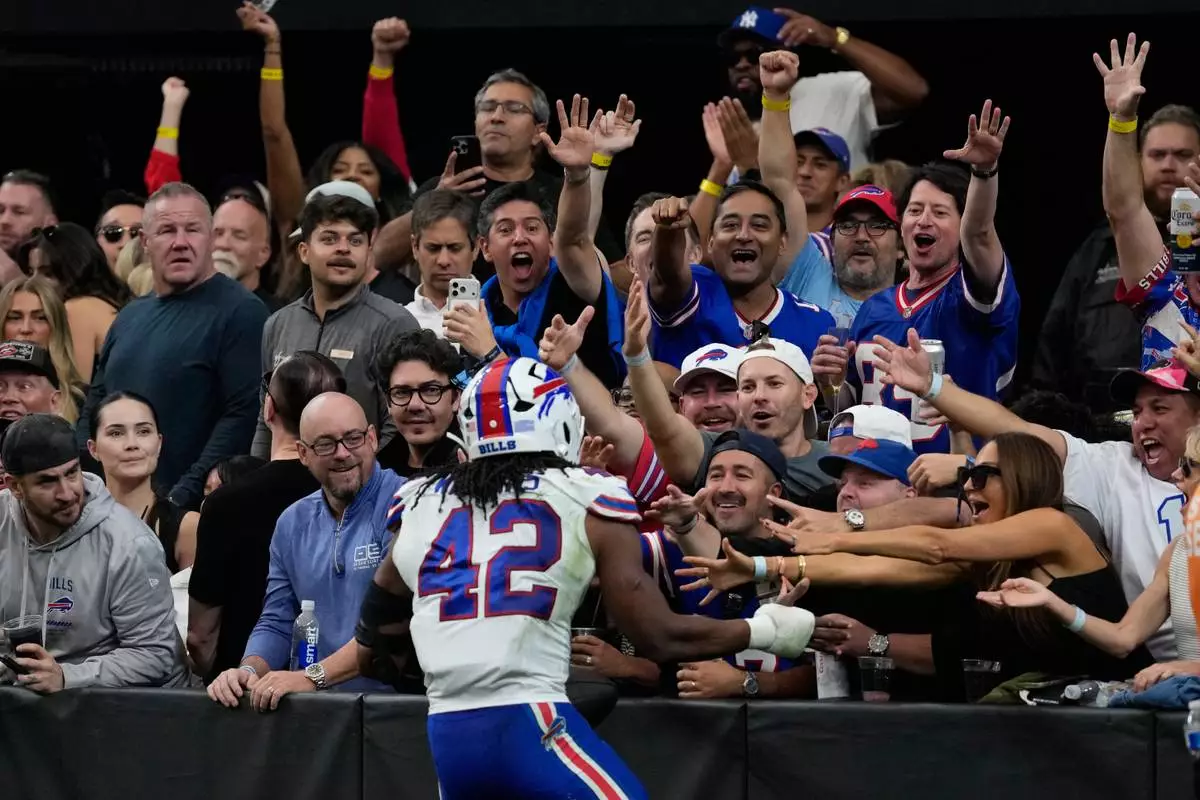
Buffalo Bills linebacker Dorian Williams (42) celebrates with fans after an interception against the Las Vegas Raiders during the second half of an NFL football game in Las Vegas, Sunday, Oct. 18, 2026. (AP Photo/John Locher)
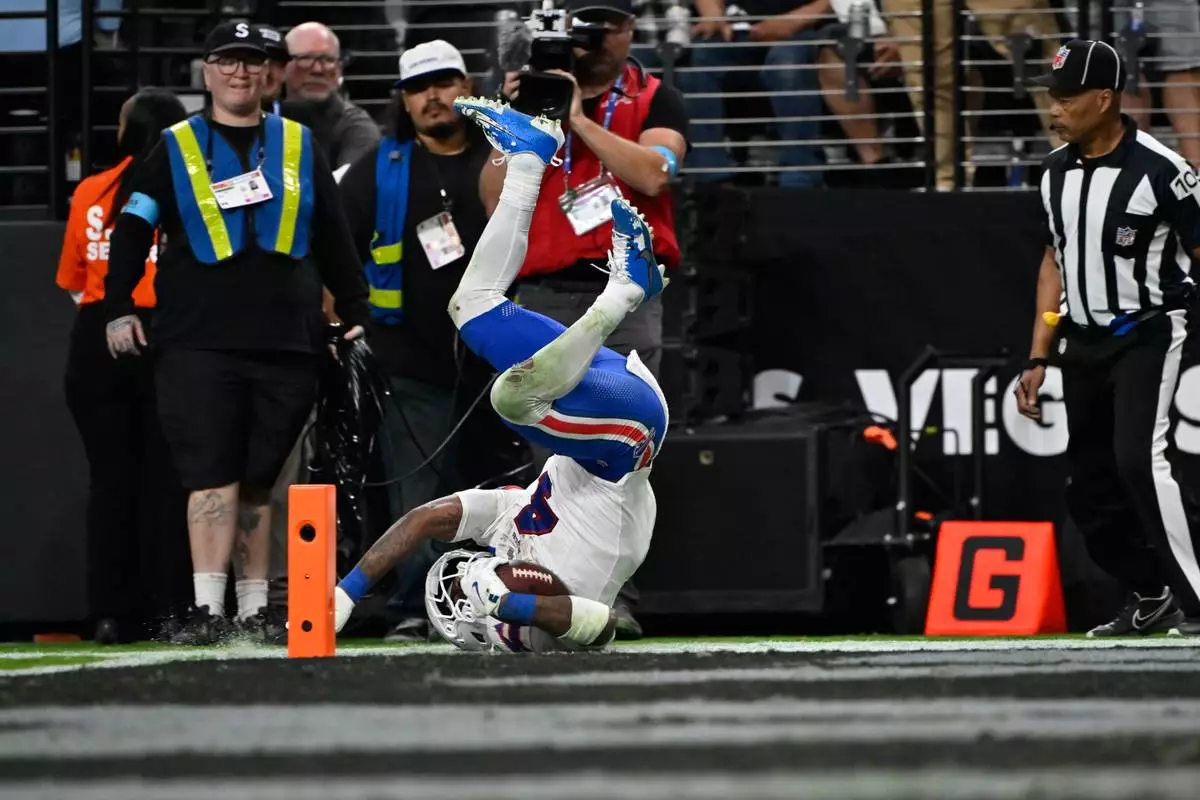
Buffalo Bills running back James Cook III (4) is flipped out of bounds just short of the goal line during the second half of an NFL football game against the Las Vegas Raiders in Las Vegas, Sunday, Oct. 18, 2026. (AP Photo/David Becker)
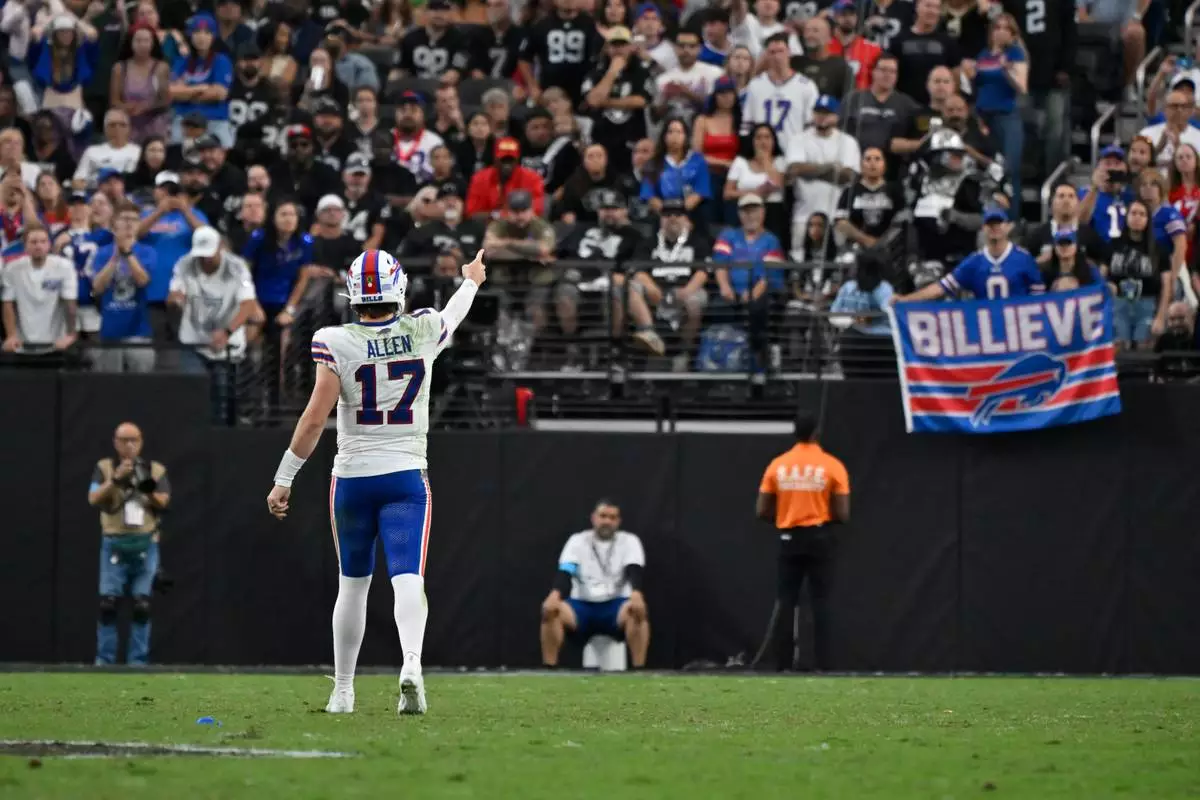
Buffalo Bills quarterback Josh Allen (17) celebrates with fans during the second half of an NFL football game against the Las Vegas Raiders in Las Vegas, Sunday, Oct. 18, 2026. (AP Photo/David Becker)
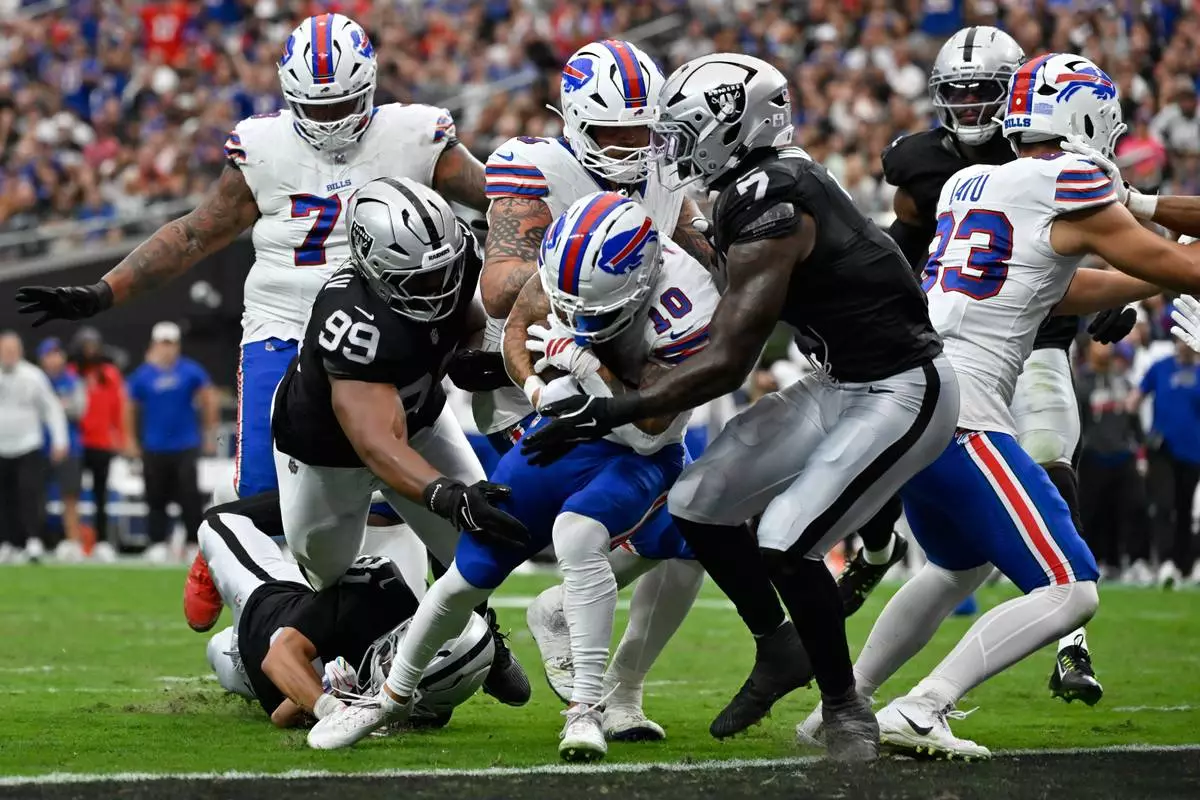
Buffalo Bills wide receiver Khalil Shakir (10) runs for a touchdown against the Las Vegas Raiders during an NFL football game in Las Vegas, Sunday, Oct. 18, 2026. (AP Photo/David Becker)
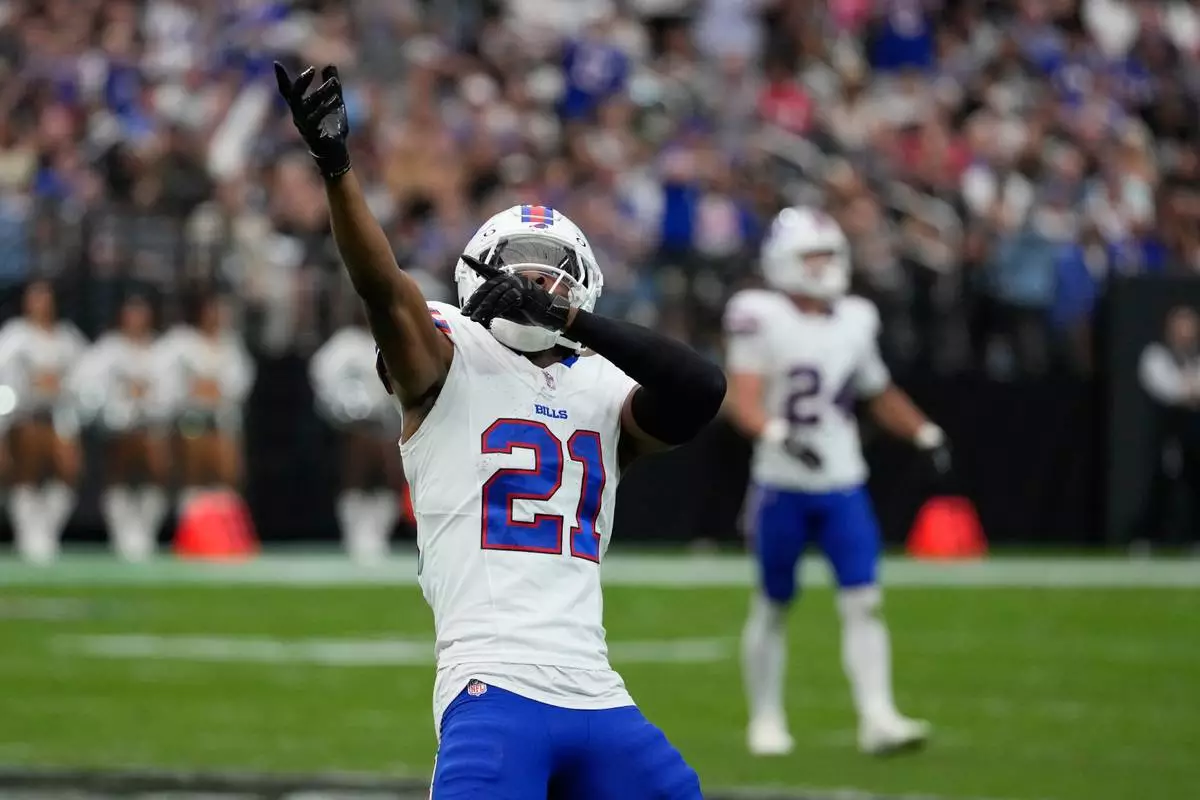
Buffalo Bills cornerback Davison Igbinosun (21) celebrates a play against the Las Vegas Raiders during an NFL football game in Las Vegas, Sunday, Oct. 18, 2026. (AP Photo/John Locher)
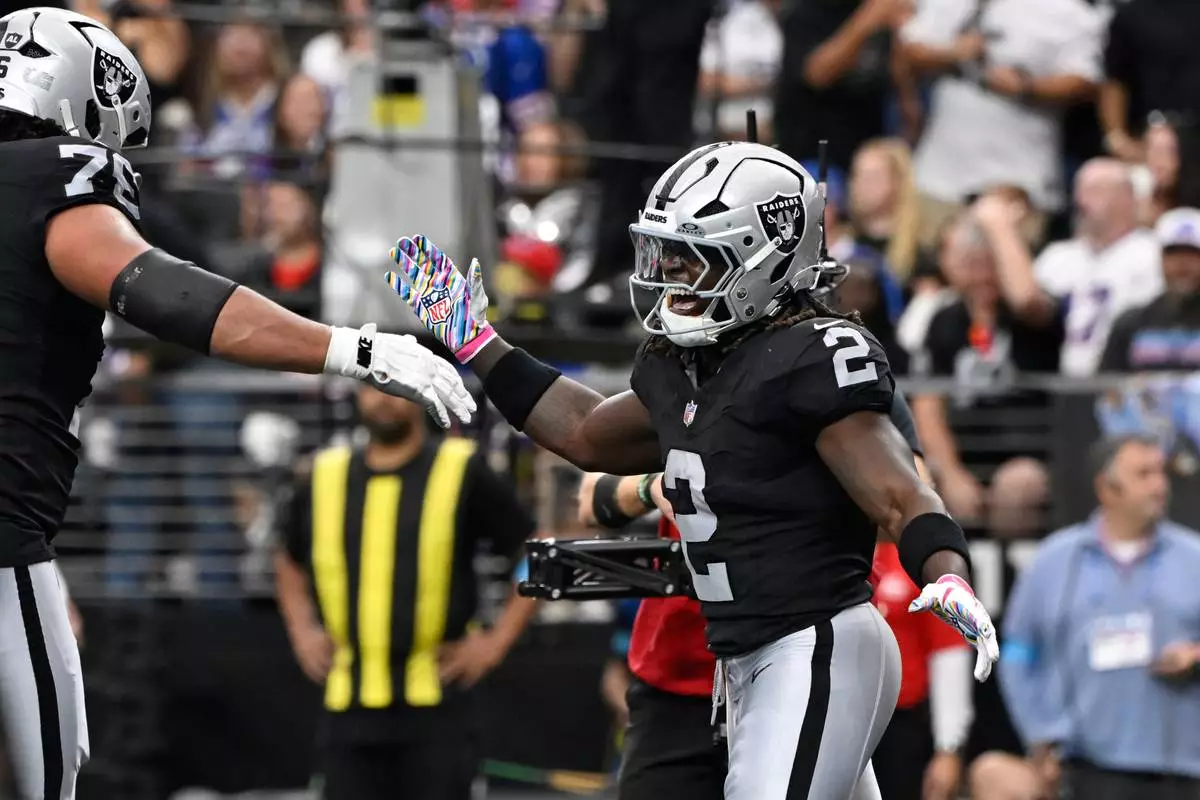
Las Vegas Raiders running back Ashton Jeanty (2) celebrates his touchdown against the Buffalo Bills during an NFL football game in Las Vegas, Sunday, Oct. 18, 2026. (AP Photo/David Becker)
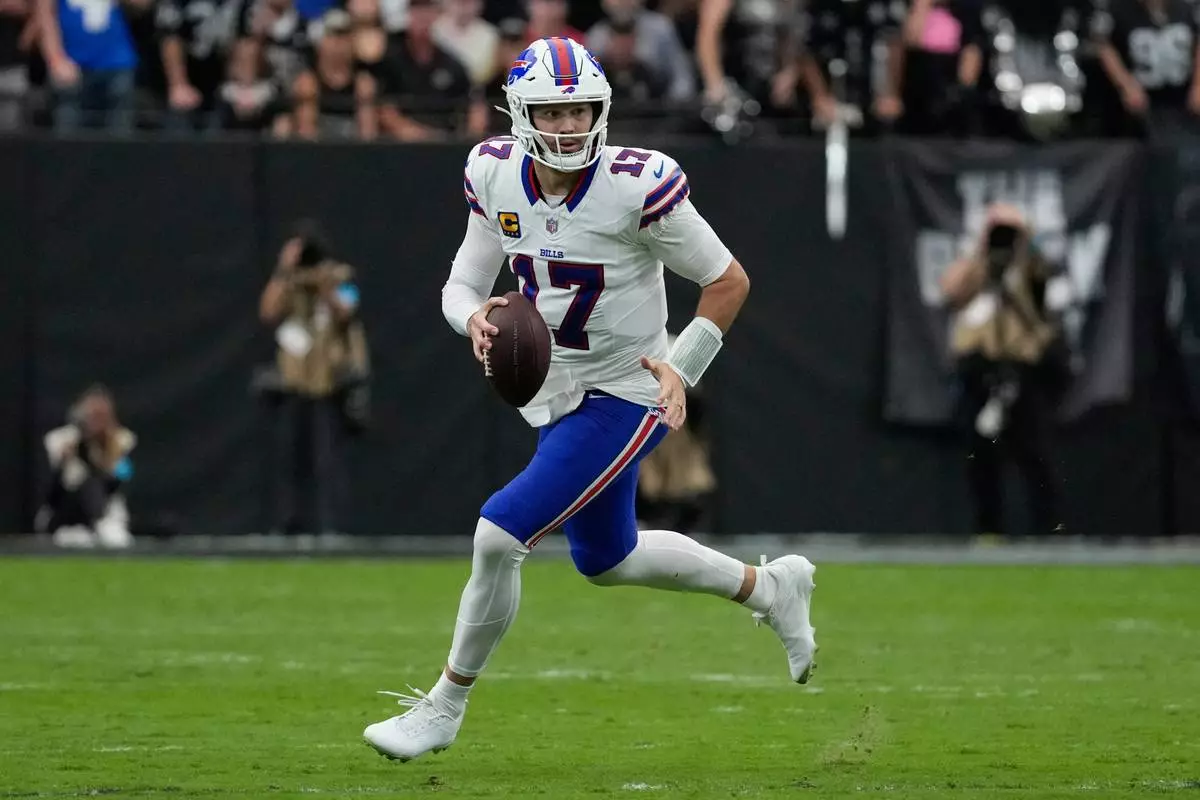
Buffalo Bills quarterback Josh Allen (17) scrambles as he looks to throw against the Las Vegas Raiders during an NFL football game in Las Vegas, Sunday, Oct. 18, 2026. (AP Photo/John Locher)
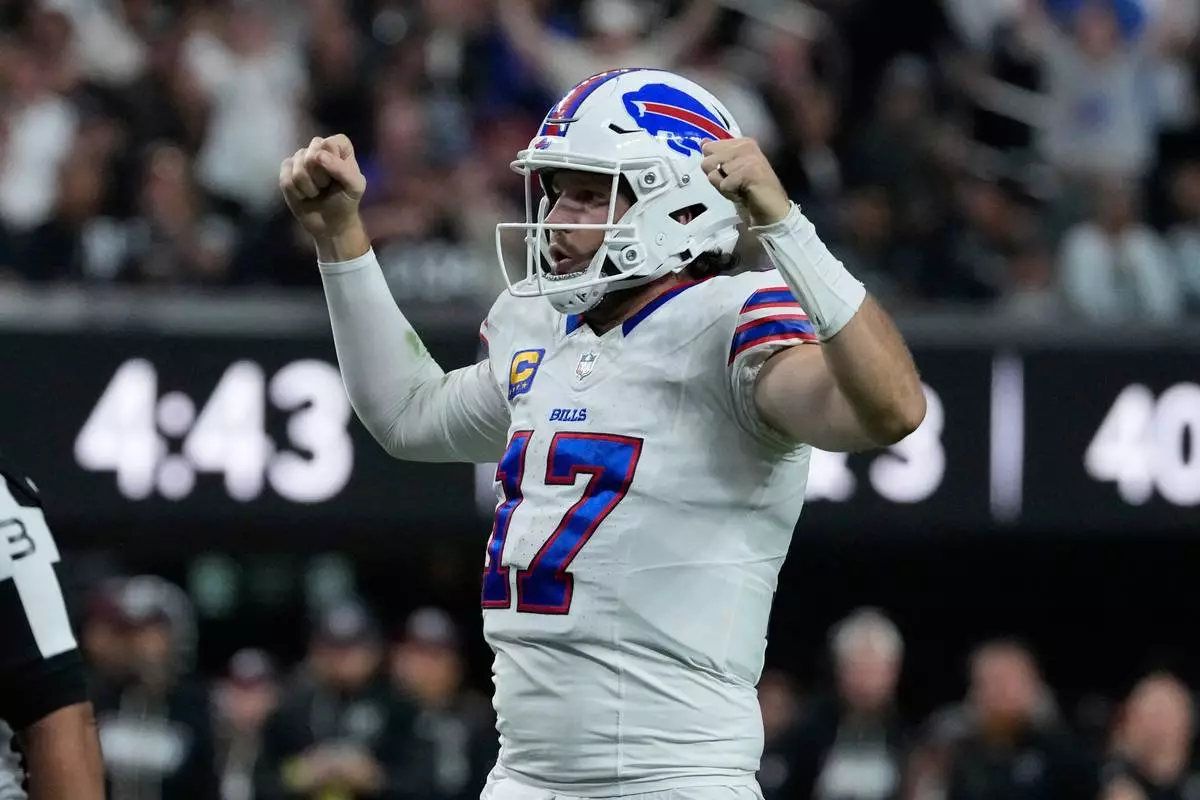
Buffalo Bills quarterback Josh Allen (17) celebrates a touchdown against the Las Vegas Raiders during the second half of an NFL football game in Las Vegas, Sunday, Oct. 18, 2026. (AP Photo/John Locher)