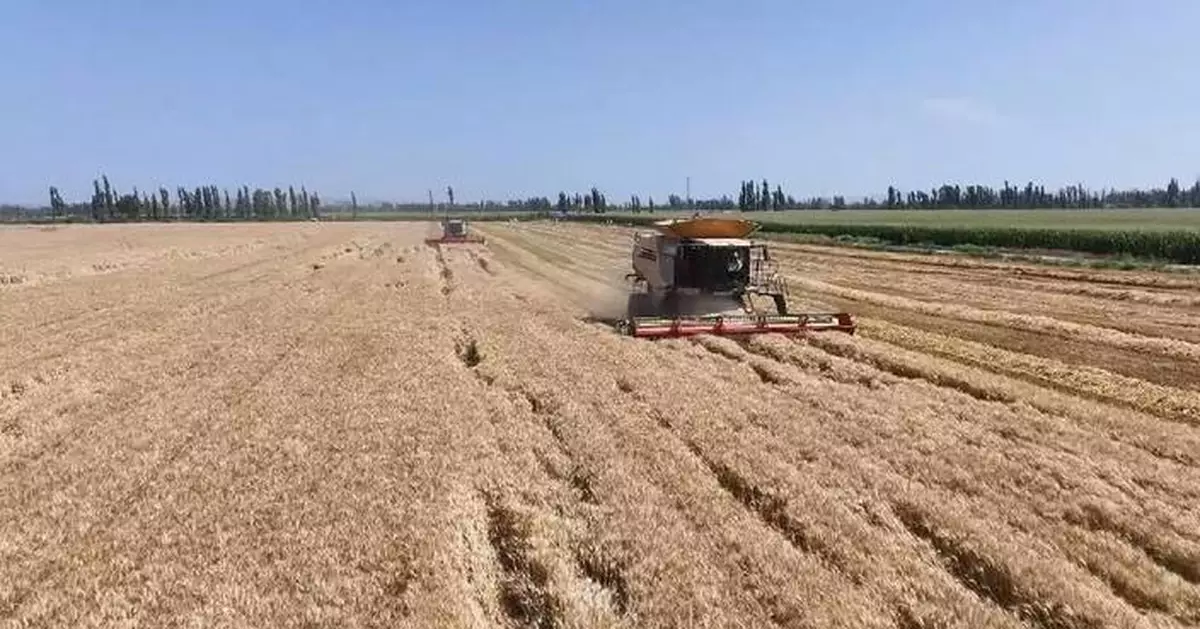
China's Xinjiang has so far achieved the highest winter wheat unit yields nationally for 2024, recent data from the Ministry of Agriculture and Rural Affairs showed.
The ample yields of the staple crop help bolster the country's food security. Currently, the summer grain harvest in northwest China's Xinjiang Uygur Autonomous Region has reached 70-percent completion.
Experts from the ministry measured winter wheat yields in Huocheng County of Ili Kazakh Autonomous Prefecture, finding 11,937 kg and 11,343 kg per hectare in fields of 33 hectares and 80 hectares, respectively.
"This year, the unit yield in fields ranging from 100 to 1,000 mu (about 6 to 66 hectares) has exceeded last year's record. Additionally, we carried out our first harvest in fields ranging from 1,000 to 10,000 mu (about 66 to 666 hectares) and fields of more than 10,000 mu in this region, aiming to gain experience to enhance unit yields in the future," said Zhang Rui, a professor at the Northwest Agriculture and Forestry University.
In Qapqal Xibe Autonomous County, the yield of winter wheat per hectare reached 10,812 kg in a demonstration field exceeding 666 hectares, achieving the highest winter wheat unit yield nationally for fields of this size in 2024, according to the ministry.
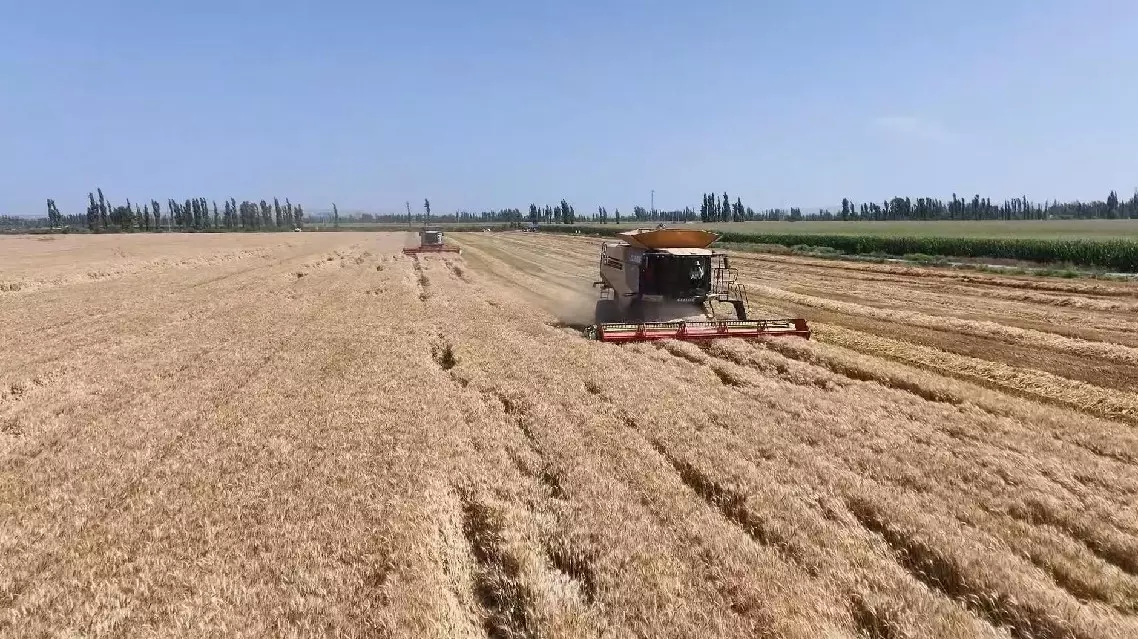
Xinjiang achieves China's highest winter wheat unit yields for 2024
China officially delivered a custom-made AI-driven meteorological early warning system, MAZU-Nepal, to Nepal on Tuesday on the sidelines of the ongoing Second China-Central Asia Meteorological Cooperation Forum held in northwest China's Xinjiang Uygur Autonomous Region.
MAZU, which stands for "multi-hazard, alert, zero-gap, and universal," is an intelligent meteorological early warning system developed in China that integrates artificial intelligence with physical forecasting models. It is named after the Chinese guardian goddess of the sea.
"The customized system represents a deeply-localized adaptation tailored to Nepal's unique geographic environment and disaster-response needs. Nepal's complex terrain, with large elevation differences across the Himalayas, crisscrossing river valleys, and constrained transportation and communications, places very high demands on meteorological monitoring and early warning," said Dai Kan, deputy director general of China's National Meteorological Center .
"With this deeply-customized version, we can achieve a resolution of one kilometer within Nepal, covering basic elements such as precipitation, temperature, wind and humidity. Our forecasting team and Nepal's experts are able to monitor conditions in real time," Dai continued.
Since the devastating mudslide disaster occurred on Aug 26, China has provided Nepal with weather monitoring, forecasting, early warning and impact-based services, including a version of MAZU for trial use in Nepal.
"So we've found it very productive and a very important tool for us, as it has observation feature. We have the high-resolution satellite image there and in nowcasting, we have the nowcasting -- what will be the weather for the next few hours -- so all the things are included in this platform. And along with this, we have AI-derived weather forecasting, including the ensemble of multiple modal output there, so we can tally the product from the different models at the single frame. So it was very helpful for us, and we hope we can utilize it more effectively, more efficiently in future as well," said Sanjib Adhikari, a meteorologist at the Nepal Meteorology Department.
MAZU has been applied in seven countries and is currently being trialed on the cloud in more than 50 countries.
China announced earlier this year that it will work to deploy the MAZU platform in more countries that need it over the coming years.
At the same event, the China Meteorological Administration unveiled a plan for implementing the MAZU system in Central Asian countries for 2026-2027, aiming to deepen meteorological cooperation between China and Central Asian countries, jointly enhance regional disaster prevention and mitigation capacity, and better serve regional economic and social development.
The Second China-Central Asia Meteorological Cooperation Forum was held from Tuesday to Wednesday in Urumqi, capital of the Xinjiang Uygur Autonomous Region.
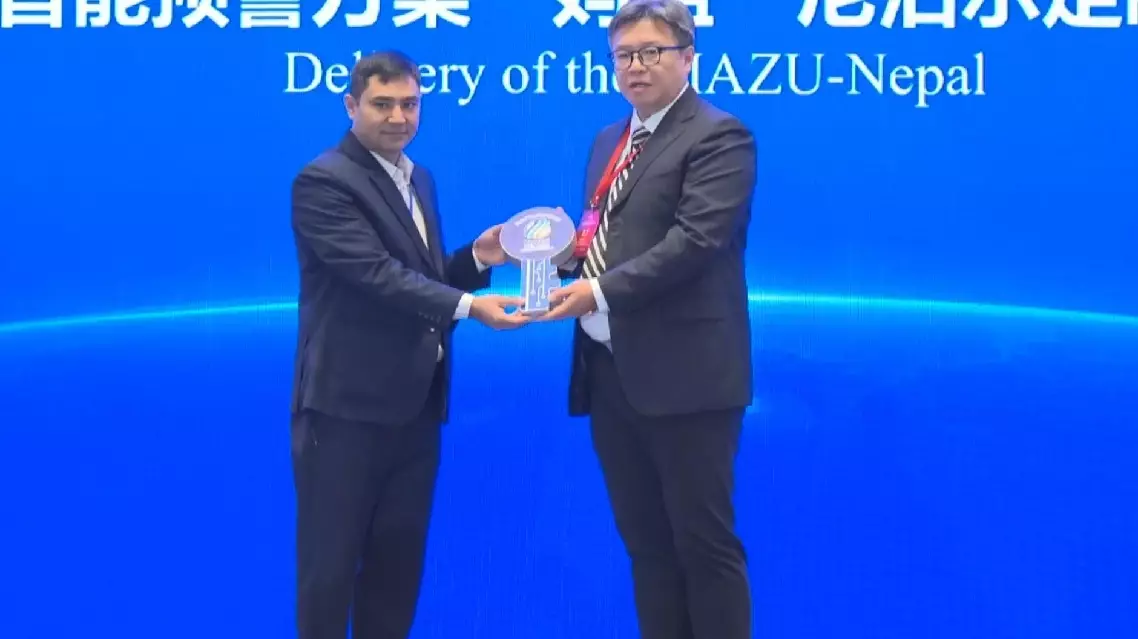
China delivers custom-made AI-driven meteorological early warning system to Nepal