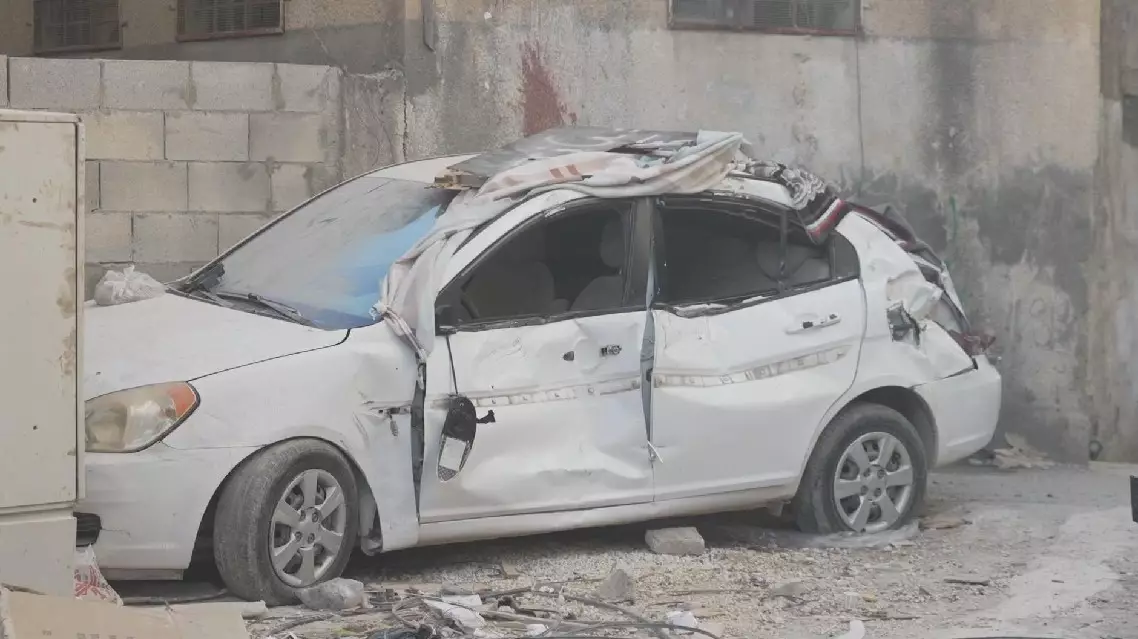
People living in the Jenin refugee camp in the occupied West Bank are still reeling from the ten-day military assault launched by the Israeli army since Aug 28, saying the operation destroyed their homes and dashed hopes for a normal life.
The operation left 21 Palestinian people dead, including children and the elderly, while injuring many others, according to the Palestinian official news agency WAFA.
Local resident Mohammed recounted the harrowing ten-day siege, saying they were gripped by an ominous fear of death.
"They opened heavy fire on these areas. The shooting rippled through the Jenin refugee camp from this side, and we were very scared then. As you can see, the bullets were coming in this direction and there were huge explosions. We could hear the bulldozers destroying the houses. We were helpless and scared, especially when we heard the bulldozers, the gunshots and the barking of their trained dogs. We felt like we were going to die," said Mohammed.
The clear bullet holes on the doors and walls of Mohammed's house are a reminder of the intensity of the Israeli raid.
Mohammed said Israeli soldiers patrolled the area every two or three hours each day. And for most of the time, they had to remain indoors while lying on the floor to avoid being hit by bullets.
With the water and electricity being cut off, their home became especially sweltering, with their food going bad. Mohammed said each of the ten agonizing days felt like an entire year.
"It's not about food. We could survive without food for 10, 15 or 20 days. It doesn't matter. But I want to feel the presence of life. Food was not a problem, even though it's very little. What really scares me and my wife is the overwhelming fear," he said.
This is not the first Israeli large-scale military operation in Jenin. Back in 2002, the Israeli army carried out a 10-day major assault on the Jenin refugee camp, causing hundreds of local casualties.
At that time, Mohammed's home was completely destroyed. But he said the scale and intensity of the operation this time were far greater than in 2002.
"This time the force is bewildering. They're acting like there are in a state of madness, worse than ever, never seen before. It is unbearable for us. We love life and desire to have hope and the pursuit of life. But they don't give us a chance. Every week or two, they come and destroy our dreams and homes," said Mohammed.
Even though the Israeli military claimed to have ended its ten-day military operation in Jenin, the fear hasn't dissipated among locals as the sound of drones can be heard overhead and a few gunshots still ring out from time to time.
Israeli military operation in Jenin refugee camp leaves lasting trauma on locals