The rising popularity of Guochao, also known as the trend of "China-chic", has contributed to a consumption boom and more diversified consumption scenarios ahead of the Mid-Autumn Festival.
China-chic refers to fashion trends native to China, which incorporates unique native cultural elements into the latest trends.
For this year's Mid-Autumn Festival, the brand-new event "The Empress's Mid-Autumn Feast" at the Mingtang Tiantang Scenic Area in the National Archaeological Site Park of Sui-Tang Luoyang City in central China's Henan Province has attracted many visitors.
Through interactive experiences such as the performance of court music and dance, and the Empress Wu Zetian bestowing incense, it recreated the Mid-Autumn Festival celebrations in the Tang Dynasty (618-907) palace, allowing visitors to fully immerse themselves in the festive atmosphere of the holiday.
The "Hanfu craze" in Luoyang City has led to an increase in the number of tourists visiting scenic spots and has extended the overall economic chain. This trend has boosted the popularity of services such as Hanfu rental, makeup and styling, and professional photography, making them widely popular.
In Luoyang's Luanchuan County, activities such as the "Fairy Palace Moon Viewing Party" at the peak of the Laojun Mountain, which stands over 2,000 meters above sea level, have driven a surge in business for the Hanfu stores at the mountain's summit, leading to a peak in consumer activity.
"This year's Mid-Autumn Festival is witnessing an increase of over 50 percent in Hanfu rentals and sales, as well as travel photography services, compared with the same period last year. With such beautiful scenery as a backdrop, the demand for traditional China-chic consumption remains strong," said Jin Ge, owner of a Hanfu store atop the Laojun Mountain.
Driven by the rise of China-chic, creative cultural products are continuously updated with new offerings.
At a glazed glass workshop in Zibo City, east China's Shandong, skilled workers were busy crafting creative glassworks featuring lively jade rabbits, a symbol of the Mid-Autumn Festival.
As soon as the products hit the market, they quickly became popular both online and offline.
"While inheriting tradition, we've been exploring something new, developing creative products that better meet current market demands, thus winning the favor of a wide range of consumers," said Liu Jianhua, deputy general manager of Xiye Workshop.
The Mid-Autumn Festival, celebrated on the 15th day of the eighth month in the Chinese lunar calendar, is a cherished occasion for family reunions in China. It falls on September 17 this year.
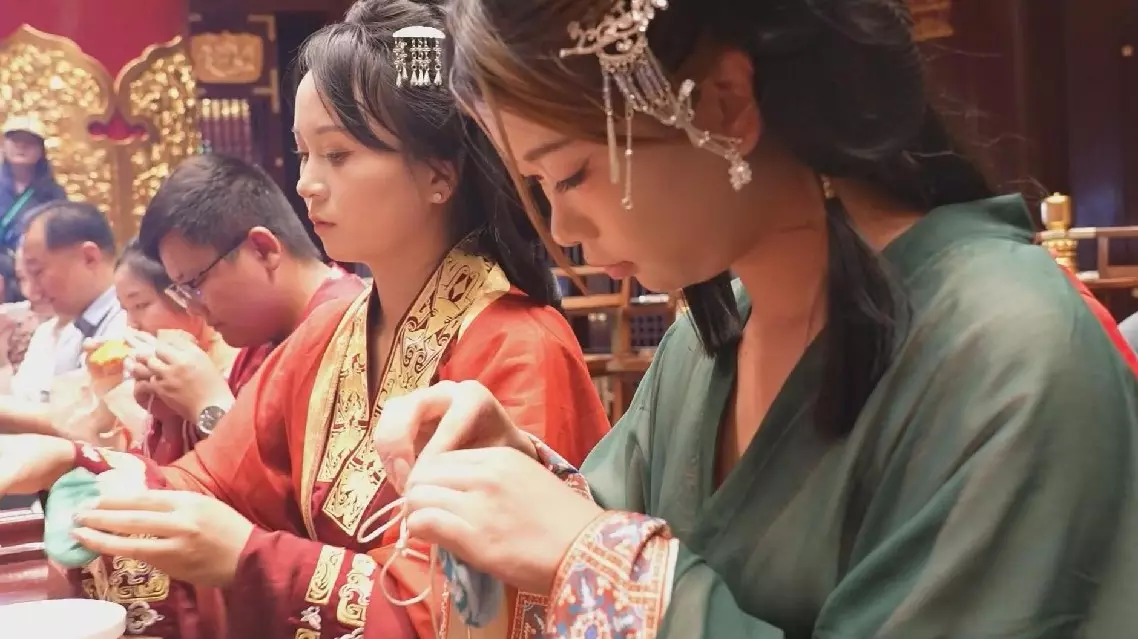
China-chic boom fuels consumption for Mid-Autumn Festival
A new round of trade-in subsidy program is energizing China's consumer market these days, with provinces across the country seeing a surge in demand for cars, home appliances and digital devices.
In north China's Shanxi Province, the new trade-in subsidy program, which started on January 9, has further helped boost sales in home appliances and digital devices which are covered by the new round of subsidies.
To enjoy the subsidies, six types of home appliances, including refrigerators and washing machines, must meet national Level 1 energy-efficiency or water-efficiency standards. Digital and smart products include four types, such as mobile phones and tablets, with a sales price cap of 6,000 yuan (about 800 U.S. dollars) per item.
In both categories, subsidies are set at 15 percent of the final transaction price. For home appliances, the maximum subsidy is 1,500 yuan per item. For digital products, the cap is 500 yuan per item. Each consumer can receive a subsidy for one unit in each category.
Neighboring Shanxi, Hebei Province kicked off the year of 2026 with the new round of trade-in subsidy program starting on January 1.
The subsidies cover automobiles, home appliances, and digital products. Individual consumers who purchase designated Level 1 energy-efficiency appliances or eligible digital products priced at no more than 6,000 yuan can receive subsidies equal to 15 percent of the transaction price. The maximum subsidy is 1,500 yuan per appliance and 500 yuan per digital or smart device, with each person limited to one subsidized item in each category.
Data showed that from Jan 1 to 9, Hebei's home appliance trade-in program alone disbursed more than 130 million yuan in subsidies, driving sales of over 920 million yuan.
In east China's Jiangsu Province, the new trade-in subsidy program, taking effect for two weeks, has brought the province a boom in trade-in.
At a local 4S store in Jiangsu's Suqian City, showroom traffic has spiked as salespeople walked customers through the new benefits from the trade-in subsidy program.
"Under the scrappage-and-replacement scheme, customers who buy a new energy vehicle (NEV) can receive a subsidy worth 12 percent of the vehicle price, capped at 20,000 yuan (about 2,860 U.S. dollars). For combustion-engine cars, the subsidy is 10 percent, with an upper limit of 15,000 yuan. For trade-ins, NEVs are able to receive a subsidy worth 8 percent of the vehicle price, up to 15,000 yuan, while combustion-engine cars will receive a 6-percent subsidy, with a cap of 13,000 yuan," said Sun Yue, a saleswoman at the store.
In the home appliance sector, Jiangsu's policy this year stipulates that only products that meet China's Level 1 energy-efficiency standard are eligible for subsidies. The scheme covers six major categories, including refrigerators and washing machines.
Consumers who purchase qualifying appliances can receive a subsidy equal to 15 percent of the final retail price, up to a maximum of 1,500 yuan per item. Each person is limited to one subsidized unit per product category.
Four types of digital and smart products, such as mobile phones and tablets, are eligible for a 15-percent subsidy capped at 500 yuan per unit, with a retail price no more than 6,000 yuan.
"With the national subsidy policy back in place this year, I went to the store to check what discounts I could get. It knocked 500 yuan off the price. [The discounted price is] very reasonable," said Wang Kang, a resident of Jiangsu's Xuzhou Province.
To enhance the shopping experience for consumers, many retailers are pairing subsidies with "one-stop" services that combine the delivery of new products with on-site collection of old ones.
"After consumers place an order for new home appliances, our staff will schedule a time to pick up the old units. Recycling the old appliance can also further offset the purchase price of the new one," said Yang Jie, a sales supervisor at a major home appliance company.
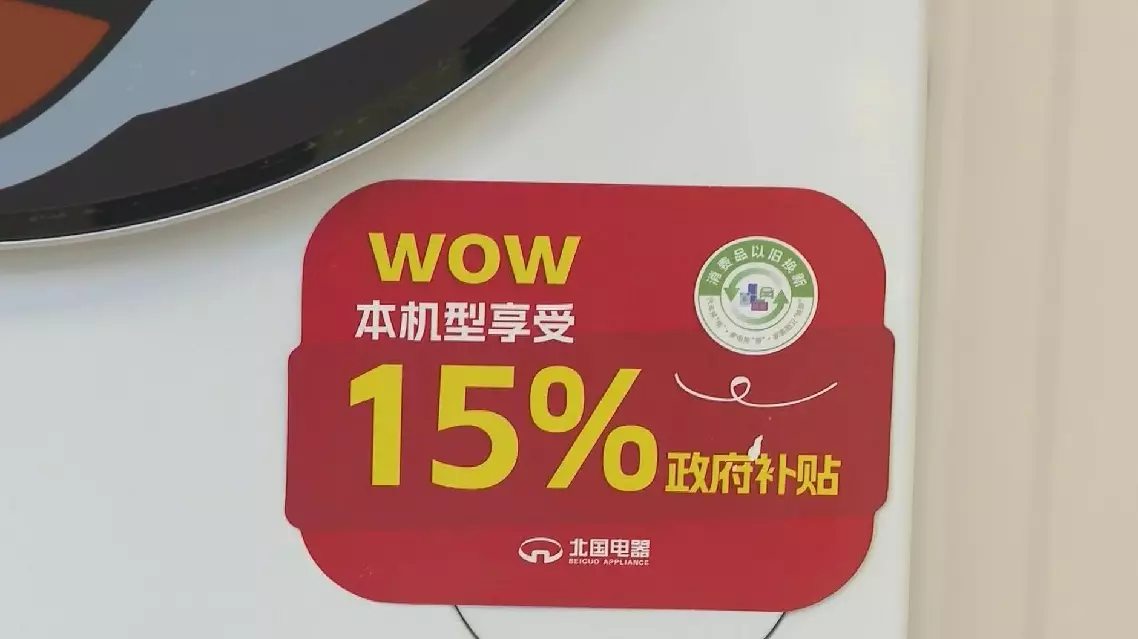
China's new trade-in program sparks consumption boom