A rescued Asian elephant which was earlier reintroduced to nature has shown signs of successfully merging into a wild elephant herd, a milestone achievement of this reintroduction experiment.
In 2018, the then 12-year-old A Bao became estranged from his herd and had to be rescued.
Researchers in July 2022 officially launched the pilot project of returning the rescued Asian elephant to nature.
In May this year, A Bao was released into the wild following years of meticulous training and preparation -- marking China's first successful case of reintroducing a rescued Asian elephant to nature.
Thanks to the Asian elephant monitoring system launched in 2020, tracking wild elephants no longer relies solely on ground patrols. The use of drones and infrared cameras has greatly improved monitoring efficiency and accuracy.
Despite continuous tracking, it remains challenging to monitor the real-time movements of a lone elephant, especially in a dense forest.
A Bao wears a collar that sends positioning data to a monitoring drone, so rangers can know his whereabouts in the jungle.
And soon, A Bao was found having fun together with other wild elephants along a river in the Xishuangbanna National Nature Reserve in southwest China's Yunnan Province.
"We monitored the trajectory and discovered that he remains active within the reserve. The farthest place recorded was only 10 kilometers from our center, and he did not enter villages. However, he will still approach people when hearing voices from human beings. He will respond like this," said Wang Bin, director of the Protection and Management Center of Asian Elephants in Xishuangbanna.
"We have captured images of him both during the day and at night as he ate crops, corn and pitaya. He is becoming healthier and has gained weight, possibly by 250 to 300 kilograms more than before," said Xu Tuanming, an observer.
The fact that A Bao has been moving about with other wild elephants indicates that he has gradually adapted to the wilderness and merged into the wild elephant herd, Wang said.
"I'm very excited because there are more baby elephants in the herd, which means that the elephant herd is growing. The herd, which once had over 10 elephants, now boasts more than 20, and soon the number will reach 30. This year alone, five additional baby elephants have been born. The adult elephants are standing guard outside, and the baby elephant is playing with water inside. They are protecting and ensuring that the baby elephant feels safe. The baby elephant is playing with water freely, with its trunk sticking out of the water and turning back and forth. They are playing so happily," he said.
To date, the center has been involved in the rescue of 23 wild Asian elephants. Staff members at the center provide them with wild training and regular physical examinations to help them return to their natural habitat as soon as possible.
They also expressed their hope that A Bao will eventually have offspring of his own after the merger into the wild elephant herd.
"I am happy for him as he has merged into the elephant herd which also accepts him. It would be better if he could find a girlfriend and have some children, and he could return and show us his own children. I truly hope this will happen," said Chen Yubing, a staff member of the center.
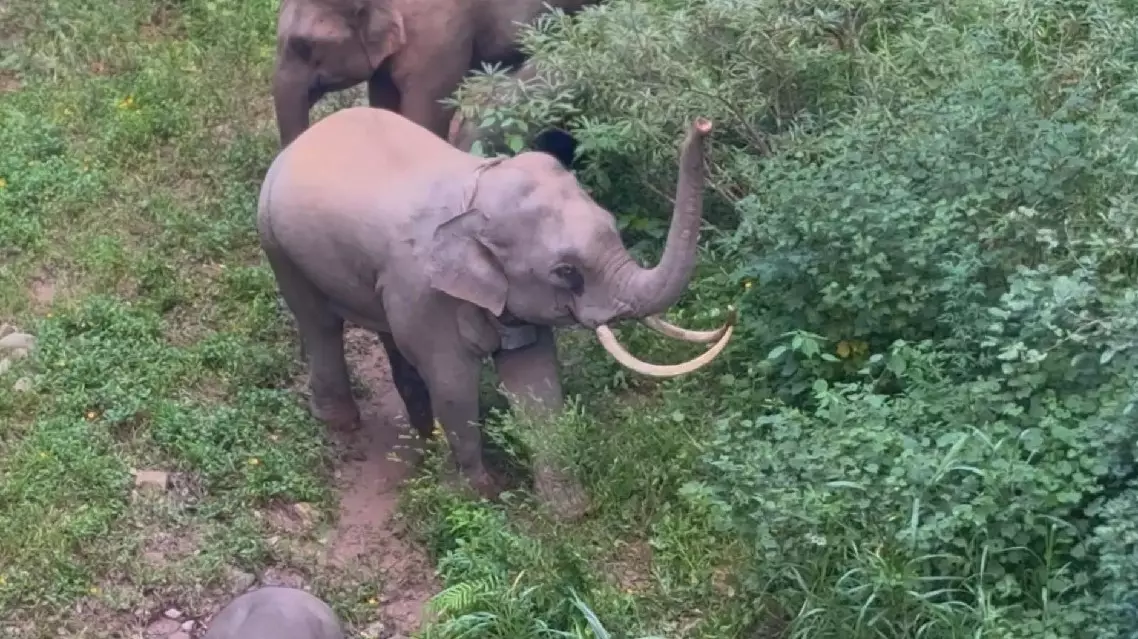
China-rescued Asian elephant adapts well after reintroduction to nature