The 8th Silk Road International Expo in Xi'an City of northwest China's Shaanxi Province concluded on Tuesday with attendees hoping to enhance cooperation and boost connectivity between China and countries along the trans-Caspian International Transport Route (TITR).
Themed "Deepen Connectivity and Strengthen Economic and Trade Cooperation", the five-day event featured five exhibition areas focusing on international exchanges, inter-provincial cooperation, transportation logistics, advanced manufacturing, and the modern energy sector.
Representatives from 15 organizations and leaders of prominent international logistics companies along the Caspian Sea gathered to discuss future cooperation along the trans-Caspian International Transport Route (TITR), a key cross-continental transport route also known as the Middle Corridor.
Significant agreements were reached among participants at the expo, including one on cooperation on the implementation of the Aktau Container Hub Project and the establishment of the Aktau International Container Partnership, marking a crucial step forward in advancing a major container hub project in Kazakhstan, which will help to greatly strengthen the country's logistics sector.
According to Yuan Xiaojun, general manager of the Xi'an Free Trade Port Development company, railway and shipping companies from various countries along the Trans-Caspian route have gained a deeper understanding of the Chinese market through several days of in-depth discussions in Xi'an, while multiple enterprises have also expressed their commitment to continuously promoting trade.
"Our next step will be to work with members of the Trans-Caspian Alliance to further reduce costs and improve efficiency, enabling Chinese goods to travel more quickly between Central Asia, Western Asia, and European countries," said Yuan.
Greater efforts have been made to implement the outcomes of the landmark China-Central Asia Summit, which was the first gathering attended in person by the heads of state of China and five Central Asian countries - Kazakhstan, Kyrgyzstan, Tajikistan, Turkmenistan and Uzbekistan - and was held in Xi'an, the historical starting point of the ancient Silk Road, last May. The summit has created a new platform and opened up new prospects for China-Central Asia cooperation.
Aligning with the Belt and Road Initiative that was proposed in 2013, the Silk Road International Expo was first held in 2016 with an aim to promote cultural exchanges and economic cooperation among countries along the Belt and Road.
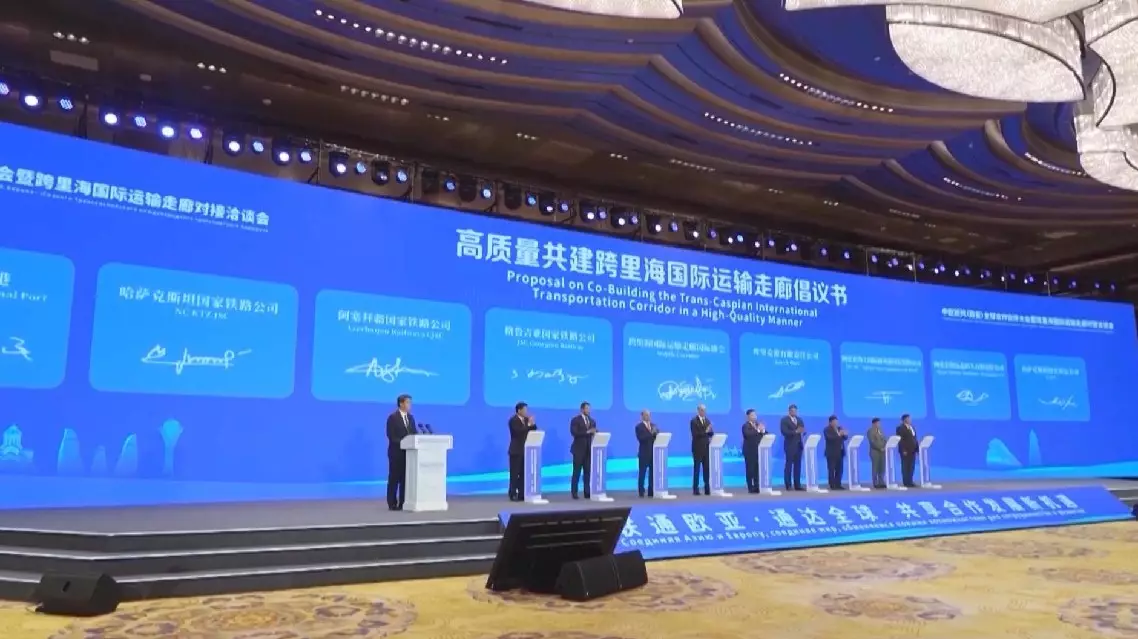
Cooperation along trans-Caspian international transport corridor enhanced at Silk Road Expo
Chinese speed skater Ning Zhongyan has made Asian history at the Milan-Cortina Olympic Winter Games after a long and solitary journey of rebirth following earlier setbacks.
Ning clocked an Olympic record of one minute 41.98 seconds to win the men's 1,500m speed skating event at the Milan-Cortina Olympic Winter Games on Thursday. This triumph follows two previous bronze medals he won in the men's 1,000m and team pursuit.
The men's 1,500 meters is often called the "King's Race" of long-track speed skating, demanding a rare blend of explosive speed and sustained endurance. The event has long been dominated by European and North American skaters. Since the first Winter Olympics in 1924, no Asian athlete had ever won gold in the event until now.
The journey to the throne was not plain sailing for Ning. The joyful tears shed on the Olympic ice at Milano Speed Skating Stadium carried the weight of four hard years.
At the Beijing 2022 Winter Olympics, Ning competed in three events - the 1,000m, 1,500m and mass start - but failed to reach the podium in any of them. In his most practiced discipline, the 1500-meter race, he ranked seventh.
Regrets lingered for a long time. But as a professional athlete, Ning had to adjust his mindset and accept the setback.
"After thinking over it, I was able to face it and realize that there's no need to burden myself with such pressure anymore. After all, it's already in the past. I can't change that reality, so I just chose to accept it," said Ning in an interview with China Media Group in Milan.
In 2023, Ning started to train with Dutch coach Johan De Wit. The move reshaped his career and his mindset.
"When it comes to training abroad, the first thing you face is loneliness. You need to confront this sense of isolation on your own, for only then can you discover a way of life that truly belongs to you. The changes have been indeed very significant, as some training philosophies were entirely new to me," said Ning.
The transformation soon became evident. During the 2023–2024 season, he not only clinched titles in both the men's 1,000m and 1,500m at the ISU World Cup, but also became the first Chinese male World Sprint Champion in speed skating history.
"[At the World Cup 1500m event,] my opponent was the Olympic champion [Kjeld] Nuis, and I defeated him at the 'Ice Ribbon' (China's National Speed Skating Oval), where he won the Olympic championship in 2022. This victory made me accept my past defeat, and also gave me firmer confidence in myself," said Ning.
Having fulfilled his long-held dream of raising the Chinese national flag on the Olympic podium, the newly crowned "King of Speed Skating" said he is grateful for the setbacks four years ago, which made him stronger, and that he never regretted his choices or the hardships he endured along the way.
Reborn from setbacks, Chinese speed skater makes Asian history at Milan-Cortina Winter Olympics