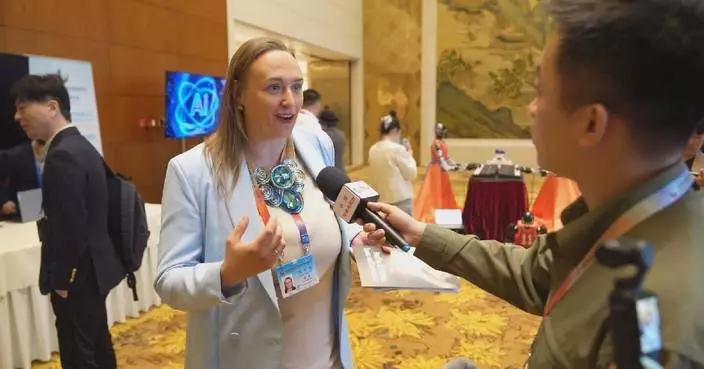
Ludger Schuknecht, vice president of the Asian Infrastructure Investment Bank (AIIB), highlighted how the world's second-largest multilateral development bank has expanded beyond just building up connectivity to help improve sustainability and disaster readiness across the continent.
The AIIB concluded its annual meeting in Uzbekistan on Thursday. It welcomed its 110th member after its Board of Governors approved the application of the island nation of Nauru in Uzbekistan on the same day.
The just-ended event marks the first time the AIIB has hosted its annual meeting in Central Asia, setting a milestone that bears great significance to the region, according to the bank vice president.
"We had [Uzbek] President [Shavkat] Mirziyoyev speak at our opening ceremony. This was a very impressive speech, because this was not just making promises, but it was showing that the country is delivering with its progress to improve people's lives, reducing the poverty rate, increasing the access to electricity, improving connectivity through roads and, of course, contributing to decarbonization by reducing the carbon-dioxide emissions. And some of our projects are directly affecting people's wellbeing, if we do urban development or the water projects, having access to clean water, having good sanitation so that you don't get sick from sewage, having roads that you can travel from one place to another in half the time. That is very tangible benefits for people and improving their quality of life," he said.
When asked about the expansion of AIIB members to 110, Schuknecht explained the bank's global impact.
"What we in our collaboration needs to show is some Asian connectivity, some Asian connection: trade, digital, roads, ports, airports, but the reason why we can finance outside Asia is global public goods, especially decarbonization, fighting climate change. Also in the pandemic, it has been fighting the pandemic with support for countries' vaccination efforts, etc. Now that the pandemic is over, it has fallen away but we also have actually our members who have asked us to also provide financing in the case of certain emergency situations, natural disasters. If they want us us to that, to also then finance, for instance, infrastructure rehabilitation. We are doing that in Turkey and Pakistan," Schuknecht said.
The vice president also described how the AIIB leverages the unique resources of the Central Asian countries like Uzbekistan to enhance regional development.
"When we came, we visited our Masdar solar energy project, not far from Samarkand, a very impressive project of 220 Megawatt solar energy, so, a really big one financed by AIIB. But it is a non-sovereign project which means it involves the private sector. So, in Uzbekistan, we do not just have sovereign projects, we also have non-sovereign projects, private sector projects, which is part of our mission that we do not just finance governments, but we also want to have the infrastructure financing with the help of private capital. So, this solar energy project, which is a really impressive project, is one. We have a road project, Bukhara road, we have the water project coming up that is also supported now by one of our members as a donor for technical assistance," said Schuknecht.
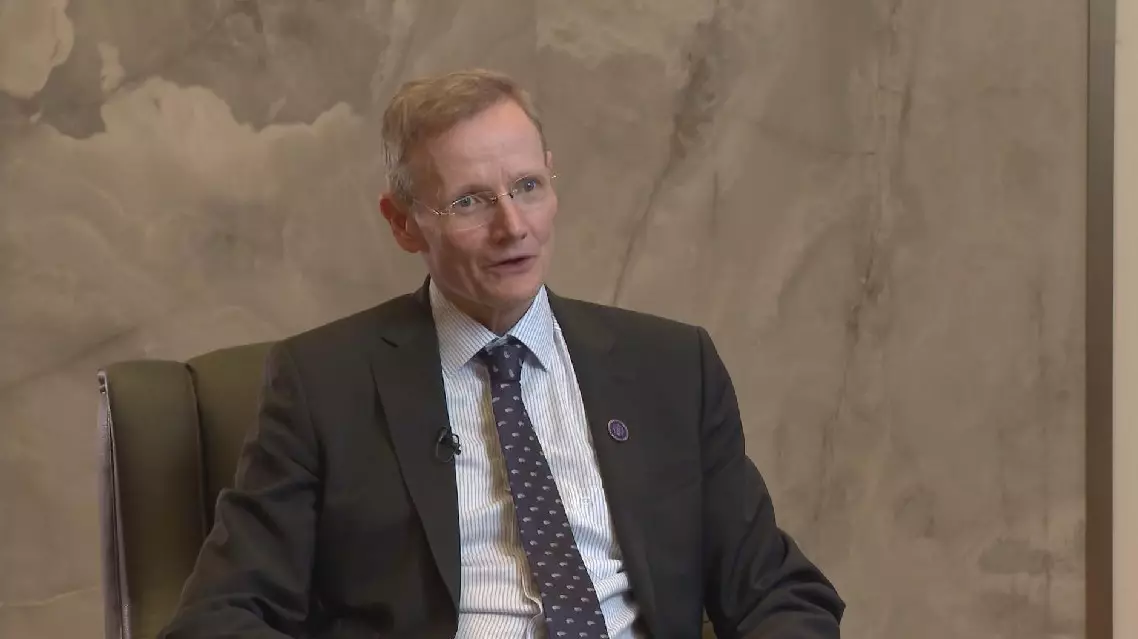
AIIB boosts sustainability, emergency preparedness across continent: bank VP