China's first wave-resistant floating photovoltaic platform, "Yellow Sea No. 1," is currently undergoing the final equipment commissioning in the Yellow Sea, before starting a one-year experimental session.
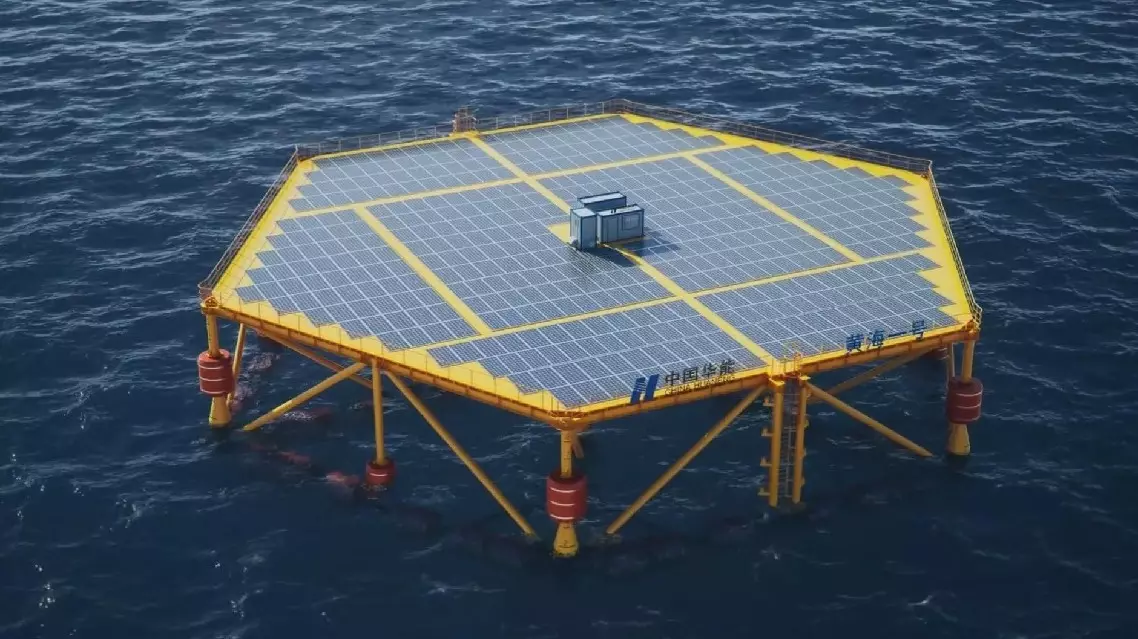
The platform, located in waters near the southern part of Shandong Peninsula, is a huge hexagon with 434 photovoltaic panels. The main function of this platform is to test different photovoltaic panels and select those with the highest power generation efficiency and the most suitable for actual sea conditions, providing a basis for the construction of large-scale offshore photovoltaic platforms in the future.
The platform is about 7.5 meters from the sea surface, so that waves and sea wind can pass through under the platform almost without any obstruction, making the platform more stable. There are dozens of buoys in a large circle near the sea surface, which provide buoyancy for the entire platform and prevent waves from contacting the photovoltaic panels.
"When the waves come into contact with the photovoltaic panels, salt crystals will form, which will affect the efficiency of photoelectric conversion. In addition, seawater will corrode our photovoltaic components and electrical systems. Therefore, our entire platform is raised to a higher level above the sea, so that even under sea conditions unseen in 50 years, the waves will not come into contact with our photovoltaic panels," said Bi Cheng, an engineer of the "Yellow Sea No. 1" project under China Huaneng Group.
The water depth of the sea area where the platform is located is over 30 meters. In order to ensure that it can stand firm in the rough sea, six anchor chains, each weighing 55 tons and about 265 meters in length, are used to firmly tie the platform to the seabed.
The project team aims to use the one-year experiment to collect and analyze key offshore data. In the future, hexagonal platforms will be spliced and combined to maximize the use of ocean area, providing a new technical route for the large-scale development of deep-sea photovoltaics, and continuously promote the intensive and efficient development and utilization of marine energy resources.
"The project adopts a development model absorbing wind and solar energy simultaneously. Having wind and solar power complementing each other makes power generation more stable. Power transmission sharing and joint operation and maintenance can further save costs. More importantly, it can improve the utilization rate of the ocean. The platform can not only help us optimize the energy structure, but also further promote the realization of the carbon peaking and carbon neutrality goals," said Nan Mingjun, manager of the "Yellow Sea No. 1" project.
At present, China is accelerating the technological innovation for deep-sea photovoltaic platforms. With technological progress and large-scale production, the cost of offshore photovoltaics is expected to be further reduced in the future. Offshore photovoltaics will also achieve integrated development with other marine industries such as offshore wind power and marine ranching, forming a diversified industrial model.
China's wave-resistant floating photovoltaic platform to enter experimental session