Venezuela's Acting President Delcy Rodriguez on Tuesday reaffirmed the country's sovereignty while denying external forces' control.
Addressing recent claims by U.S. President Donald Trump that the United States has gained control over Venezuela, Rodriguez emphasized that Venezuela remains independent and is governed by its constitutional government.
Rodriguez, previously vice president of Venezuela, was sworn in on Monday as the acting president of the country, after President Nicolas Maduro and his wife were taken by force on Jan. 3 during a U.S. military operation against the South American nation.
Meanwhile, Venezuela's Attorney General Tarek William Saab held a press conference on Tuesday, urging the United States to recognize Maduro's immunity as the president of Venezuela and demanding that the U.S. immediately release the president and his wife.
Saab stated that the current head of state enjoys absolute personal immunity, which is not only a personal right, but also a constitutional principle with universal effect and a fundamental norm of international law.
Even if the U.S. fabricates any false accusations, it has no right to take action against the Venezuelan presidency, said Saab.
The military operation was an attack on national territory launched without prior declaration of war and without a UN Security Council resolution, constituting an illegal armed aggression, possessing terrorist characteristics, and violating the UN Charter, he said.
Saab emphasized that the forced abduction and detention of Venezuela's leader and his wife constitute acts of international kidnapping and illegal deprivation of liberty, which reflect acts of state terrorism. He emphasized that U.S. laws and the U.S. Constitution do not have jurisdiction over Venezuela's territory.
The attorney general also called on U.S. Judge Alvin Hellerstein overseeing the case to respect international law and recognize that the court has no authority to prosecute a head of state enjoying diplomatic immunity. He also demanded that the U.S. cease all human rights violations against Maduro, his wife and the Venezuelan people.
Saab said that three prosecutors have been assigned to form a special investigation team to thoroughly investigate the casualties caused by the U.S. side to dozens of innocent civilians and soldiers.
On the same day, the Bolivarian National Guard of Venezuela announced the deployment of troops nationwide while the Bolivarian National Police strengthened security measures amid external unrest.
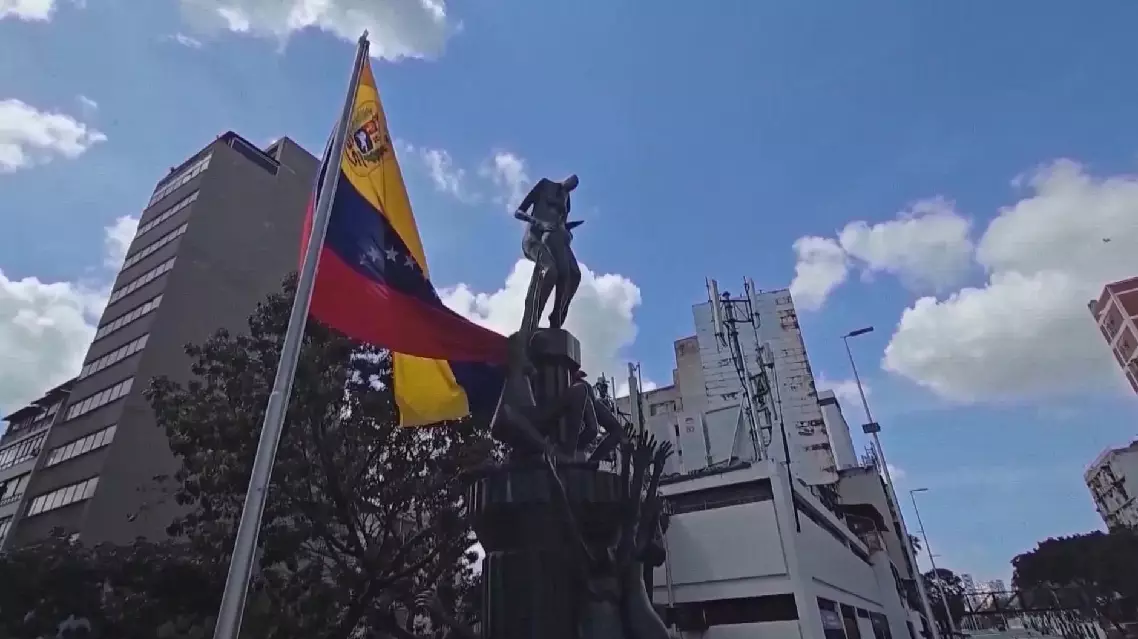
Venezuela's acting president denies external forces' control