Some representative sites in Chinese capital Beijing have set good models of developing the practical value of ancient buildings while repairing and protecting them.
Beijing has been the capital of China for nearly 700 years, with only brief interruptions. The city has a rich architectural culture, from imperial palaces like the Forbidden City to traditional residential buildings.
China Global Television Network (CGTN) walked with national certified architect Zhang Yue presented into several remarkable cases of reusing historical structures and listened to her insights on preserving the antique architectures.
After graduating with a degree in architecture, Zhang started her career in 1999. For 25 years, Zhang has spent her regular working days on usual investigation in downtown Beijing.
Focusing on old buildings and renovated historical structures, she said the Memorial Hall of Qi Baishi's Former Residence is a typical well-done example.
The noted artist Qi Baishi died in 1957 at the age of 94. The memorial hall is a typical quadrangle residential building built in the middle of the Qing Dynasty, about 250 years ago. Located in the Yu'er Hutong in downtown Beijing, the building is not very big, but its simplicity, elegance and peace matter.
Zhang said its restoration is basically in line with the four principles proposed by the UNESCO, which is authenticity, minimal intervention, recognizability and reversibility.
"From the perspective of professionals, we hope that the issue of reuse should be considered before the restoration of ancient buildings. Such repairs could be better if there is consistency between conservation and utilization," Zhang said.
When she spoke of the difficulties during her 25 years as an architect, Zhang noted that she has covered some 5,000 kilometers on foot with her expeditionary style. She said that the more she explores, the stronger her reverence for Chinese traditional architectural culture.
"At the very beginning, my understanding of traditional architecture was only limited to the actual structures we saw. But there are many stories behind it, leaving us a great number of messages. After 20 years of working in this field, I still can't express myself easily because the mystery of traditional architecture is so deep," the architect said.
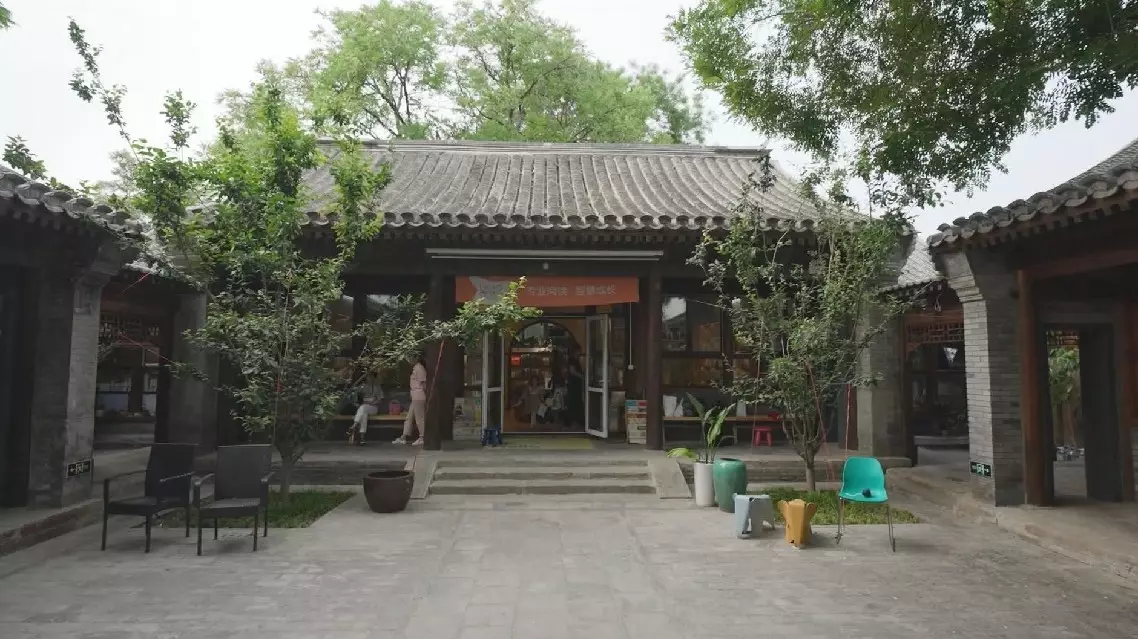
Just a 10-minute walk crossing the bustling Nanluoguxiang pedestrian street, a courtyard house called "HelloReading" is another site considered a good example of reuse after renovation.
"I think the good thing about this case is that learning knowledge of traditional culture or modern culture in such a traditional courtyard actually gives children a subtle influence," Zhang said.
Since its establishment in 2016, HelloReading has served over 1,500 families as a reading studio for children aged 15 and under. The organizers moved the studio into the popular scenic area in March 2023. They said the rent is higher than before, but it's worth it, considering the profound meaning behind reading.
"Particularly when you compare the hustle and bustle from the Nanluoguxiang street, you feel very quiet as soon as you enter the courtyard, as if you have come to another world. Many of our members and children live in apartment buildings. They say there are few other kids to play with when living in the apartment buildings. And they can hardly feel the weather changes all year round. But when they come here, they feel very down to-earth and energetic. Parents have also realized that their children are more relaxed and natural in this place," said Sarah Hu, an event organizer at HelloReading.
Restoration, reuse of ancient buildings in Beijing