Skip to Content Facebook Feature Image

Yamaha's journey in Hangzhou inspires vision for more robust development in China

China

China

China

Yamaha's journey in Hangzhou inspires vision for more robust development in China

2024-10-05 22:29 Last Updated At:22:37

Yamaha, one of the world's largest piano manufacturers, has established a significant presence in Hangzhou City of east China's Zhejiang Province for more than two decades, witnessing remarkable growth of the market in the country while envisioning long-term development on this dynamic land.

The Japanese company's factory in Hangzhou produces approximately one in every five pianos in China. At its peak, nearly 70 percent of Yamaha's pianos and one-third of its woodwind instruments and guitars are manufactured in this facility. The products not only cater to the Chinese market but are also exported worldwide, earning the brand a prestigious reputation.

The friendly relations between Zhejiang and Shizuoka Prefecture, the center of musical instrument production in Japan, began in 1982, fostering deeper exchanges and cooperation. As trade between the two sides flourished, Yamaha Corporation focused its attention on Zhejiang, seeking to capitalize on its potential.

"Yamaha has high expectations for the Chinese market. The increasingly open Chinese market provides our company with stable support from material procurement to product sales,” said Seiichi Suzuki, general manager of Xiaoshan Yamaha Musical Instruments Co., Ltd.

Yamaha established its factory in Hangzhou's Xiaoshan District in 1997. Initially, the factory relied on assistance from its Japanese headquarters for worker training and production equipment. However, over the years, advancements in China's industrial technology have transformed this dependency. Chinese suppliers have now developed the capability to design and manufacture processing equipment for complex piano parts, even exporting some of the equipment to Japan.

The factory has grown from a modest workforce of fewer than 100 to nearly 3,000 employees. Its production processes have evolved from simple assembly to full-fledged instrument manufacturing, with an increasing focus on localizing component production, thereby enhancing the entire supply chain.

"There is a big difference between 2007 and now," said Taku Okamoto, head of the production department.

Okamoto was sent from Yamaha's Japan headquarters in Shizuoka Prefecture to China seven years ago to oversee product quality. He witnessed rapid development of the country, saying that nowadays tasks that might take a long time in Japan can often be completed in about a third of that time in China.

Today, Yamaha, like many foreign-funded enterprises, is capitalizing on the opportunities presented by China's robust growth. Suzuki, as well as many workers like Okamoto, say they believe that building on the foundation of the past two decades, Yamaha can seek an even more robust development in this land for the next 30, 50, or even 100 years.
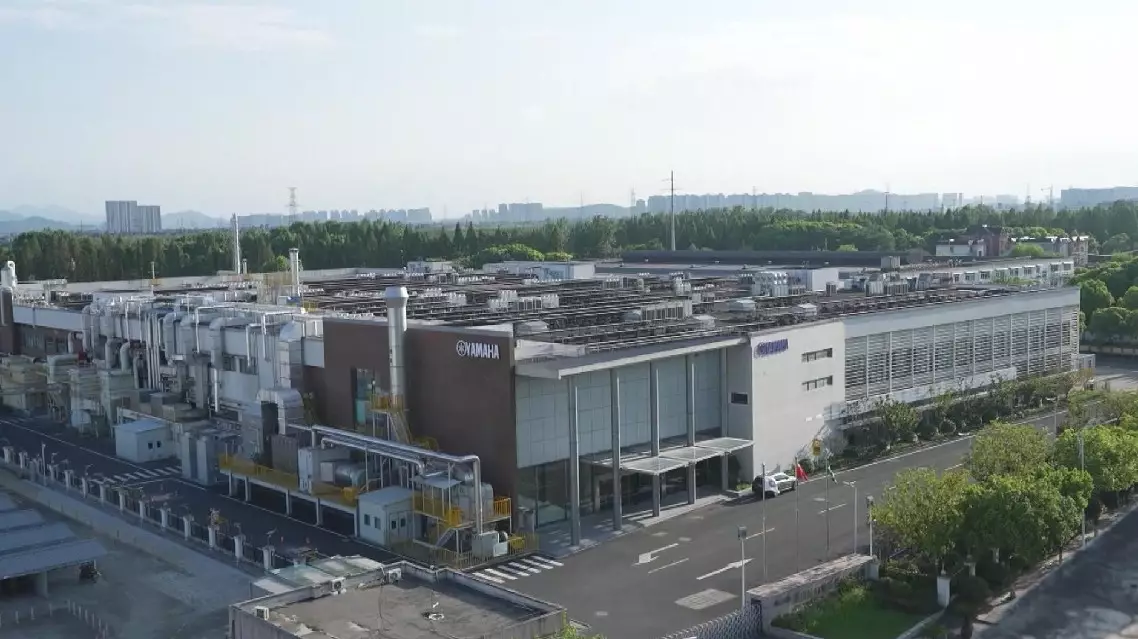
Yamaha's journey in Hangzhou inspires vision for more robust development in China
Yamaha's journey in Hangzhou inspires vision for more robust development in China

Chinese investments are bringing new development opportunities to Hauts-de-France, a traditional industrial region in northern France, as local governments actively attract Chinese new energy enterprises to participate in the region's industrial transformation.

The Hauts-de-France region was once home to Griset, a copper processing company with a history of over 260 years and a pillar of France's metallurgical industry. Faced with global competition and fluctuations in metal prices, the company teetered on the brink of bankruptcy until its acquisition by TNMG, China's leading copper producer, enabled it to rise from the ashes under the name TG Griset. "Today, we have achieved our production target of 7,000 tons per year. This is a remarkable change compared to when we started back in 2016, when a small team of just 12 people launched operations. Now we have 70 employees, along with new projects, development prospects, and a future strategy. The group has also provided us with investment support," said David Derache, general manager of TG Griset.

Located nearly equidistant between Paris and London, as well as nearby the industrial heartlands of Western Europe, Hauts-de-France enjoys huge geographical advantages and a solid foundation in the automotive industry, with carmakers like Renault and Stellantis present. Official data shows that the region has drawn nearly 50 Chinese enterprises to invest and establish operations across sectors including automotive, energy, and chemicals.

Leading the charge the promotion of the region is Nord France Invest, which offers support to international companies and investors seeking to expand in Hauts-de-France.

"We go on a regular basis in China to meet with Chinese groups and, once again, to explain where we are, what we do, and how we can help them choose our region and make sure that we are the hub for them in Europe and the best gateway for Chinese investment here," said Yann Pitollet, CEO of Nord France Invest.

Beyond capital, Hauts-de-France values China's strengths in the new energy vehicle (NEV) manufacturing sector, particularly in batteries and materials. For this traditional industrial region, attracting Chinese enterprises is not only about drawing investment but also about the electrification transformation and the future development of its automotive industry.

"The best-selling electric vehicle in France today is a Renault car -- the Renault 5. It uses Chinese batteries, and these batteries are produced right here in the Hauts-de-France region. These modern examples -- whether in electric vehicle batteries, related investments, or the development of port industries -- show that these new industrial developments are significant for regions like ours," said Xavier Bertrand, president of the Hauts-de-France Regional Council.

China-France cooperation powers transformation of traditional French industries

China-France cooperation powers transformation of traditional French industries

Recommended Articles