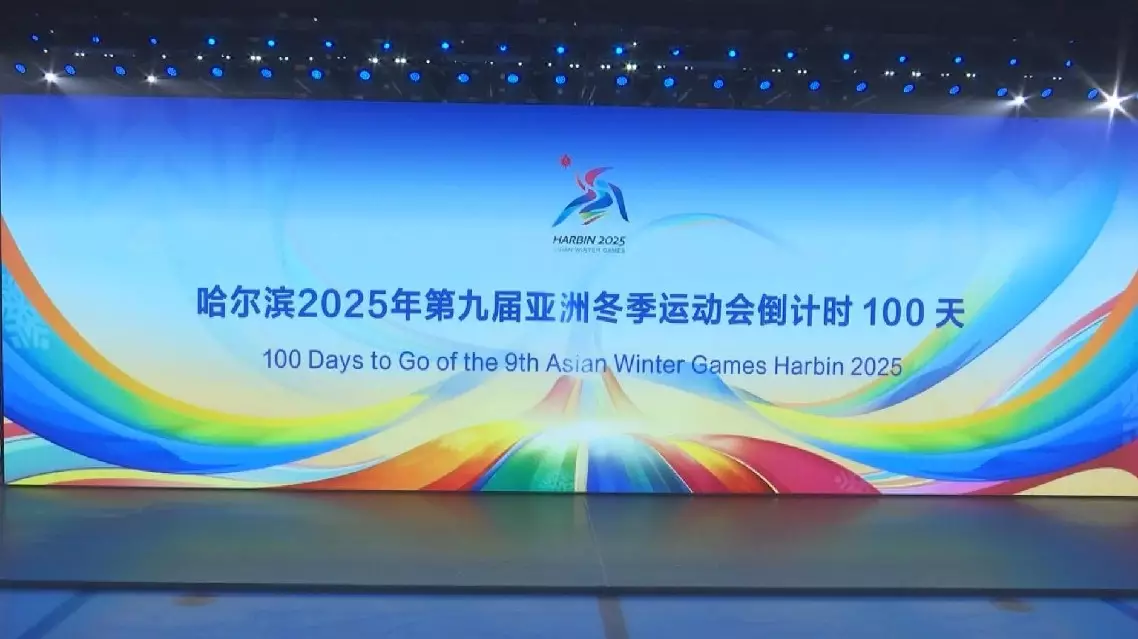
The medals, torch and anthem for the 2025 Asian Winter Games in Harbin City of northeast China's Heilongjiang Province were officially unveiled at a 100-day countdown ceremony on Wednesday.
The front of the medals, titled "Spirit of Speed", combines the streamlined shape of a racetrack with the emblem of the 9th Asian Winter Games. The flowing curves of the racetrack incorporate the silhouette of the Harbin Grand Theatre, reflecting the city's unique aesthetic.
The reverse side of the medal features a picturesque landscape of Yabuli, with mountain ranges and forests that mirror the terrain of the Greater and Lesser Khingan mountain ranges.
At the center, the emblem of the Olympic Council of Asia is embedded with a rare Xunke red agate gem from Heilongjiang.
"A lot of regional culture and scenery from Heilongjiang has been integrated into the medals. It presents a close-up, medium-range and long-range visual effect on the whole, showing the beautiful and rich landscapes of Heilongjiang," said Zou Cunliang, the medal design team leader.
The height of the torch is 735mm, with a top diameter of 115mm and a grip diameter of 50mm. The theme of the design, "Surging", symbolizes that the 9th Asian Winter Games will be filled with vitality and passion.
The design takes the form of a blossoming lilac, integrating colors such as China Red, Lilac Purple, and Snow White, reflecting sincerity, warmth, openness, and inclusiveness.
"In the design of the outer shell, we used a transition from a snowy white in the bottom to a clear ice-like texture at the top. We also full integrate the city flower of Harbin, the lilac, into the design of the top of the torch. It's a blooming lilac, as is the burner nozzle," said Zhang Junhai, the torch designer.
The anthem for the event is titled "Snow of Harbin". The lyrics and melody closely follow the official slogan "Dream of Winter, Love among Asia". The music video for the anthem combines live shooting and AI technology to perfectly integrate the dreamy ice and snow world with real scenery.
"We specially invited lyricist Wang Pingjiu and composer Chang Shilei who created the anthem for the Beijing Winter Olympics. They completed the 'Snow of Harbin' within five months. The lyrics in the anthem like 'Harbin and you, a bond so true' and 'dream of winter, you and I' express the positive vision of people in Asian countries and regions to work together to build a community with a shared future for mankind and also shows the openness and inclusiveness of Harbin," said Liu Xueguang, a staff member of the Asian Winter Games Executive Committee.
The Asian Winter Games will be held from February 7 to 14 and all competition venues are now ready.
More than 1,500 athletes from 34 countries and regions have registered to participate in the Games, with the number of participating delegations and athletes expected to reach a record high.
Torch, medal, anthem for Asian Winter Games unveiled
A historic global energy shock linked to the U.S.-Israel war on Iran is causing significant turbulence in the world's air travel, leaving many unable to fly as planned and placing financial pressure on airlines.
The conflict and disruptions in the Strait of Hormuz -- a crucial waterway for about 20 percent of global oil shipments -- have caused jet fuel prices to roughly double since March, creating supply chain havoc.
"Fuel is, let's say, 30 percent of the cost of travel, but it's the most variable portion. You double the price of jet fuel, that's the entire margin of the airline, and putting it into a loss," said Joseph Foudy, an economics professor at New York University's Stern School of Business.
The impact is already being felt in the aviation industry, particularly in parts of Asia and Europe, which depend heavily on Middle Eastern oil. This comes as a growing chorus of international agencies warns that Europe could start facing jet fuel shortages in the next few weeks.
Across the industry, airlines are cutting routes, trimming capacity, and increasing ticket prices and baggage fees to cope with fuel shortages and rising operating costs.
Germany's Lufthansa Group announced it is cutting 20,000 of its less profitable short-haul flights through October. Air France will increase long-haul ticket prices, while Hong Kong's Cathay Pacific has increased fuel surcharges on most routes by more than 30 percent this month.
Even record passenger demand in the U.S. is not enough to insulate American operators. Distressed U.S. budget carrier Spirit Airlines is seeking a significant bailout from the federal government to remain operational.
Foudy noted that bailouts are not necessarily the best solution and that conditions could worsen for airlines and passengers before improving.
"Financially, large carriers, there's a history, we saw this during COVID, of going to governments for money. And again, that can sort of keep them afloat. That's not much comfort to shareholders. What's unusual in this case, it's not simply a financial hit, it's going to be operationally, if there's a shortage of fuel, which flights from which carriers do you cancel? Ultimately, if there's a shortage, it means, you know, some flights won't take off. Again, in some individual countries, like the U.S. or like China are better off, but if you're Japan or Korea, you're nervous. And for Europe in particular, they're highly dependent on Middle Eastern oil," said the economist.
Further complicating the situation for airline passengers, the U.S. Department of Homeland Security warns that it could run out of funding for security agents at the nation’s airports by May, potentially leading to long security lines and wait times.
Experts advise travelers to book flights early, purchase travel insurance, be prepared for cancellations, and, if possible, consider skipping the flight altogether in favor of a road trip.

Global energy shortage disrupts air travel amid Iran war