The additional tariffs imposed by the European Union (EU) on Chinese electric vehicles (EVs) is an unreasonable and unwise move, which will not only damage China-EU cooperation and risk hindering global green transformation, but also eventually harm the interests of its own people, according to a commentary released by the China Media Group (CMG) on Thursday.
An edited English-language version of the commentary is as follows:
The European Commission , the European Union's executive arm, declared on Tuesday its decision to impose anti-subsidy tariffs ranging from 7.8 percent to 35.3 percent on EVs imported from China for a period of five years.
In response, China has said it does not approve of or accept the European Commission's decision. China has already appealed to the WTO's dispute settlement mechanism over the issue and will continue to take all necessary measures to safeguard the legitimate rights and interests of Chinese enterprises.
EU's practices are unreasonable and non-compliant, which actually engaged in unfair competition in the name of fair competition, carrying out trade protectionism.
From selecting sampling companies based on a target-oriented approach to artificially fabricating and exaggerating the so-called "subsidy" projects, and coercing and pressuring Chinese companies to provide commercially sensitive information, these practices by the EU have violated the WTO's principles of openness, fairness, and non-discrimination, and stood in opposition to the free market rules it has always advocated.
All these practices of the EU proceed from both factors that its economic policies move towards conservatism and politicization, and the influence of the United States to draw a small circle to contain China. But such doings will only result in multiple losses and cost the EU itself heavily.
From an economic perspective, the first victim will be the stability of the automotive industry's production and supply chains, with the interests of European automakers and consumers damaged. Higher prices and deprivation of market choices will be the price that European consumers have to pay.
Meanwhile, the China-EU investment cooperation will also be affected. One of the main purposes of the EU imposing additional tariffs on Chinese EVs is to force more Chinese automakers to invest and build factories in Europe. However, suppressing businesses while trying to draw investments will only dishearten more companies.
In addition, the EU's acts will also undermine its own efforts of green transformation and global efforts to address the climate change. China possesses innovative technologies related to green development. If the EU "decouples" from China in the EV field, it will only make the situation worse.
From a deeper perspective, the EU's acts will aggravate its internal division and bear political costs.
At present, Europe is facing problems such as unbalanced economic development and energy security, and the rise of right-wing forces has aggravated social divisions.
Meanwhile, there are also different voices within the EU over the additional tariffs on Chinese EVs
Hungarian Prime Minister Viktor Orban and German Chancellor Olaf Scholz have repeatedly said that this approach will damage the EU's own competitiveness, while Finnish President Alexander Stubb pointed out that a vicious cycle of raising tariffs and escalating trade frictions should be avoided.
Economic and trade were originally an area where consensus was most easily reached within the EU, but now major differences have emerged, which will exacerbate Europe's divisions and will also affect its future development, according to Cui Hongjian, director of the Department for European Studies of China Institute of International Studies.
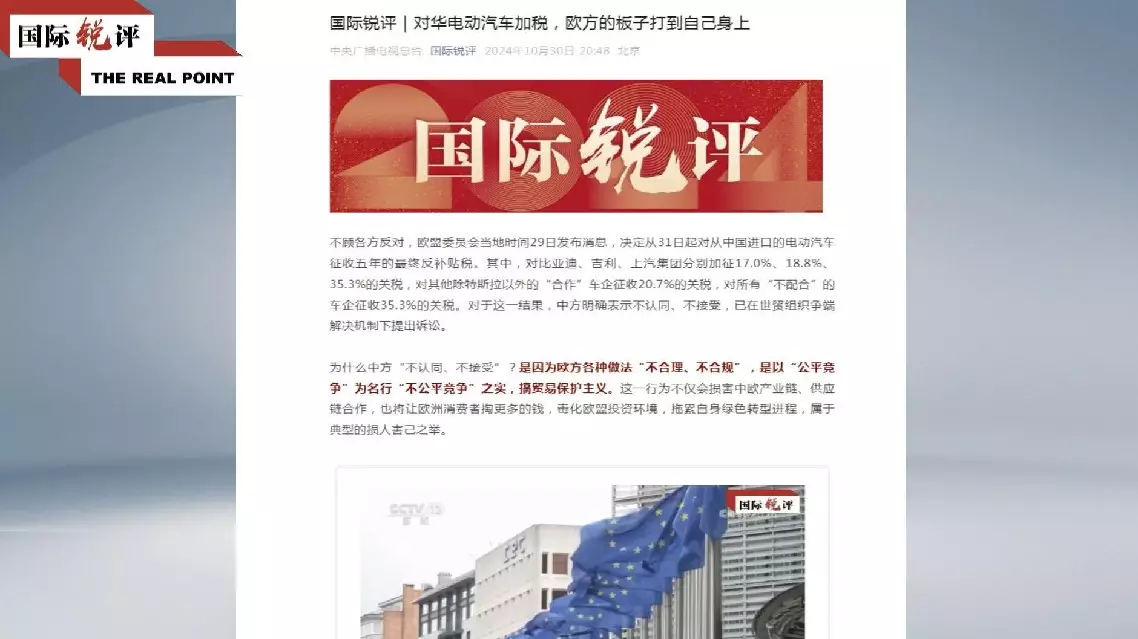
EU's additional tariffs on Chinese EVs will eventually backfire: commentary