China tops the 2023 list of global invention patent applications which hit a record-breaking 3.5 million filings, said a World Intellectual Property Organization (WIPO) report released on Thursday.
The World Intellectual Property Indicators 2023 highlight a fourth consecutive year of growth in global invention patent applications, despite economic challenges.
China led with 1.64 million applications in 2023, followed by the U.S., Japan, South Korea, and Germany.
Computer technology dominated patent filings globally, accounting for 12.4 percent of the total applications, with electrical machinery, measurement, medical technology, and digital communication also ranking high.
In addition to invention patents, Chinese applicants led in industrial design applications with 882,807 filings in 2023, followed by the U.S., Germany, Italy, and South Korea. The five countries collectively accounted for nearly 75 percent of global design applications in 2023. The growing Chinese application volume has helped boost the top five origins' share by 3.6 percent over the past decade.
The report also said that China was the most active in plant variety applications, filing more than 15,000 of the world's over 29,000 submissions, representing over half of global activity.
China also had the most registered geographical indications within its territory in 2023, it said.
China tops global invention patent applications in 2023: WIPO report
China has delivered a significant batch of emergency humanitarian aid to Iran, consisting of 58 tonnes of urgently needed medical supplies, as Iran grapples with the consequences of the recent conflict with the United States and Israel.
The aid was formally handed over on Wednesday during a signing ceremony in Tehran between the Chinese Embassy in Iran and the Iranian Red Crescent Society. Chinese Ambassador to Iran Cong Peiwu and President of the Iranian Red Crescent Society Pir Hossein Kolivand attended the event.
Cong said that China has always been concerned about the Iranian people and will continue to work with the international community to promote the early restoration of peace and stability in the Middle East.
"This aid package, totaling 58 tonnes, consists entirely of medicines. The recent war launched by the United States and Israel has caused a major humanitarian disaster for Iran, and medicine is in urgent need. Through this assistance, we hope to demonstrate the deep friendship of the Chinese people toward the Iranian people and help them overcome these hardships as soon as possible," said Cong.
Kolivand expressed sincere gratitude to China for extending a helping hand during difficult times and for providing valuable support to Iran on various occasions.
"In addition to China's support for the Iranian government, China's humanitarian aid has also been delivered to Iran. This assistance reflects China's care and compassion for our country and people. We extend our heartfelt gratitude, with special appreciation for the delivery of nearly 60 tonnes of medicine from China," he said.
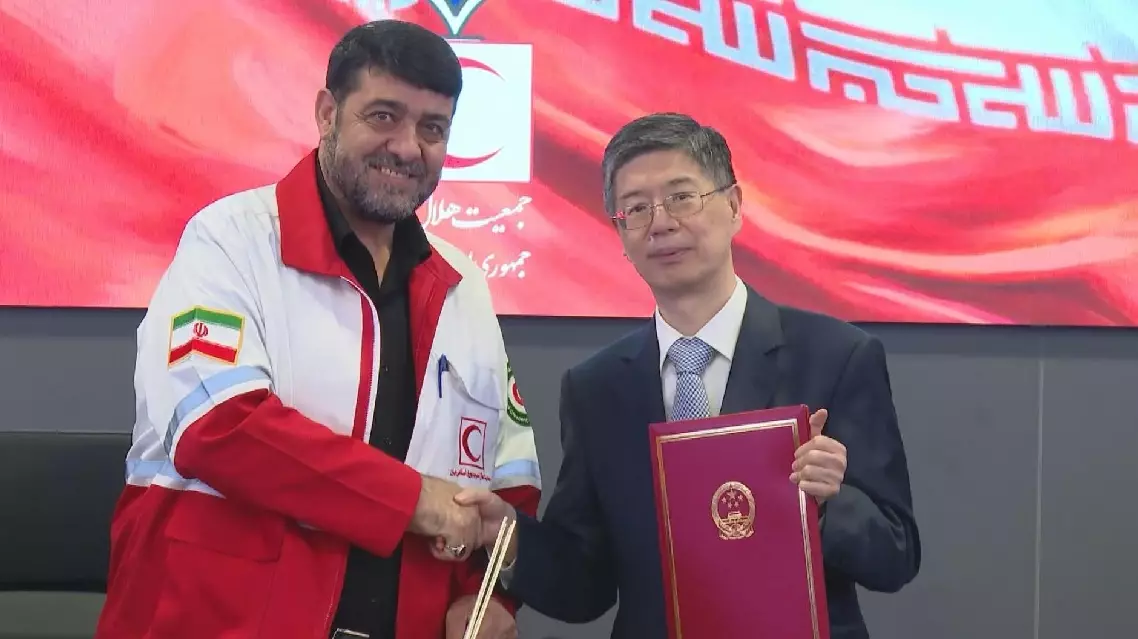
China provides emergency humanitarian aid to Iran